Arpit Arora, Adam Holmes, Krysta M. Svore, and Taylor L. Patti of NVIDIA have demonstrated a new AI-assisted workflow verified by the formal verification tool Lean. The researchers connected a quantum code space to the low-energy states of a physical device model for the first time, testing the approach on an eight-qubit toric code array built on a superconducting device.
Their work compares three methods for bounding unwanted interactions, finding that grouping anticommuting Pauli interactions provides a more efficient approach to hardware design than simply summing interaction strengths. This workflow offers a reusable tool for designing quantum error correction codes directly onto quantum hardware, enabling predictive engineering for future development.
AI Agent Orchestrates Toric Code Mapping to Superconducting Hardware
The pipeline’s capabilities extend beyond simply finding workable parameters. It also identifies the most problematic unwanted interactions and the specific qubits they impact. This granular detail provides actionable insights for refining device couplings and control mechanisms, potentially streamlining hardware development. Analysis of residual channels revealed that Pauli grouping yields a bound that is tighter than the conventional sum and closer to the diagonalization result, providing a method that avoids overly conservative compensation requirements in hardware design.
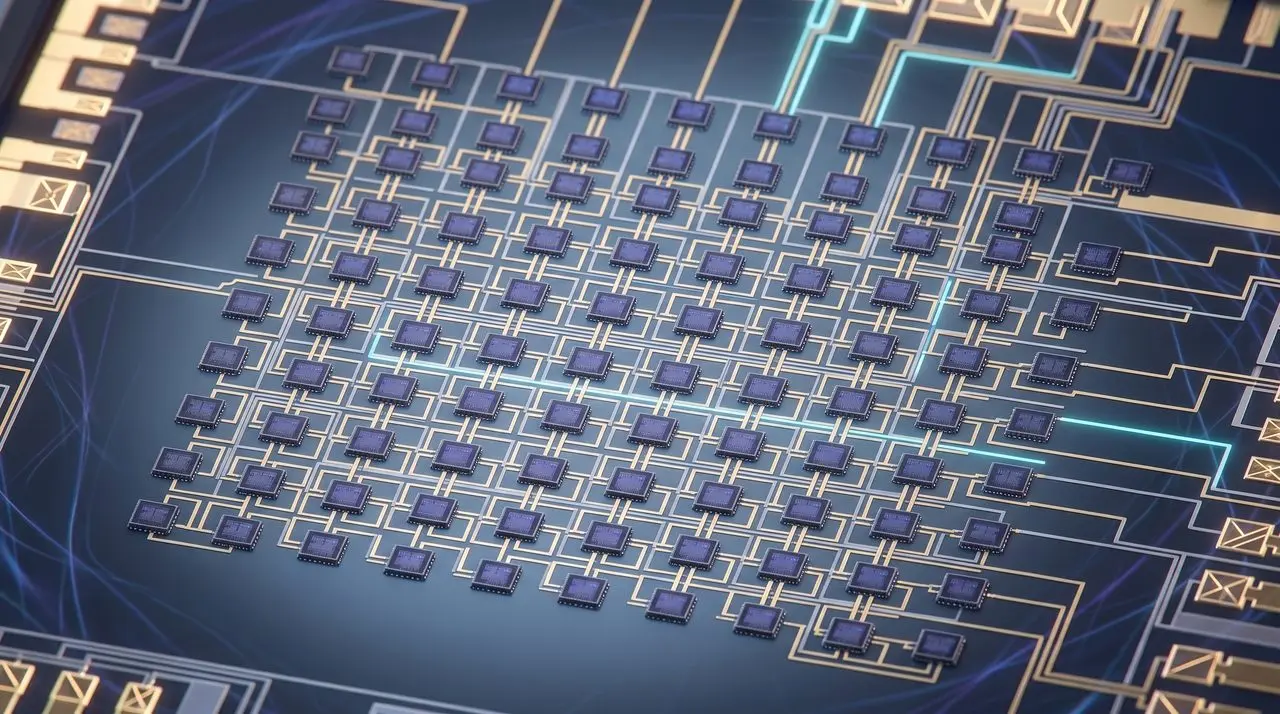
This was demonstrated on a model of the L = 2 toric code, using a driven superconducting architecture where four-qubit interactions are generated by nonlinear SQUID couplers. The same drive that creates the desired interactions also introduces unwanted dynamics, necessitating a careful balance between strengthening the code and preserving the necessary low-energy sector.
The demonstrated pipeline not only determined viable device parameters but also formally verified the presence of four isolated low-energy states, essential for maintaining the intended code space within the eight-qubit toric code.
Target Hamiltonian Construction from QEC Code Specifications
The demonstrated workflow constructs an ideal Hamiltonian from qubit and parity check specifications, establishing conditions to guarantee a device design retains the target number of low-energy states. This process determines an excitation gap protecting the code space, then tests if the device maintains the required isolated low-energy states and quantifies how closely the resulting subspace matches the intended code space. This approach moves beyond simply identifying workable parameters, instead pinpointing the strengths and weaknesses of specific hardware configurations.
The pipeline resolves the device Hamiltonian into Pauli interactions, subtracting the target Hamiltonian to identify residual effects, interactions that deviate from the ideal. The initial Hamiltonian construction begins with defining the code space, states satisfying every parity check, and then assigns costs, and , to violations of star and plaquette checks, respectively.
The resulting standard Hamiltonian, , incorporates these costs, with each XXXX interaction receiving a coefficient of -J_X/2 and each ZZZZ interaction a coefficient of -J_Z/2. Researchers established a ground projector, , representing the sum of projections onto the ground states of , to define the target Hamiltonian’s ground state subspace. “Human authors set the scientific scope, and interpret the results,” the paper states, emphasizing that researchers retain responsibility for all claims made within the study.
The team demonstrated this by comparing three methods for quantifying the impact of these unwanted interactions on the stability of the quantum code. The study involved evaluating the spectrum of the toric code both with and without accounting for residual interactions, which represent deviations from the ideal Hamiltonian.
Residual Hamiltonian Analysis Identifies Dominant Couplings
Analysis of residual interactions revealed the dominant unwanted couplings within the tested system, providing insight into optimizing quantum hardware development. This process generated a breakdown of coupling magnitudes, dissecting the total coupling into interactions involving individual qubits and allowing for targeted optimization of coupler designs to suppress unwanted channels. Results demonstrate that grouping anticommuting residual interactions yields a tighter bound on energy shifts than simply summing the individual interaction strengths. The team validated this finding by diagonalizing the central Hamiltonian, confirming that grouping anticommuting interactions imposes a more precise constraint on the system’s behavior.
Energy Gap Protection of the Toric Code Space
An excitation gap, a feature key for maintaining quantum information, was directly assessed in a superconducting device implementing a toric code, a specific type of topological quantum error correction, using eight qubits. This assessment moved beyond simply calculating an expected gap to verifying its existence through an AI-assisted workflow. The team constructed the ideal Hamiltonian defining the code space, then determined the excitation gap protecting it, and subsequently tested if the physical device retained the required number of isolated low-energy states.
Analysis focused on deviations from the ideal, quantifying how closely the device’s subspace matched the intended code space through comparison of three methods for bounding energy shifts caused by unwanted interactions. The standard approach involves summing the strengths of individual interactions, but this can lead to overly conservative estimates requiring excessive hardware compensation.
The researchers found that grouping anticommuting Pauli interactions yielded a tighter bound on these energy shifts than the conventional summation method. Results closely matched those obtained through a more computationally intensive diagonalization approach. Analysis of the residual interactions identifies the dominant unwanted couplings.
Analog Compilation Workflow for Quantum Error Correction
The pipeline begins by constructing an ideal Hamiltonian from qubits and parity checks, then determining the excitation gap protecting the code space, a critical feature for maintaining quantum information integrity. This approach allows for continuous access to the spectra and dynamics of quantum states, a key advantage of analog simulation over digital methods, and provides a framework for mapping complex Hamiltonians onto physical quantum devices.
Predictive Hardware Engineering via Agentic Pipelines
This approach moves beyond simply realizing many-body Hamiltonians, instead focusing on engineering them directly from continuous native quantum interactions, enabling continuous access to their spectra and dynamics. The researchers write, suggesting a pathway for hardware optimization guided by the identified interactions. Beyond finite-system realization, the decomposed residual interactions could inform hardware optimization and enable comparisons with and without stabilizer energy penalties. The workflow provides a reusable tool for the analog-compilation of a QEC code on a quantum device, which allows for predictive engineering of quantum hardware development.
👉 More information
🗞 Agentic Pipelines for Mapping Topological Codes to Quantum Hardware
✍️ Arpit Arora, Adam Holmes, Krysta M. Svore and Taylor L. Patti (NVIDIA, Santa Clara, California 95051, USA)
🧠 ArXiv: https://arxiv.org/abs/2611.03329v1




See today’s quantum computing news on Quantum Zeitgeist for the latest breakthroughs in qubits, hardware, algorithms, and industry deals.