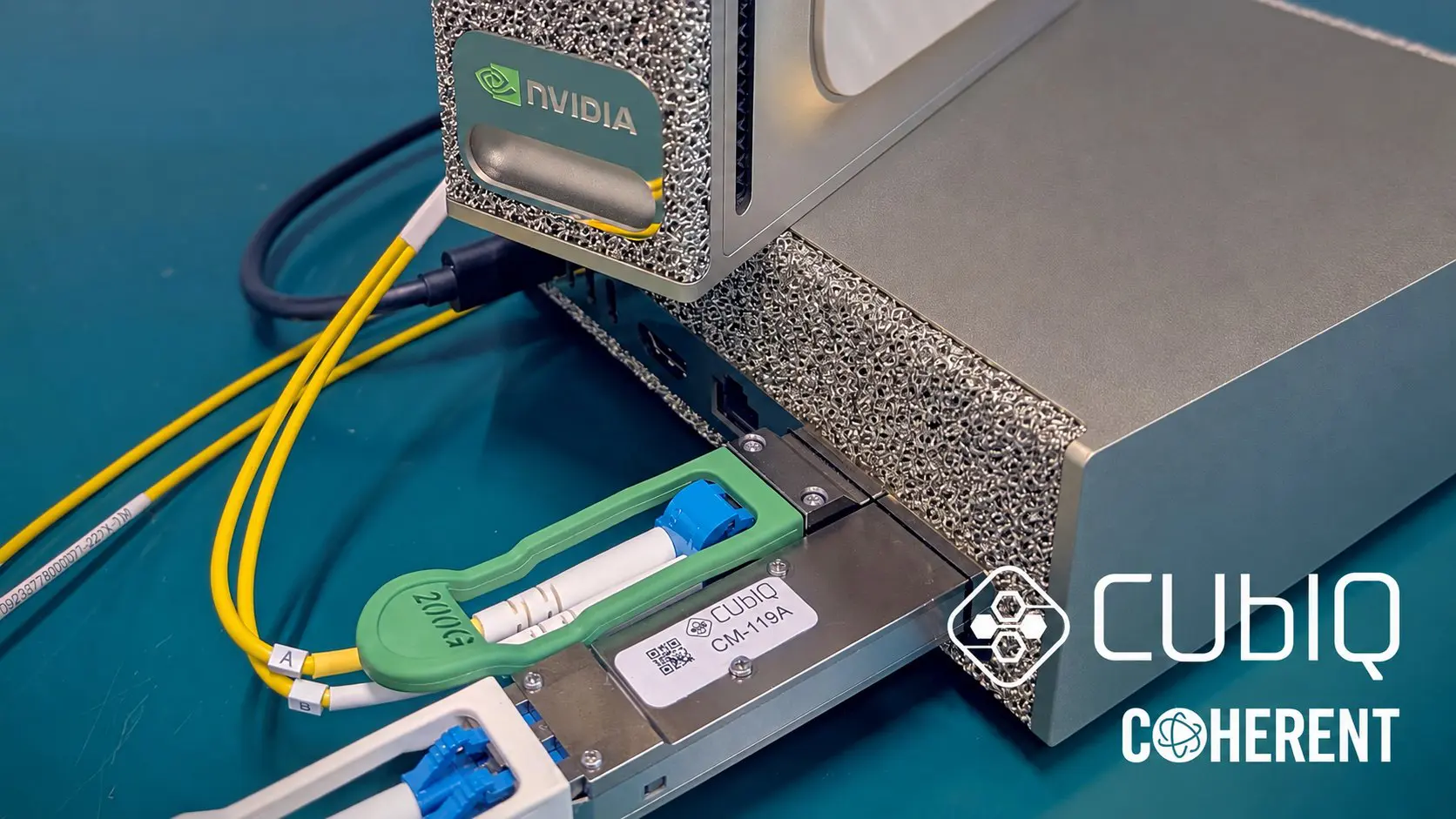
CUbIQ Technologies demonstrated a continuous-variable quantum key distribution (CV-QKD) system at ECOC 2026, fitting quantum security into a standard QSFP-28 pluggable module. The system, tested on NVIDIA ConnectX-7 network interface cards and Coherent 200G optics, includes live eavesdropper detection directly on the link, a feature that improves security over encryption methods that offer no proof of secure key travel.
“CUbIQ’s mission is to show practical, accessible physical layer security that can extend across AI infrastructure,” says Aaron Albores Mejia, CEO of CUbIQ Technologies. This demonstration proves quantum-safe networking can integrate with existing AI deployments without requiring dedicated hardware.
CV-QKD Pluggable Design for AI Infrastructure Integration
This form factor allows the QKD transceiver to occupy the same port as conventional optics, eliminating the need for dedicated rack space, power supplies, or management planes typically associated with quantum security appliances. The design significantly reduces the logistical hurdles to deploying quantum-safe networking within existing data center infrastructure. CUbIQ Technologies’ approach centers on compatibility with Common Management Interface Specification (CMIS), a standard protocol for managing network devices.
By adhering to CMIS, the QKD module can be integrated into existing network management systems without requiring custom software or interfaces. This allows a standard CMIS driver to manage the module, while custom drivers handle the QKD-specific functions, enabling the host system to access the quantum-generated keys through existing communication channels. This interoperability is important for smooth integration into complex AI infrastructure, where minimizing disruption is paramount.
The vulnerability the system addresses isn’t the encryption cipher itself, but the key exchange process. Conventional methods offer no verifiable evidence of how a key traveled, leaving intercepted links indistinguishable from secure ones. This means even currently encrypted communications are susceptible to compromise if the key exchange is intercepted and manipulated. CUbIQ’s system actively addresses this by performing a live eavesdropper detection on the link itself, providing real-time confirmation of connection integrity.
NVIDIA’s involvement extends beyond simply providing the host hardware; the company has been actively developing the software infrastructure to support quantum computing and networking, the company says. NVIDIA builds software and hardware for hybrid quantum-classical computing, including the open-source CUDA-Q platform and cuQuantum simulation libraries. The ConnectX-7 NIC, used in the demonstration is capable of inline encryption at line rate, meaning it can encrypt data as it is transmitted without introducing significant latency.
This capability is essential for maintaining the high throughput required by modern AI workloads. The integration with NVIDIA’s DGX Spark systems highlights the potential for scaling quantum security across large AI clusters. As AI models become increasingly complex and data-intensive, they often extend beyond the confines of a single data center, requiring secure communication across multiple sites. The pluggable QKD module offers a scalable solution for securing these distributed AI deployments, enabling organizations to protect their sensitive data and intellectual property, according to NVIDIA.
The ability to run QKD over existing dense wavelength division multiplexing (DWDM) channels further simplifies deployment. This allows the quantum channel to coexist with production traffic without requiring dedicated fiber optic cables, reducing costs and complexity.
The CMIS compatibility and DWDM integration represent a step towards making quantum security accessible to a wider range of organizations. The division of responsibility between the components, with CUbIQ handling key generation, NVIDIA providing the host system and encryption, and Coherent Corp. supplying the data-plane transport demonstrates a collaborative approach to building a comprehensive quantum-safe networking solution. The system’s success hinges on the ability of each component to scale in tandem, ensuring that throughput and encryption capabilities remain aligned.
CUbIQ’s QSFP-28 Module & NVIDIA ConnectX-7 Key Path
This modular approach sidesteps the need for dedicated fiber infrastructure, a significant barrier to widespread quantum key distribution adoption, by using established communication channels. supplies the data-plane transport between hosts. NVIDIA’s network interface card encrypts data at line rate, meaning encryption does not impede data transfer speeds, while Coherent’s 200G FR4 optics provide the necessary bandwidth for high-speed communication. The CMIS compatibility of the CUbIQ module is also central to its integration, allowing it to be managed by standard network switches and routers without requiring specialized control systems.
During the ECOC 2026 demonstration, a live eavesdropper detection was performed on the link itself, highlighting that CUbIQ’s system doesn’t just promise security, but actively proves if a connection has been compromised in real-time, the company says. This moves beyond passive encryption to active threat detection, addressing a fundamental vulnerability in conventional key exchange protocols. The recent addition of CUDA-Q Logical, an orchestration layer for designing fault-tolerant quantum applications, further demonstrates NVIDIA’s commitment to building a comprehensive quantum computing platform, the company states.
NVIDIA reported in July 2026 that its Ising AI pre-decoder cut logical error rates for color codes by 347.7 times against Chromobius at distance 31 and a 0.3% physical error rate demonstrating the power of AI-assisted quantum error correction. The company’s OpenShell runtime, added in September 2026, allows AI agents to run longer and safer, further enhancing the security and reliability of AI workloads. This work with Coherent Corp., running on NVIDIA’s AI Supercomputer systems via the ConnectX interface, proves that quantum-safe networking can be demonstrated on the AI infrastructure that operators are already deploying.
CUbIQ’s mission is to show practical, accessible physical layer security that can extend across AI infrastructure. This work with Coherent Corp., running on NVIDIA’s AI Supercomputer systems via the ConnectX interface, proves that quantum-safe networking can be demonstrated on the AI infrastructure that operators are already deploying.
Live Eavesdropper Detection via Quantum Signal Monitoring
The demonstration at ECOC 2026 went beyond simply establishing a quantum-secured link. It actively detected a simulated eavesdropper during key exchange, a feat confirmed by real-time telemetry. CUbIQ Technologies’ continuous-variable quantum key distribution (CV-QKD) system identified an attempted interception by monitoring changes in the optical signal, triggering an automatic key discard before any data could be compromised. This isn’t a passive defense, but an active confirmation of link integrity, distinguishing it from post-quantum cryptography which relies on unproven mathematical assumptions.
This modular approach allows for deployment within existing AI clusters without requiring a complete overhaul of networking hardware. “Throughput and encryption must scale together,” explained the team, highlighting the importance of maintaining line-rate encryption alongside high-speed data transmission. The demonstrator tracked several key metrics, including quantum key distribution signal-to-noise ratio, optical input power, module temperature, and bytes transmitted, to establish a baseline of normal operation.
During testing, the system successfully detected a simulated attack involving a 50% optical signal split, triggering a cascade of security checks, the company’s account states. First, a drop in average optical input power at the receiving module signaled a potential issue. However, the system didn’t immediately declare the link insecure. It required confirmation from the excess-noise estimate and QKD signal-to-noise ratio. Only when these parameters deviated from the established baseline did the system definitively identify the attempted eavesdropping.
This multi-layered approach minimizes false positives, preventing unnecessary disruptions to network traffic. Calibration is a critical step, establishing the parameters that define a “secure” link. The system learns the expected range of values for optical input power, noise levels and QKD SNR. This baseline is then used to detect anomalies that indicate a potential attack.
However, the team cautioned that calibration must be performed on a trusted link, as an existing eavesdropper could be inadvertently incorporated into the baseline, masking its presence. The company’s broader strategy in hybrid quantum-classical computing is supported by platforms like CUDA-Q, cuQuantum and NVQLink, all designed to accelerate quantum algorithm development and error correction. The demonstrator was designed for inter-building and inter-site spans, targeting distances up to tens of kilometers where key rate can degrade with signal attenuation.
While the initial tests were conducted over a short bench link, the team plans to publish results from longer-distance deployments in the future. The ability to detect eavesdropping in real-time, combined with the use of readily available hardware, positions CUbIQ’s system as a viable solution for securing the rapidly expanding network infrastructure supporting artificial intelligence.
Complementary Security: CV-QKD with Post-Quantum Cryptography
This demonstration moves beyond theoretical concepts by integrating quantum security directly into current AI infrastructure, a critical step for scaling secure networks beyond single data centers. The system’s design prioritizes compatibility, avoiding the need for a complete network redesign to incorporate physical layer security. CUbIQ Technologies’ approach differs from traditional post-quantum cryptography (PQC) by deriving keys from the quantum properties of the optical signal itself, providing a fundamentally different foundation for security.
Unlike PQC, which relies on the mathematical difficulty of certain problems, QKD uses the physics of measurement; any attempt to intercept the signal disturbs it, leaving a detectable fingerprint and causing the protocol to discard the compromised keys before encryption. This real-time detection of tampering offers a distinct advantage, as it provides evidence of a compromised channel rather than relying on the assumption that a problem remains computationally hard to solve.
The demonstrator combines these two approaches, using QKD keys when available and falling back to PQC-based key exchange when QKD signal quality degrades, ensuring continued operation even under adverse conditions. The system’s dashboard provides operators with visible indicators of channel health, displaying error counts when conditions deteriorate rather than silently failing, a key feature for maintaining security awareness.
QKD signal-to-noise ratio (SNR) is monitored against a pre-defined threshold established during experimentation. Key generation remains reliable above this threshold, while intermittent key generation below it triggers a visible warning. This proactive monitoring allows for timely intervention and prevents a complete security breakdown, a feature not present in systems relying solely on PQC.
This layered approach ensures continuous security, even in the face of potential attacks or signal degradation. The CUbIQ CV-QKD pluggable is seated in an NVIDIA DGX Spark host. By fitting the QKD module into a standard QSFP-28 port, the system minimizes disruption to existing network infrastructure. This allows operators to scale AI clusters across buildings or sites without requiring a complete network redesign.
Demonstrator Architecture: Coherent Optics & DGX Spark Hosting
The demonstrator at ECOC 2026 uses existing network components to establish a quantum-secured link, using commercially available Coherent 200G FR4 optics alongside NVIDIA ConnectX-7 network interface cards. This approach deliberately avoids bespoke hardware beyond the quantum key distribution module itself, streamlining integration into established data center infrastructure. A high-bandwidth data plane is ineffective without commensurate encryption capabilities, and vice versa, a point emphasized by the system’s design.
Key exchange within the demonstrator follows conventional pathways, a deliberate choice to maximize deployability. Quantum keys are transmitted from the pluggable module to the host system via the Common Management Interface Specification, or CMIS, the same interface already used for communication between hosts and standard optical modules. This compatibility eliminates the need for custom side channels or entirely new driver development, simplifying integration and reducing operational complexity.
All module data is accessible to the host through this existing interface, allowing for smooth management and control. The architecture’s modularity extends to the host platform, with NVIDIA DGX Spark systems serving as the foundation for running the demonstration, the company says. NVIDIA introduced NVQLink, an open interconnect that links quantum processors to GPU supercomputers, on 28 October 2025 with 17 QPU builders, five control-system builders and nine U.S. national labs.
The use of FR4 optics in the demonstrator is a deliberate choice, demonstrating the system’s compatibility with existing datacenter infrastructure. While the module is capable of DWDM coexistence, this functionality wasn’t the focus of the ECOC 2026 demonstration.
Instead, the emphasis was on demonstrating a functional, physical implementation of quantum security that integrates smoothly with current high-speed networking hardware. The demonstrator, currently on display at ECOC 2026 in Málaga, allows attendees to test the system firsthand, potentially booking appointments with CUbIQ’s Chief Commercial Officer, Peter Rajec, to discuss technical or commercial inquiries., according to NVIDIA.



See today’s quantum computing news on Quantum Zeitgeist for the latest breakthroughs in qubits, hardware, algorithms, and industry deals.