Lorenzo Bechelli and colleagues from ETH Zurich have directly measured quantum projection noise in mesoscopic ensembles of nitrogen-vacancy (NV) spin defects at room temperature. The experiment, enabled by an optically-detected magnetic resonance contrast exceeding 20%, enables projection noise measurements and allows for the counting of up to 43 spins within nanoscale NV ensembles. The protocol promises sharp improvements in magnetometry sensitivity without requiring cryogenic temperatures or strong magnetic fields, representing a key advance for practical quantum sensing applications.
High-contrast ODMR enables room-temperature quantum projection noise and nanoscale spin counting
Optically-detected magnetic resonance (ODMR) contrast now exceeds 20%, a substantial improvement over previous methods limited to sharply lower values. This enhancement unlocks the ability to directly measure quantum projection noise, a feat previously unattainable in solid-state spin ensembles at room temperature. Dr. Tim Schröder, Dr. Richard Schlegel, and colleagues achieved this breakthrough by combining polarization-selective optical excitation with a spin-to-charge conversion technique, maximising signal clarity and enabling precise spin state determination. Quantum projection noise represents the fundamental limit to the precision with which the population of spin states can be determined. It arises from the inherent quantum uncertainty in measuring a binary property, spin up or spin down, and is analogous to the shot noise encountered in photon counting. Previous attempts to observe this noise in solid-state systems were masked by overwhelming classical noise sources originating from the readout process itself.
The resulting protocol enabled projection noise measurements and spin counting from nanoscale nitrogen-vacancy (NV) ensembles containing up to 43 spins, providing a calibration-free method for quantifying the number of contributing spins. The variance of the observed projection noise offers a calibration-free method for determining the number of spins contributing to the signal, eliminating the need for complex modelling or prior knowledge of the NV centre density. This is particularly valuable as accurately determining the number of spins is crucial for calibrating the sensitivity of NV-based sensors. Operating effectively at room temperature, the protocol avoids cryogenic cooling or strong external magnetic fields, broadening its potential applications in sensitive magnetometry and many-body spin physics. This achievement builds upon the high ODMR contrast achieved for a single crystallographic orientation. However, current measurements focus on relatively small ensembles and do not yet demonstrate the scalability needed to address complex quantum systems or practical sensing devices. A specific crystal alignment is required, potentially restricting sensor deployment where precise alignment is difficult, but this does not negate the significance of demonstrating projection noise measurement from a solid-state system. Future work will focus on relaxing the alignment requirements and increasing the ensemble size to enhance signal strength and enable more complex measurements.
Enhanced NV centre signal via polarization control and spin-to-charge transduction
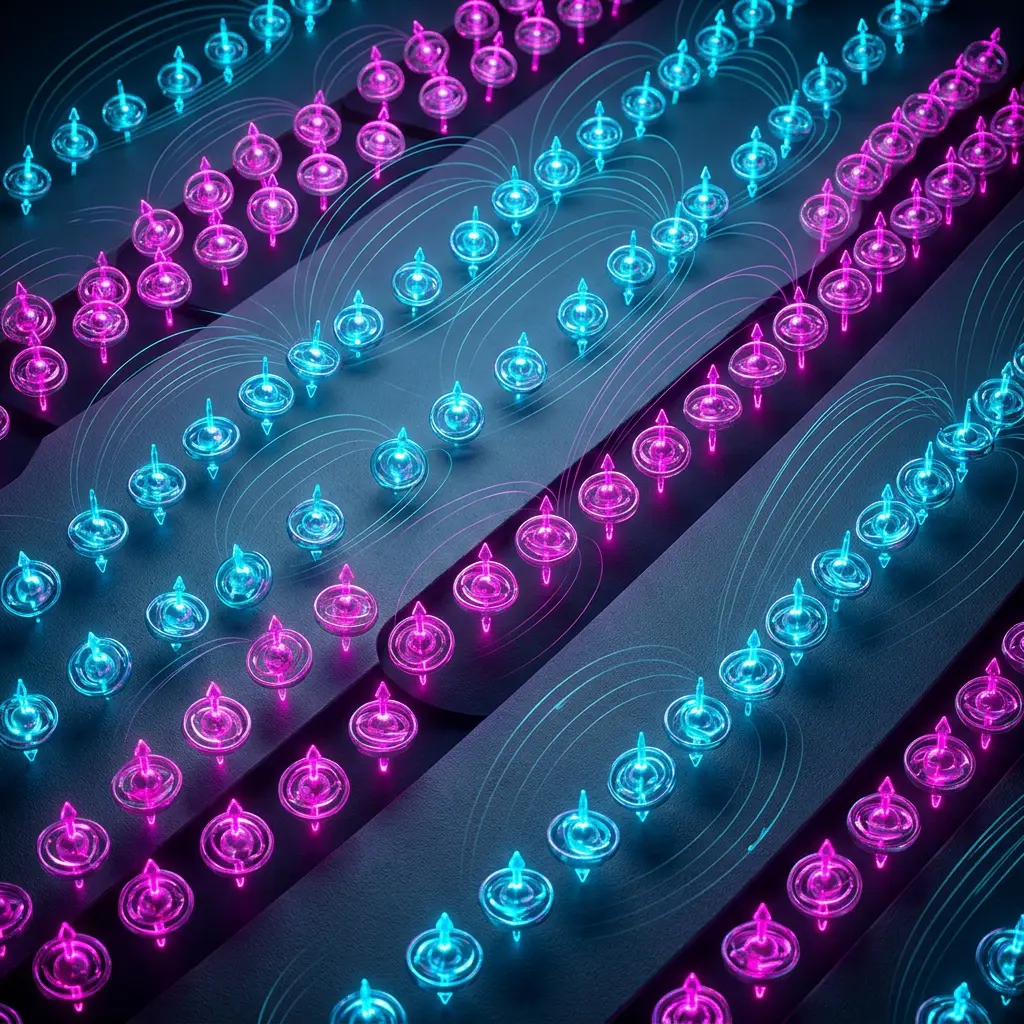
Polarization-selective optical excitation and spin-to-charge conversion proved central to this work, enabling a sharply enhanced signal from the nitrogen-vacancy (NV) centres. NV centres, tiny imperfections in diamond behaving like miniature compass needles, typically suffer from weak and noisy signals. The team carefully controlled the light used to excite the NV centres, selecting only light with a specific polarization to maximise the contrast between different spin states, akin to improving the clarity of an image on a screen to reveal finer details. NV centres possess a ground state triplet, meaning the electron spin can align in three distinct orientations. Polarization control selectively addresses these states, enhancing the ODMR signal. Without this precise control, the signal would be significantly weaker and more susceptible to noise.
The researchers converted the spin information into an electrical charge, amplifying the signal and allowing for more precise measurements. This approach bypassed challenges associated with classical readout noise, a common limitation in solid-state spin ensembles, and avoided the need for cryogenic cooling or strong magnetic fields. The spin-to-charge conversion relies on the interaction between the NV centre’s spin state and the surrounding charge carriers within the diamond lattice. By monitoring changes in electrical conductivity, the researchers could effectively ‘read out’ the spin state of the NV centre. This technique is far more sensitive than traditional optical readout methods, which are often limited by photon shot noise and detector inefficiencies. This allows for broader exploration of diamond-based sensing technologies for diverse applications, potentially revolutionising fields reliant on precise measurements. These applications include biomagnetic field mapping, materials science, and fundamental tests of quantum mechanics.
Nitrogen-vacancy centres demonstrate projection noise despite crystallographic orientation
Establishing a reliable quantum measurement benchmark is vital for advancing solid-state quantum technologies, yet this has proven elusive due to inherent classical noise. Dr. Schröder, Dr. Schlegel, and their team successfully measured projection noise from ensembles of up to 43 nitrogen-vacancy (NV) centres. The team’s direct measurement of quantum projection noise in nitrogen-vacancy (NV) centres, tiny defects within diamond, establishes a fundamental limit for spin measurement in solid materials at room temperature. This measurement confirms that the observed noise is indeed quantum in origin and not simply a result of classical fluctuations in the measurement apparatus.
This achievement bypasses limitations imposed by classical noise, a long-standing obstacle in solid-state quantum sensing. Previously, such measurements were largely confined to atomic systems requiring cryogenic conditions. Combining targeted light with the technique converting spin information into electrical charge, scientists not only observed this quantum effect but also accurately counted up to 43 individual spins within nanoscale ensembles. This advance enables improved magnetometry, potentially without the need for expensive cooling or strong magnetic fields, and researchers in London have demonstrated a key advance in quantum sensing technology. The ability to perform projection noise-limited measurements at room temperature opens up new possibilities for developing compact, portable, and energy-efficient quantum sensors. Furthermore, understanding and mitigating projection noise is crucial for scaling up NV-based quantum technologies, such as quantum computing and quantum communication, where precise control over individual spins is paramount. The observed projection noise scales with the square root of the number of NV centres, consistent with theoretical predictions for uncorrelated spins.
The researchers successfully measured quantum projection noise from ensembles of up to 43 nitrogen-vacancy centres in diamond at room temperature. This demonstrates a fundamental limit to how precisely the spin of these materials can be measured, and confirms the observed noise originates from quantum effects rather than classical sources. By combining polarisation-selective light with a spin-to-charge conversion technique, the team overcame previous limitations caused by classical noise. This advance allows for improved magnetometry without requiring cryogenic cooling or strong magnetic fields, and is a vital step towards scaling up nitrogen-vacancy-based quantum technologies.
👉 More information
🗞 Spin counting via projection noise measurement of mesoscopic solid-state spin ensemble
🧠 ArXiv: https://arxiv.org/abs/2606.14437

See today’s quantum computing news on Quantum Zeitgeist for the latest breakthroughs in qubits, hardware, algorithms, and industry deals.