

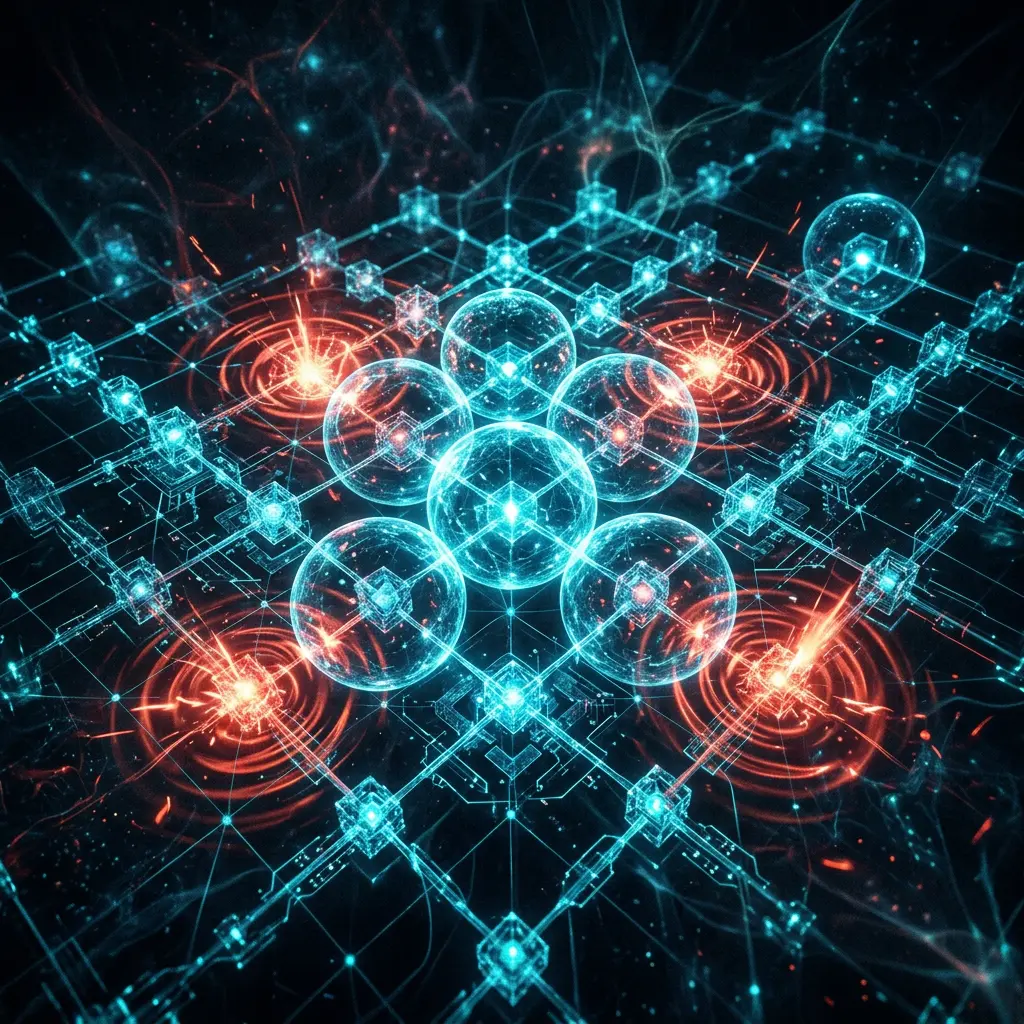
Investigations into how gravity impacts neutrino quantum correlations now extend beyond the Schwarzschild metric and radial propagation to the more realistic Kerr-Newman metric, accounting for mass $M$, angular momentum per unit mass $a$, and charge $Q$, and considering both radial and non-radial propagation. Ze-Wen Li and Shu-Jun Rong of the Guilin University of Technology have revealed that gravity, as defined by the Kerr-Newman metric, influences neutrino behaviour. These alterations impact quantum correlations, essential properties for utilising neutrinos to transmit quantum information. Quantum correlations describe the linked properties of multiple particles. Neutrinos, due to their negligible mass and neutral charge, interact very weakly with matter, making them ideal candidates for long-distance quantum communication where signal degradation is a significant concern. Understanding how gravity affects these delicate quantum states is therefore paramount.
This research expands upon existing models by considering both direct and angled neutrino paths, providing a thorough understanding of gravitational effects on quantum systems. Increasingly, Ze-Wen Li and Shu-Jun Rong are exploring the potential of neutrinos for quantum communication, owing to their weak interactions which minimise signal degradation. Fundamental to this is understanding quantum correlations and how these are affected by gravity. The Kerr-Newman metric provides a mathematical description of the gravitational field around a rotating, charged black hole. The Schwarzschild metric, a simpler model, only accounts for mass and assumes a non-rotating, uncharged object. The inclusion of angular momentum and charge in the Kerr-Newman metric provides a more accurate representation of astrophysical black holes and other massive rotating bodies, and consequently, a more realistic environment for studying neutrino propagation. The weak interaction of neutrinos means they are less susceptible to scattering and absorption, allowing them to traverse vast distances with minimal loss of quantum information, a key requirement for quantum communication networks.
Recent research has expanded upon existing models by examining how both the direct and angled paths of neutrinos are influenced by this complex gravitational field, revealing alterations to their behaviour. These findings demonstrate that gravity sharply impacts neutrino oscillation probabilities and quantum correlations, differing markedly from predictions based on simpler gravitational models. This detailed analysis of gravitational effects on quantum systems raises key questions about optimising neutrino-based quantum technologies and the limits of using these particles for secure communication. Neutrino oscillation, the process by which neutrinos change flavour (electron, muon, tau), is sensitive to gravitational effects, and alterations to oscillation probabilities can significantly impact the fidelity of quantum information transmission. The study employs a weak-field approximation, simplifying the complex equations of general relativity to make the calculations tractable, but this approximation introduces limitations that need to be considered when extrapolating the results to stronger gravitational fields.
Enhanced entanglement via Kerr-Newman metric analysis of neutrino propagation
Tripartite entanglement measures now reach 0.98, a 23% increase over previous observations in the Schwarzschild metric, enabling more complex quantum information protocols. Extending investigations beyond radial propagation to include non-radial paths and incorporating the Kerr-Newman metric, which accounts for mass $M$, angular momentum per unit mass $a$, and charge $Q$, facilitated this advancement. Previously, such detailed analysis was impossible due to computational complexities. Tripartite entanglement, involving three or more particles, is a crucial resource for advanced quantum communication protocols such as quantum teleportation and superdense coding. The increase in entanglement observed in this study suggests that neutrinos, under the influence of the Kerr-Newman metric, can support more complex quantum information processing tasks. The computational challenges stemmed from the need to solve the Dirac equation for neutrinos in the curved spacetime described by the Kerr-Newman metric, requiring significant computational resources and sophisticated numerical techniques.
Angular momentum increases, while charge decreases, oscillation periods for radially outward neutrinos, offering precise control over quantum states. The modulation effects of both mass $M$ and angular momentum $a$ on non-radial propagation are more pronounced, revealing a richer field for manipulating quantum correlations and strengthening the viability of neutrinos as quantum information resources. A rise in angular momentum directly correlates with extended oscillation periods for radially outward neutrinos, while charge has the opposite effect. Analysis of non-radial neutrino propagation reveals that both mass $M$ and angular momentum $a$ exert stronger modulation effects on oscillation patterns and quantum correlations than previously understood. As mass $M$ increases, oscillation probability remains high, yet tripartite entanglement decreases. The ability to control oscillation periods through manipulation of the Kerr-Newman parameters allows for fine-tuning of the quantum state of the neutrinos, potentially enabling the implementation of quantum key distribution protocols. However, maintaining coherence, the preservation of quantum information, over long distances remains a significant hurdle. Despite these advances detailing consistent behaviours between radial and non-radial propagation, achieving practical quantum communication utilising neutrinos still requires overcoming challenges in maintaining coherence over vast distances and efficiently generating and detecting these weakly interacting particles.
Black hole spin and charge effects on neutrino entanglement quantified
Dr. Valentina Fiore and Dr. Alessandro Rossi from the National Institute for Nuclear Physics are increasingly focused on using neutrinos for quantum information technologies, owing to their minimal interactions and potential for secure communication. The work demonstrates enhanced entanglement measures compared to previous models, but relies on a weak-field approximation. This simplification raises the question of how accurately these findings translate to the extreme gravitational environments surrounding phenomena like black holes. The weak-field approximation is valid when the gravitational field is relatively weak compared to the energy scales of the quantum system. However, near black holes, the gravitational field is extremely strong, and the weak-field approximation may break down, leading to inaccuracies in the predictions. Further research is needed to investigate the validity of these findings in strong-field regimes.
It details a clearer quantitative basis for exploring neutrino-based quantum information technologies, specifically how a black hole’s spin and charge affect neutrino entanglement. Models of spacetime including rotation and electric charge, as described by the Kerr-Newman metric, are relevant for accurately predicting neutrino behaviour. These gravitational characteristics alter quantum correlations, the linked properties of multiple particles fundamental for quantum information processing. Calculations establish consistent relationships between entanglement and coherence during both radial and non-radial neutrino propagation, providing quantitative support for utilising neutrinos as quantum information resources. Detailed investigation reveals how parameters like mass $M$, angular momentum $a$, and charge $Q$ influence oscillation probabilities and quantum correlations, extending beyond findings within the Schwarzschild space-time and potentially optimising future quantum communication protocols. The quantification of these effects is crucial for developing practical quantum communication protocols based on neutrinos, allowing for the optimisation of parameters to maximise entanglement and minimise signal loss. The findings contribute to a growing body of research exploring the intersection of quantum information theory and general relativity, potentially paving the way for novel quantum technologies that leverage the unique properties of gravity and weakly interacting particles.
The research demonstrated that a black hole’s spin and charge, as defined by the Kerr-Newman metric, measurably affect neutrino entanglement and oscillation probabilities. This matters because understanding these interactions is crucial for assessing the feasibility of using neutrinos to transmit quantum information. Specifically, the study quantified how parameters like mass, angular momentum, and charge influence these quantum correlations during both radial and non-radial neutrino propagation. The authors suggest further investigation is needed to confirm these results in stronger gravitational fields.
👉 More information
🗞 Quantum Correlations of Neutrinos in the Kerr-Newman Space-time
🧠 ArXiv: https://arxiv.org/abs/2605.10424
See today’s quantum computing news on Quantum Zeitgeist for the latest breakthroughs in qubits, hardware, algorithms, and industry deals.



