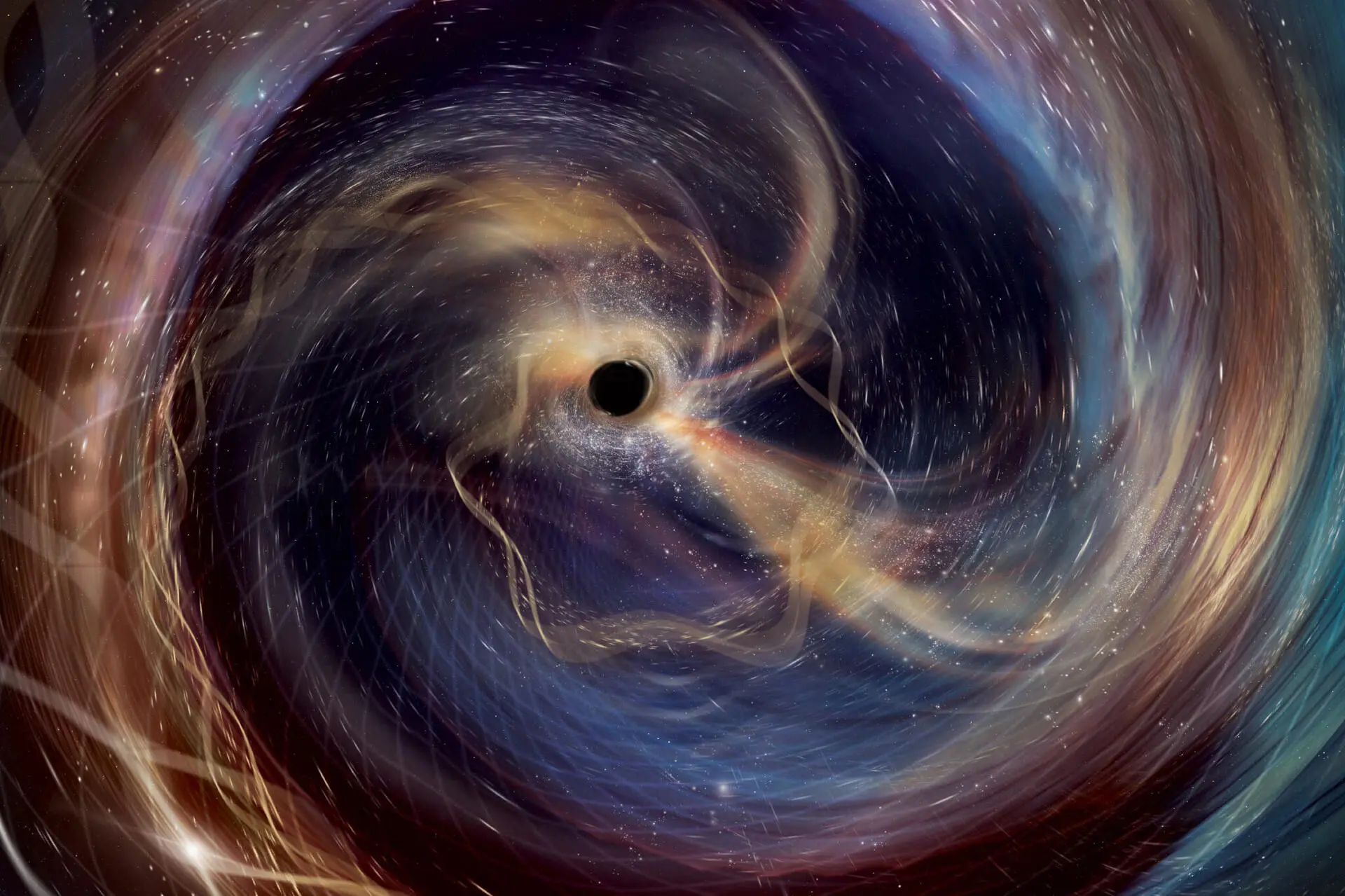
An international network of gravitational wave detectors has identified 161 new cosmic collisions during its latest observing run, expanding the catalog of known events and initiating a new era for statistical astronomy. The updated Gravitational Wave Transient Catalog-5.0, representing all observations to date, includes data from April 10 to January 28, bringing the total number of confirmed gravitational wave events to 390 since the first detection in 2015. Scientists were able to distinguish the clearest-ever gravitational wave signal, which they described as hearing a “cosmic bell” across the universe. “The gravitational-wave events accumulated in our catalog have enabled population studies and tests of general relativity with increased precision,” said Leo Tsukada, a postdoctoral research fellow with the Nevada Center for Astrophysics at UNLV.
LIGO, Virgo, KAGRA Collaboration Releases GWTC-5.0 Catalog
The latest gravitational wave catalog reveals a universe filled with colliding black holes, offering insights into these cataclysmic events. The international LIGO, Virgo, KAGRA (LVK) Collaboration has released the Gravitational Wave Transient Catalog-5.0 (GWTC-5.0), an updated compilation of all gravitational wave events observed to date, including 161 new detections from the O4b observing run between April 10 and January 28. This brings the total number of confirmed events observed since 2015 to 390, demonstrating the increasing sensitivity of the global detector network. The increase in detections is directly linked to improvements in detector technology; the fourth observing run alone accounts for approximately 75% of all gravitational wave events detected thus far.
This enhanced capability allowed scientists to “hear” celestial collisions with unprecedented clarity, even distinguishing subtle tones ringing like a cosmic bell across the universe. The inclusion of the Virgo detector has been particularly transformative, enabling triangulation of sources with an accuracy of just a few square degrees. Among the new detections are several record-breakers, including the best sky localization ever achieved for a gravitational wave source, an area of only 6 square degrees, and the clearest signal ever recorded, with a signal-to-noise ratio of 76.9. This exceptional signal, GW250114, originated from the merger of two black holes with masses 32 and 34 times that of the Sun, occurring over a billion light-years away. The clarity of this signal has already yielded the most accurate test of general relativity and confirmation of Stephen Hawking’s black hole area theorem.
The catalog provides the first direct evidence for second-generation black holes, formed from the repeated mergers of earlier black holes in dense stellar environments. “Each new detection provides important insights about the universe, reminding us that each observed merger is both an astrophysical discovery and an invaluable laboratory for probing the fundamental laws of physics,” says Carl-Johan Haster, assistant professor of astrophysics at UNLV. The LVK Collaboration anticipates further discoveries as they continue to analyze data from the fourth observing run.
Virgo Detector Triangulation Improves Source Localization
The detection of gravitational waves has rapidly matured from a confirmation of Einstein’s theories to a robust tool for astronomical observation, now yielding a detailed catalog of cosmic events. While the Laser Interferometer Gravitational-Wave Observatory (LIGO) in the United States initially spearheaded these detections, the addition of the Virgo detector in Europe has dramatically enhanced the precision with which these events can be localized in the sky. This improvement is not merely incremental; it is fundamentally changing how astronomers follow up on gravitational wave signals and piece together the stories of colliding black holes and neutron stars. The recently released Gravitational Wave Transient Catalog-5.0 (GWTC-5.0) reflects this progress, incorporating 161 new gravitational wave events detected during the O4b run between April and January.
This ability to pinpoint the origin of these cosmic collisions is vital for multi-messenger astronomy, where gravitational wave data is combined with observations from traditional telescopes across the electromagnetic spectrum. A prime example of this enhanced localization occurred on June 15, when a signal was detected by both LIGO detectors and Virgo, resulting in a source identification within just 6 square degrees, a remarkably small area of the celestial sphere. The precision afforded by the three-detector network allows astronomers to more efficiently target potential electromagnetic counterparts, such as flares or afterglows, providing a more complete picture of the event. The clarity of the signals has improved to the point where scientists can discern subtle characteristics within the waveforms themselves. The new catalog includes the “clearest” gravitational wave signal ever detected, boasting a signal-to-noise ratio of 76.9. The combination of improved detector sensitivity and triangulation with Virgo is not just increasing the number of detections, but also the quality of the data, opening new avenues for astrophysical research and fundamental physics.
Each new detection provides important insights about the universe, reminding us that each observed merger is both an astrophysical discovery but also an invaluable laboratory for probing the fundamental laws of physics.
Carl-Johan Haster, assistant professor of astrophysics at UNLV
Record Signal-to-Noise Ratio in GW250114 Detection
Following the release of the Gravitational Wave Transient Catalog-5.0, researchers at the LIGO Scientific Collaboration are meticulously examining data from the O4b observing run, with particular attention paid to the event GW250114 and its unprecedented clarity. Jonah Kanner, a senior scientist for the LIGO Laboratory at Caltech, highlighted the expanding impact of this work, noting that “Our data releases are cited in over 200 scientific papers each year, and thousands of young and aspiring scientists have enrolled in our annual Open Data Workshops.” This surge in utilization underscores the growing importance of publicly accessible gravitational wave data for a broad range of astrophysical investigations. The highest signal-to-noise ratio recorded was 76.9. Detecting gravitational waves isn’t simply about registering a signal, but rather isolating it from the inherent noise within the detectors, requiring sophisticated data analysis techniques. This level of precision promises to unlock further insights into the nature of black holes, the dynamics of spacetime, and the fundamental laws governing the universe.
We have an outstanding team of scientists, engineers and supporting staff who build, operate and improve these amazing detectors, and who analyze the data with great care to answer scientific questions.
Peter Shawhan, deputy spokesperson of the LIGO Scientific Collaboration and professor of physics at the University of Maryland
Evidence for Second-Generation Black Hole Mergers
The expanding catalog of gravitational wave events isn’t just revealing more collisions; it’s beginning to unveil the complex life cycles of black holes themselves. Analysis of the latest data release, the Gravitational Wave Transient Catalog-5.0 (GWTC-5.0), includes evidence for second-generation black holes. This discovery offers a new window into the environments where these extreme objects thrive and the processes that shape their properties. Signals GW241011 and GW241110, detected just one month apart in October and November, are key to this understanding. These events originated from black hole mergers approximately 700 million and 2.4 billion light-years away, respectively, and exhibit characteristics suggesting a history of prior collisions. Specifically, the spin of the black holes involved indicates they likely formed in dense stellar clusters, where repeated mergers are more probable. The identification of these second-generation black holes confirms theoretical predictions based on earlier observations.
Researchers had long anticipated their existence, but this marks the first direct evidence supporting the model. The growing number of detected events allows scientists to not only identify these objects but also to study their properties and determine if they constitute a distinct sub-group with shared characteristics. This is a significant step forward in understanding the population dynamics of black holes and the environments in which they evolve. This enhanced precision is crucial for pinpointing the origins of gravitational waves and extracting detailed information about the colliding objects.
The gravitational-wave events accumulated in our catalog have ushered us into a new era of statistical astronomy, where this growing collection of detected signals enables population studies and tests of general relativity with unprecedented precision.
Leo Tsukada, a collaborating scientist and postdoctoral research fellow with the Nevada Center for Astrophysics at UNLV


See today’s quantum computing news on Quantum Zeitgeist for the latest breakthroughs in qubits, hardware, algorithms, and industry deals.