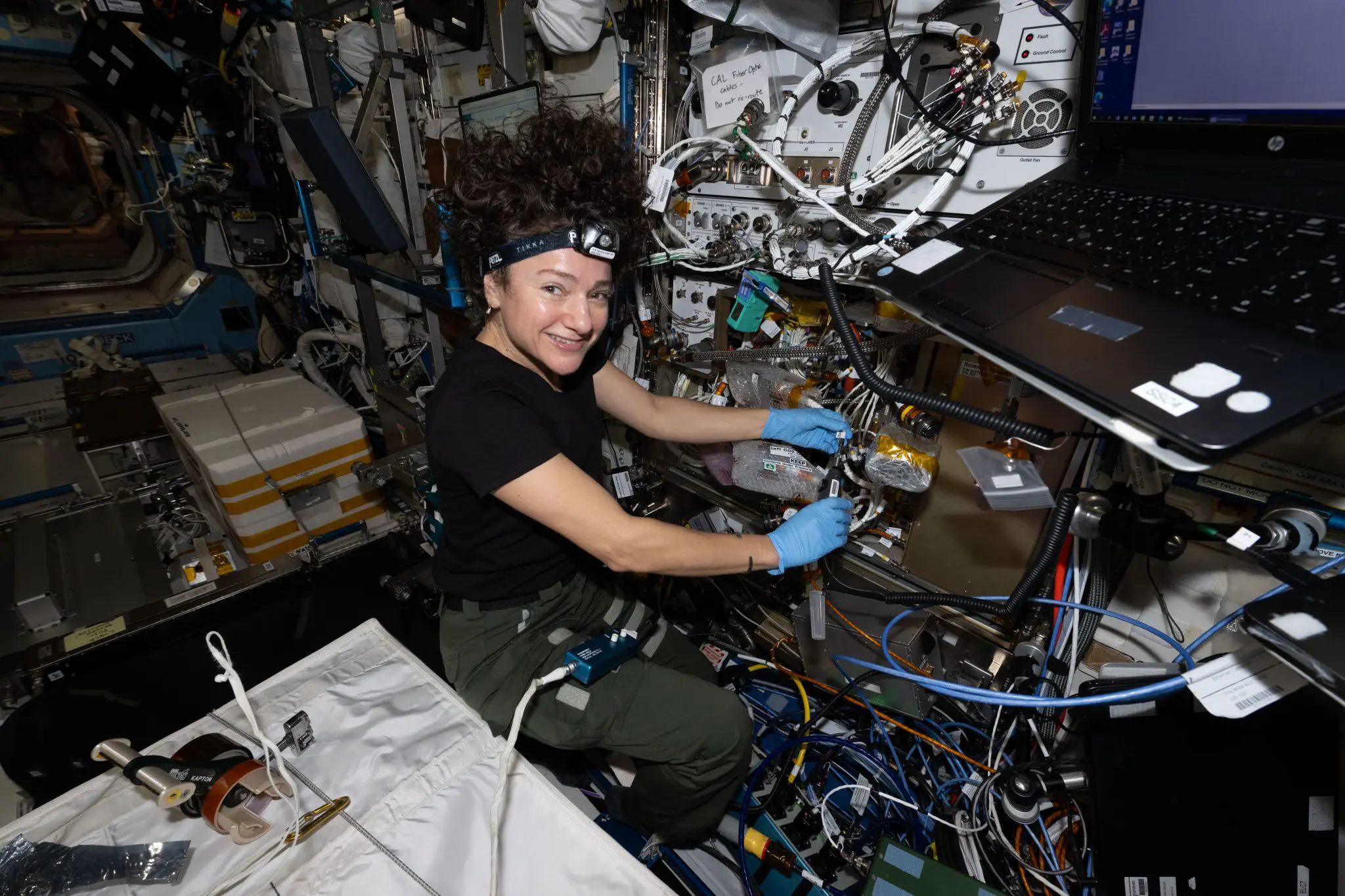
NASA astronauts recently activated an upgraded facility aboard the International Space Station capable of chilling atoms to minus 459 degrees Fahrenheit, just above absolute zero, to explore quantum physics. About the size of a minifridge, the Cold Atom Lab enables researchers to create Bose-Einstein condensates, or BECs, that exhibit wave-like behavior. This microgravity environment allows for the creation of larger, longer-lasting quantum waves than possible on Earth, pushing the boundaries of quantum research. “At the coldest temperatures, matter behaves drastically different from anything we have experienced,” said Jason Williams, project scientist for Cold Atom Lab at NASA’s Jet Propulsion Laboratory, which built the facility; the upgraded lab, which launched on April 11, now supports five international teams studying fundamental physics and testing quantum tools for future missions.
Cold Atom Lab Enables Bose-Einstein Condensate Creation in Orbit
The creation of Bose-Einstein condensates (BECs) within the International Space Station is now significantly enhanced thanks to recent upgrades to NASA’s Cold Atom Lab. This capability is crucial for studying quantum mechanics at a scale far exceeding that of subatomic particles. The Cold Atom Lab functions by manipulating atoms using lasers, draining energy and slowing them to near standstill within a magnetic trap. A recent upgrade, launched on April 11, introduced a redesigned magnetic trap that alters the shape of the resulting quantum gas clouds, enabling scientists to investigate diverse atomic properties. Redesigned metal strips now serve as sources for these gas clouds, improving quantum control; Kamal Oudrhiri, project manager of Cold Atom Lab at JPL, explains, “It’s the closest thing we have to controlling the boundary of the quantum world.”
This experiment is not simply a terrestrial setup relocated to orbit. The microgravity environment extends the duration and size of quantum waves, facilitating longer interactions with gravity and enabling more precise measurements of fundamental forces. Ethan Elliott, deputy project scientist, emphasizes the historical context, stating, “As the first project to create Bose-Einstein condensates in orbit, we’re demonstrating that we can make quantum technology work reliably in space.”
Laser Cooling and Magnetic Trapping of Rubidium/Potassium Atoms
The Cold Atom Lab’s capacity to manipulate rubidium and potassium atoms relies on a two-stage cooling process culminating in magnetic trapping, a technique enabling control over quantum states. Initial cooling uses lasers tuned to specific frequencies; these beams drain energy from a heated gas of rubidium or potassium, reaching temperatures as high as 750 degrees Fahrenheit (400 degrees Celsius), effectively slowing the atoms and reducing their temperature within the facility’s vacuum chamber. This laser-cooling stage prepares the atoms for the next step, where a magnetic trap contains the chilled gas. Achieving low temperatures is not the only goal; the aim is to create Bose-Einstein condensates (BECs) at temperatures below minus 459 degrees Fahrenheit, a state where atoms coalesce into a single quantum entity. This manipulation allows for the creation of BECs that exhibit wave-like behavior, extending the duration and scale of quantum phenomena. By confining these BECs with magnetic fields, scientists can maximize the time atoms spend in microgravity, facilitating prolonged observation of their quantum characteristics.
At the coldest temperatures, matter behaves drastically different from anything we have experienced.
Jason Williams, project scientist for Cold Atom Lab at NASA’s Jet Propulsion Laboratory
Microgravity Extends Quantum Gas Study Duration & Lowers Temperatures
Researchers at the Jet Propulsion Laboratory are continually refining the capabilities of the Cold Atom Lab, a facility aboard the International Space Station dedicated to quantum research, with a recent upgrade significantly extending both the duration and the achievable temperatures of Bose-Einstein condensate (BEC) studies. While terrestrial labs can produce BECs, the microgravity environment dramatically alters these experiments, allowing for larger and longer-lasting condensates. This advantage stems from the reduced influence of gravity on the delicate quantum waves; on Earth, these waves are quickly disrupted, limiting observation time. Redesigned metal strips, serving as gas sources, further enhance experimental control. The ability to sustain these ultracold gases for extended periods is crucial, as it allows for more precise measurements of fundamental forces like gravity and motion.
It’s the closest thing we have to controlling the boundary of the quantum world.
Kamal Oudrhiri, project manager of Cold Atom Lab at JPL
This improvement builds on previous upgrades since the lab’s arrival on the station, continually refining its ability to manipulate and observe matter at its most fundamental level. These BECs exhibit wave-like behavior, allowing researchers to study quantum mechanics at a scale previously unattainable. The microgravity environment of the station is crucial, extending both the duration and size of these quantum waves, and facilitating longer observation periods.


See today’s quantum computing news on Quantum Zeitgeist for the latest breakthroughs in qubits, hardware, algorithms, and industry deals.