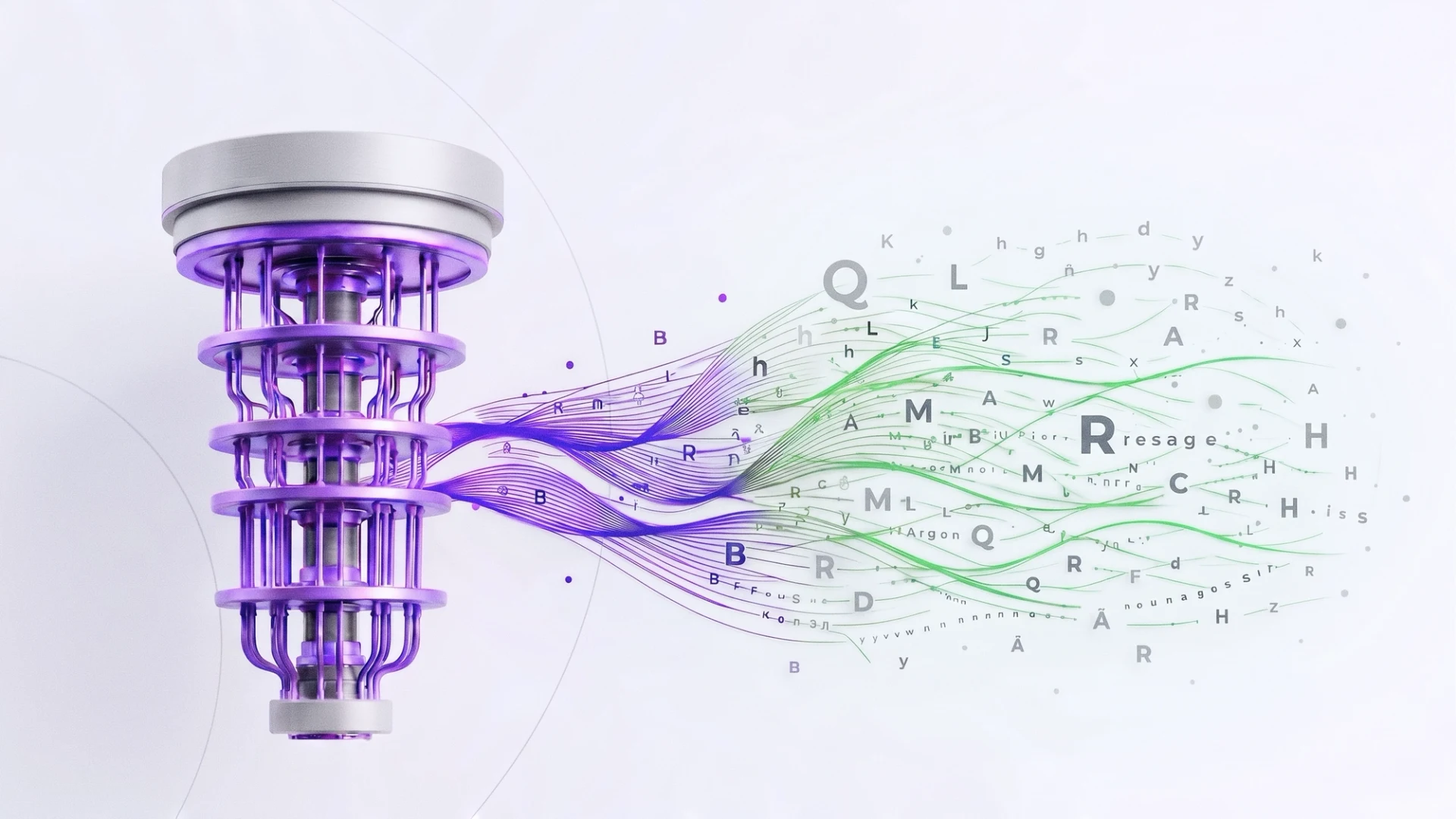
Researchers from Multiverse Computing in Spain and Canada have achieved an 83% recovery of compression-induced degradation in large language models by integrating quantum processing units. The team demonstrated this improvement using Cayley-parameterised unitary adapters inserted into a widely used 8-billion-parameter model, Llama 3.1 8B, and executed on a 156-qubit IBM Quantum System Two processor. This approach improved the model’s performance by 1.4% with only 6,000 additional parameters and enabled correct answers to questions that eluded classical models, revealing “a sharp noise–expressivity phase transition identifying the concrete path to quantum utility at larger qubit scales.” As Borja Aizpurua of Multiverse Computing notes, “We stand at a historical juncture in artificial intelligence,” with this work offering a potential pathway to overcome the unsustainable memory demands of increasingly complex LLMs.
- First QPU-verified quantum enhancement of a production LLM: Cayley Unitary Adapters improved Meta’s Llama 3.1 8B model by 1.4% using just 6,000 additional parameters, with inference confirmed on real IBM quantum hardware
- Quantum circuits can correct answers classical models get wrong: on the MMLU benchmark, the quantum-enhanced model answered expert-level questions correctly that the original Llama 3.1 8B failed, including astronomy and biology questions.
- Minimal noise impact at current scale, with a clear growth path: hardware noise degraded perplexity by only 0.08% at the 2-qubit level, and performance improved monotonically with qubit count, recovering 83% of compression-induced losses, pointing to greater gains as hardware matures.
LLM Parameter Scaling & Classical Limitations
A new approach to integrating quantum computation with large language models has yielded an 83% recovery of compression-induced degradation, signaling a potential pathway to overcome the limitations of classical scaling. Researchers from Multiverse Computing, spanning San Sebastián, Spain and Toronto, Canada, have demonstrated that strategically placed, Cayley-parameterised unitary adapters can enhance the performance of language models without an unsustainable increase in trainable parameters. This work directly addresses a fundamental constraint of current AI systems: every trainable parameter occupies classical memory, and scaling a deployed model’s parameter count requires a proportionally unsustainable expansion of compute infrastructure. The team focused on the widely used Llama 3.1 8B model, successfully improving its perplexity by 1.4% with only 6,000 additional parameters. The researchers emphasize that the adapters are structured to be hardware-efficient; a 4×4 block, requiring only six free parameters, allows for parallel execution as a shallow circuit, unlike traditional variational quantum circuits which often require exponentially growing depth.
Cayley Unitary Adapters for LLM Integration
Following advances in hybrid quantum-classical approaches to large language models, researchers are now focusing on methods to integrate quantum computation directly into existing LLM architectures. Rather than attempting full quantum implementations, the team in Spain and Canada developed Cayley-parameterised unitary adapters, quantum circuit blocks inserted into pre-trained LLMs, to enhance performance without requiring complete retraining of the original model. This strategy addresses the unsustainable expansion of compute infrastructure needed to scale LLM parameter counts, a challenge highlighted by current limitations in classical memory. The core innovation lies in the construction of block-diagonal unitaries (BDU), which offer a hardware-efficient means of introducing quantum parameters. These BDUs are designed to factorise into independent, shallow circuits executable on existing quantum processors; for experiments, the team fixed the block size to 4×4, resulting in a depth-19 native-gate circuit on the ibm_basquecountry processor.
This approach circumvents the exponential scaling of traditional unitary synthesis, making it feasible to implement on near-term quantum hardware. The team achieved a 1.4% improvement in WikiText perplexity with Llama 3.1 8B, a widely used 8-billion-parameter model, with only 6,000 additional parameters. Further mechanistic studies using SmolLM2 (135 million parameters) revealed an 83% recovery of compression-induced degradation, and the ability to correctly answer questions that classical baselines failed. This suggests a concrete path toward quantum utility as qubit scales increase, marking a significant step in the evolution of quantum-enhanced artificial intelligence.
SmolLM2 Perplexity Improvement with Unitary Blocks
Multiverse Computing researchers, spanning locations in San Sebastián, Spain and Toronto, Canada, are demonstrating a pathway toward practical quantum-enhanced large language models by focusing on a smaller, more manageable model called SmolLM2. This 135-million-parameter language model served as a testbed for their novel approach, utilizing quantum circuit blocks inserted into the model’s architecture. Recent pre-print publication details the team’s work, revealing a clear trend: perplexity, a measure of how well a language model predicts a text sample, improves consistently as the dimension of these unitary blocks increases. Notably, the researchers achieved 83% recovery of compression-induced degradation, indicating their quantum adapters effectively counteract performance loss from model compression techniques. This is a significant result, as it suggests quantum circuits can not only enhance models but also mitigate the drawbacks of reducing their size for efficiency.
Beyond simply improving performance, SmolLM2 demonstrated the ability to provide correct answers to questions that classical baselines failed, a crucial step toward demonstrating genuine quantum utility. The study also identified a “sharp noise–expressivity phase transition,” pinpointing a specific point where the benefits of increased qubit scale become apparent. This finding is vital for guiding future hardware development and optimizing the integration of quantum components into LLMs. This focus on practicality, combined with the observed performance gains, positions their work as a promising step toward realizing the potential of quantum computing in artificial intelligence.
Noise-Expressivity Phase Transition & Quantum Utility
Beyond achieving a 1.4% improvement in WikiText perplexity with only 6,000 additional parameters, the study demonstrated that increasing the unitary block dimension consistently improved perplexity, until noise overwhelmed the gains. Importantly, the Cayley-parameterised unitary adapters are designed for efficient execution on near-term quantum processors, utilising shallow circuits that minimise the impact of decoherence. The team’s construction of block-diagonal unitaries, factorised into independent 2-qubit operations, allows for parallel execution, further enhancing hardware efficiency. This approach, they argue, offers a “practical and scalable route to quantum enhancement of contemporary LLMs,” moving beyond theoretical demonstrations to tangible improvements on real-world models and hardware. The ability to correct answers to questions that classical baselines failed to address underscores the potential for quantum computation to unlock new capabilities in language processing, even with limited qubit counts.
Quantum Hardware Implementation on IBM System Two
While quantum computing often conjures images of futuristic, error-free machines, recent advances demonstrate practical progress using existing, imperfect hardware. Researchers are now directly integrating quantum processing into large language models (LLMs), moving beyond simulations and theoretical demonstrations. This work centers on quantum circuit blocks inserted into a pre-trained Llama 3.1 8B model. The team achieved a 1.4% improvement in WikiText perplexity, a measure of how well the model predicts text, with only 6,000 additional parameters. This is particularly notable given the scale of the LLM, demonstrating that even a relatively small quantum component can yield measurable gains. “We consider this a foundational result, analogous to the experimental realisation of Shor’s algorithm by Vandersypen et al. via NMR,” explains the research team, highlighting the importance of validating the physical approach.
The researchers emphasize the hardware efficiency of their approach, noting that the 4×4 unitary blocks, implemented as depth-19 native-gate circuits on the ibm_basquecountry processor for these experiments, remain within current coherence limits. This modular design, utilizing block-diagonal unitaries, allows for parallel execution and scalability, paving the way for larger, more complex quantum-enhanced LLMs.
Block-Diagonal Unitary Construction & Efficiency
The ability to recover lost information during compression represents a significant hurdle in large language model development, yet researchers have demonstrated an impressive 83% recovery of compression-induced degradation using a novel quantum approach. This advancement, detailed in recent work, hinges on the implementation of block-diagonal unitaries (BDU), a construction designed for efficient execution on current quantum hardware. These adapters are not merely additive components; they are structured to be hardware-efficient, factorising into independent blocks executed in parallel. This design allows for shallow, 19-native-gate circuits on the ibm_basquecountry processor when the block size is fixed to 4×4, comfortably within the limits of current qubit coherence. The team specifically fixed the block size to 4×4, creating a 2-qubit unitary, but expanded this in subsequent studies to explore expressivity ceilings.
This approach allows for a substantial reduction in trainable parameters; the researchers achieved a 1.4% improvement in perplexity for the Llama 3.1 8B model with only 6,000 additional parameters. The team views this as a foundational result, stating it “demonstrates the viability of the underlying physical approach and establishes a concrete basis for future scaling,” akin to early demonstrations of Shor’s algorithm.
Llama 3.1 8B Perplexity Reduction via Quantum Enhancement
The pursuit of more efficient large language models has led researchers to explore quantum computing as a potential solution to the limitations of classical architectures. While quantum machine learning has seen progress in areas like classification, demonstrating practical enhancement of a production-scale LLM remained a significant hurdle until recently. Researchers integrated quantum circuits into the Llama 3.1 8B model. Their approach centers on “Cayley-parameterised block-diagonal unitary adapters,” essentially quantum circuit blocks inserted into the LLM’s projection layers. A 1.4% improvement in WikiText perplexity was achieved with only 6,000 additional parameters. The team emphasizes the hardware efficiency of their design; the adapters factorize into shallow, parallel circuits, mitigating the challenges of qubit coherence.
Variational Quantum Circuits & Prior Quantum LLM Work
Beyond the demonstrated 83% recovery of compression-induced degradation using their approach, researchers are actively building on a growing body of prior work attempting to bridge the gap between quantum processing and artificial intelligence. Earlier efforts explored quantum machine learning for LLM classification and even quantum self-attention on 72-qubit processors for text classification, but these were largely confined to simulators or restricted linguistic scales. The team’s current strategy diverges from standard variational quantum circuits (VQCs), instead employing block-diagonal unitaries (BDU) inserted into pre-trained LLMs. This design prioritises hardware efficiency, addressing a critical limitation of earlier approaches where their Cayley-parameterised unitary adapters, trained classically while freezing original model weights, offer a scalable route to quantum enhancement. This work isn’t occurring in isolation; the authors acknowledge a landscape of previous investigations into quantum natural language processing and variational sequence models. However, they assert that “to the best of our knowledge, no prior work has demonstrated quantum enhancement of a production-scale, pre-trained Llama 3.1 8B, improving WikiText perplexity by 1.4% with only 6,000 additional parameters”.
Source: https://arxiv.org/pdf/2605.05914



See today’s quantum computing news on Quantum Zeitgeist for the latest breakthroughs in qubits, hardware, algorithms, and industry deals.