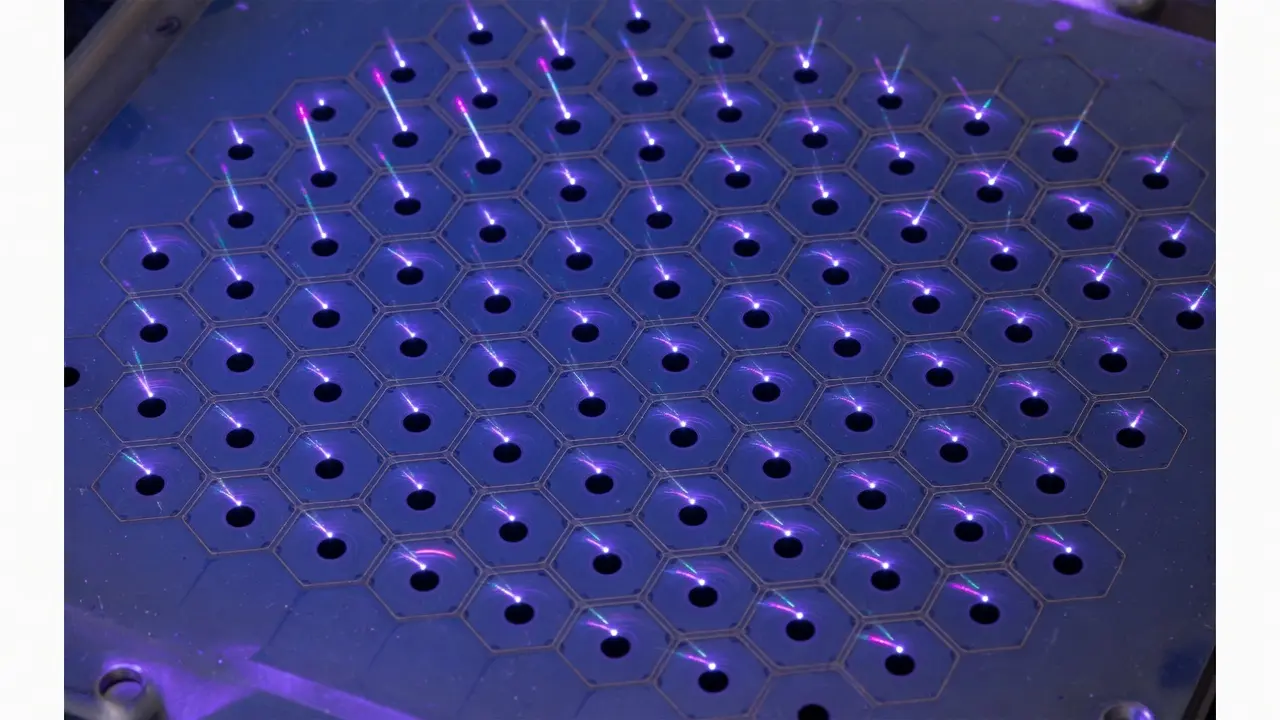
Researchers at IQM Quantum Computers have designed a honeycomb qubit lattice enabling all-to-all connectivity between qubits within a unit cell, a departure from more limited connections in existing superconducting quantum computer architectures. The work addresses key challenges in scaling quantum computers by simultaneously increasing connectivity and reducing qubit-state delocalization. The team proposes a novel conditional-Z gate scheme implemented in a single step, which they state “considerably improves the gate speed” compared to previous designs. This multi-mode coupling structure also mitigates crosstalk during simultaneous single-qubit gates.
Honeycomb Lattice Enables All-to-All Qubit Connections
This design achieves full connectivity by coupling each qubit to every other one via two dedicated tunable couplers and a shared central element, creating an effective multi-mode interaction. The lattice’s structure allows for a novel conditional-Z gate scheme that uses this multi-mode coupling, offering a potential pathway to scaling quantum processors. This new gate scheme relies on simultaneous excitation swaps within the lattice’s single- and two-excitation manifolds, involving the two qubits, two couplers and the central mode.
This approach allows for efficient, single-step calibration with a duration equivalent to two MOVE operations, a significant reduction in complexity. The resulting gate operation time is considerably reduced compared to the MOVE-CZ-MOVE protocol previously used for similar architectures, streamlining quantum calculations. Each qubit within the honeycomb lattice is coupled to three center modes, effectively connecting it to the 12 nearest neighbors.
Analysis of the unit cell also addresses potential interference from neighboring qubits and their impact on gate accuracy. The presence of these qubits and the resulting hybridization effects are explored to optimize performance. The paper explains the process of creating a CZ gate between qubits while minimizing influence on surrounding qubits. The work also provides analytical estimates for errors caused by relaxation and dephasing during two-qubit gate operations, including noise terms specific to the multi-mode coupling structure.
Transmon Qubit Connectivity via Tunable, Shared-Mode Coupling
A honeycomb lattice of superconducting qubits enables on-demand connections between each qubit pair within a single unit cell, a design departing from architectures with more limited interaction pathways. The lattice’s design incorporates a central transmon qubit coupled to six peripheral qubits via tunable couplers, allowing precise control over coupling strengths. The multi-mode coupling structure also addresses potential interference from spectator qubits, those not directly involved in a gate operation. The shared center mode acts as a filter, mitigating delocalization-induced crosstalk and improving the fidelity of two-qubit gates.
Multi-Mode Coupling Mitigates Delocalization-Induced Crosstalk
The researchers also show numerical results on how the presence of spectator qubits affects the average two-qubit-gate fidelity, and analyze how the multi-mode coupling structure mitigates the delocalization-induced crosstalk during simultaneous single-qubit gates within the unit cell. Their multi-mode coupling architecture results in a good balance between increased connectivity and available parallelism, especially when several interacting unit cells form a quantum processing unit.
The team’s approach uses multi-mode coupling within a honeycomb qubit lattice to facilitate faster quantum operations, a critical step toward scaling superconducting quantum computers. The team’s approach offers a pathway to faster, more reliable quantum computations by addressing key challenges in qubit connectivity and coherence.
Spectator Qubit Impact on Two-Qubit Gate Fidelity
Researchers investigated systems ranging from two to six qubits to specifically identify the effects arising from these spectating qubits during gate operations. This detailed examination is important because realistic quantum devices invariably include qubits not directly involved in a given computation, and their influence on gate accuracy requires careful consideration. Population leakage to spectator qubits is a particular concern, especially when those qubits approach resonance with those actively participating in the gate.
To counteract this, introducing some disorder in the idling frequencies of qubits can reduce unwanted population swapping caused by parasitic interactions. Further analysis focused on the impact of decoherence, specifically relaxation and dephasing, on average gate fidelity for a two-qubit system. Analytical results align with simulated data when coherent errors are included.
The team’s calculations reveal that the strongest hybridization occurs between qubit modes and the couplers. “More thorough analysis is given in App. H,” the researchers note. The authors show numerical results on how the presence of spectator qubits affects the average two-qubit-gate fidelity.
Honeycomb Lattice Architecture Balances Connectivity and Parallelism
The work details a thorough analysis of this unit cell, aiming for a balance between increased connectivity and parallel processing capabilities key for advanced quantum algorithms. Simulations indicate that conditional-Z gates implemented using this architecture can achieve high fidelity, above 99 percent.
This level of performance surpasses that typically seen in square-lattice topologies, offering a pathway to quantum processors with enhanced local connectivity without sacrificing the ability to execute gates in parallel. The researchers note that a similar gate scheme could also function on a square lattice, repurposing a data qubit as an additional coupling mode for next-nearest neighbor interactions, provided that qubit begins in its ground state.
The design’s advantages extend to its potential for implementing advanced quantum error correction codes, specifically high-weight qLDPC codes like tile codes, which demand substantial qubit connectivity. “Our novel quantum-processor architecture results in an enhanced local connectivity while allowing a maximum level of parallelism,” the study concludes, suggesting a viable route toward building more powerful and efficient quantum processing units. The team anticipates that these results will support the development of high-connectivity processors capable of running complex quantum algorithms with reduced overhead.
Limitations of Single- and Two-Mode Coupler Architectures
Scaling connectivity in superconducting quantum computers presents a trade-off between qubit interactions and unwanted crosstalk, a challenge addressed by the careful balance of coupling modes within a lattice architecture. While two-mode couplers offer a potential path to mitigate delocalization errors, increasing their number indefinitely introduces new sources of decoherence and dissipation, limiting their effectiveness in larger systems. The presence of spectator qubits further complicates matters, potentially exacerbating errors as the number of connected qubits grows.
The effectiveness of coupling strength is also constrained by the need to avoid coherent errors like leakage from the computational subspace, a phenomenon that limits how closely couplers can be tuned to the center mode. These results highlight the complex interplay between coupling strength, qubit control and system size, emphasizing the need for a well-considered approach to designing high-connectivity quantum processors.
Analytical Error Estimates for Multi-Mode Coupling Structures
A newly detailed pulse protocol achieves faster two-qubit gate operations by using a multi-mode coupling structure, a departure from sequential methods used in previous square lattice architectures. This speed increase is achieved through a honeycomb qubit lattice where each qubit within a unit cell connects to every other via dedicated tunable couplers and a central element, enabling on-demand, all-to-all connectivity. This crosstalk reduction is particularly important as systems grow in complexity and qubit density increases.
Beyond architectural improvements, the analysis extends to the fundamental sources of error during gate operations, providing analytical estimates for those caused by relaxation and dephasing. These estimates include specific noise terms tailored to the multi-mode coupling structure, offering a more precise understanding of error mechanisms. Further detailed analysis of these effects is available in Appendix H, according to the researchers.
This design allows for tunable coupling between any qubit pair within the unit cell while suppressing couplings to spectator qubits, a delicate balance essential for high-fidelity operations. These findings contribute to a growing body of work focused on enhancing local connectivity while maximizing parallelization in advanced quantum processors.
👉 More information
🗞 Two-qubit-gate operation in a high-connectivity transmon lattice utilizing a tunable coupling to a shared mode
✍️ Tuure Orell, Hao Hsu, Joona Andersson, Jani Tuorila, Frank Deppe and Hsiang-Sheng Ku
🧠 DOI: http://link.aps.org/doi/10.1103/5vv7-y2rj


See today’s quantum computing news on Quantum Zeitgeist for the latest breakthroughs in qubits, hardware, algorithms, and industry deals.