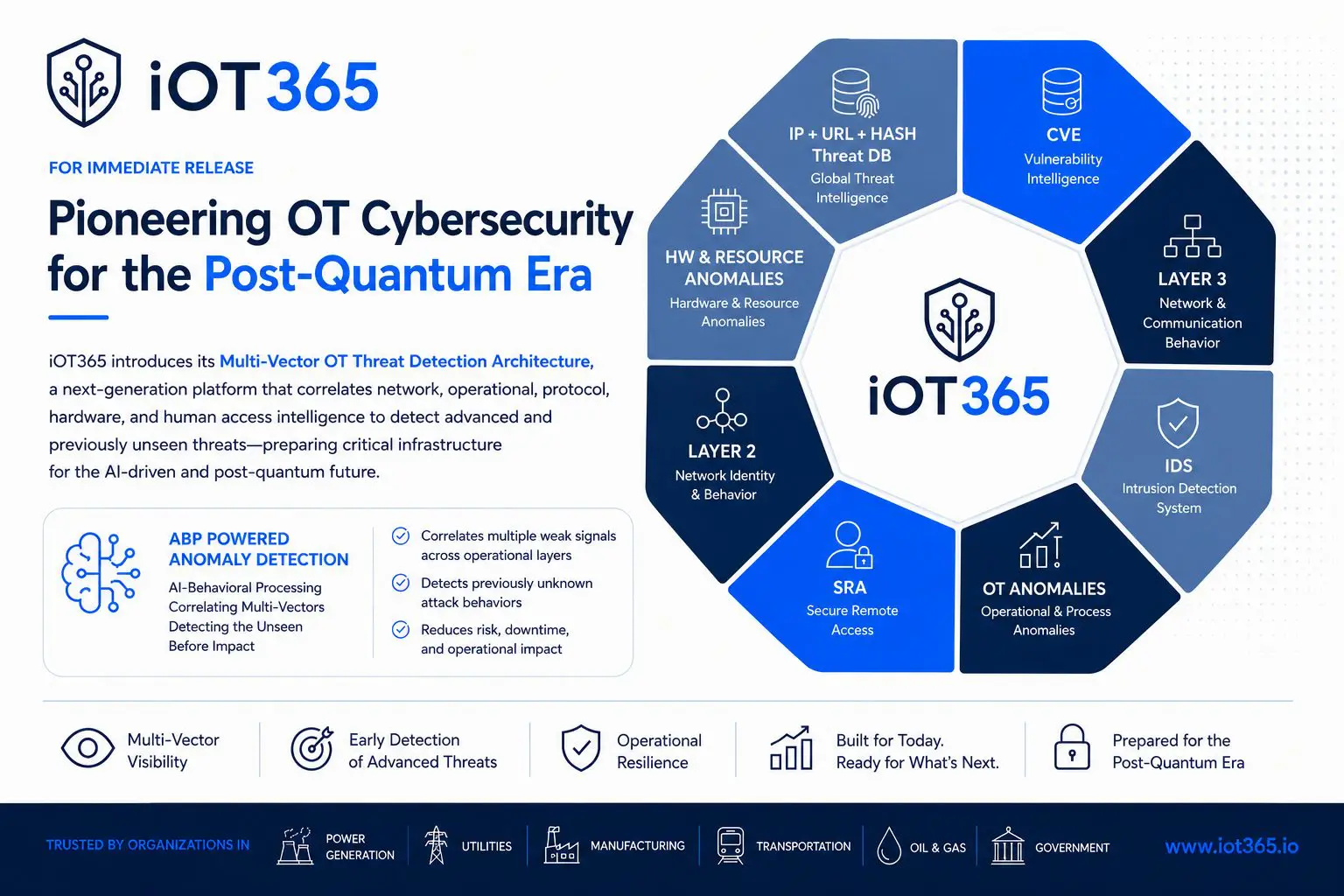
iOT365 is offering a new approach to threat detection that moves beyond decades of signature-based cybersecurity, correlating five distinct intelligence vectors, network, operational, hardware, industrial protocol, and remote access, to identify previously unseen attacks. The AI-powered OT cybersecurity platform’s Multi-Vector OT Threat Detection Architecture is designed to prepare critical infrastructure for increasingly sophisticated, AI-driven, and potentially post-quantum cyber threats. “The most significant cyber threats of the next decade may not resemble anything we have previously encountered,” says Alexander Tartakovsky, Founder & CEO of iOT365. By continuously evaluating operational behavior across these multiple sources, the platform aims to detect anomalous activity before it impacts operations, even when lacking historical precedent or known indicators.
Multi-Vector Detection Architecture for Unknown OT Threat Behaviors
Critical infrastructure faces an escalating challenge in cybersecurity; conventional methods are increasingly inadequate against novel attacks, prompting iOT365 to introduce its Multi-Vector OT Threat Detection Architecture. The architecture’s core innovation lies in its simultaneous evaluation of operational behavior across these diverse sources. Rather than isolating individual events, the platform seeks to identify coordinated anomalies that might indicate malicious activity, even in the absence of known threat signatures. This includes monitoring Layer-2 network behavior, Layer-3 communication patterns, industrial protocol activity, vulnerability intelligence, and hardware anomalies, alongside operational process behavior and secure remote access activity. During initial deployments, iOT365 successfully identified coordinated sequences of anomalous activities, unauthorized discovery, unexpected communications, abnormal hardware use, and new network identities, generating actionable alerts before any operational disruption occurred. A particularly crucial element of the system is its integration of Secure Remote Access as a security intelligence layer.
By centralizing management, monitoring, and auditing of remote connections, the platform can correlate user behavior with other operational events, providing a more holistic view of potential threats targeting a historically vulnerable attack surface. This approach is not merely reactive; it anticipates the evolution of cyberattacks, particularly those leveraging post-quantum computing capabilities. Tartakovsky emphasizes that this necessitates a detection model capable of identifying deviations from normal behavior, “regardless of whether the attack technique itself is known.” iOT365 currently deploys this unified architecture, combining OT IDS, SIEM, SOC Operations, Compliance Intelligence, Secure Remote Access, and AI-powered behavioral analytics, across power generation facilities and other critical infrastructure environments, aiming to bolster resilience against both present and future cyber threats.
The most significant cyber threats of the next decade may not resemble anything we have previously encountered.



See today’s quantum computing news on Quantum Zeitgeist for the latest breakthroughs in qubits, hardware, algorithms, and industry deals.