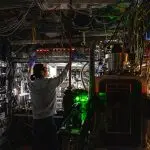
GRNET is coordinating the SEEWQCI project’s presentation at the European Quantum Technologies Conference (EQTC 2026) in Dublin, from November 30 to December 3. The event will gather representatives from academia, industry, and policymaking to discuss the future of quantum technologies as the EU prepares the Quantum Act and the next phase of the European Quantum Flagship.
Dr. Ilias Papastamatiou, Senior Project Manager and Technical Lead Net/Quantum at GRNET, will present “HellasQCI and SEEWQCI: From National Deployment to Cross-Border Quantum Connectivity,” detailing the expansion of quantum networks across four European nations. He will join speakers from the European Commission, the European Space Agency and ICFO to explore developments in quantum communication infrastructure.
SEEWQCI Project Presentation at EQTC 2026 in Dublin
The EQTC 2026 event, hosted at the Convention Centre Dublin from November 30 to December 3, is organized by the Irish Centre for High-End Computing (ICHEC) and Abbey Conferences. The session featuring Dr. Papastamatiou will also include Aymard de Touzalin, Head of Unit at the European Commission, Harald Mathias Hauschildt of the European Space Agency (ESA) and Prof. Antonio Acín, ICREA Professor at ICFO. Deirdre Kilbane, Director of Research at Walton Institute, SETU, will moderate the discussion, bringing together perspectives from European institutions and cross-border quantum communication initiatives.



See today’s quantum computing news on Quantum Zeitgeist for the latest breakthroughs in qubits, hardware, algorithms, and industry deals.