Every large organisation runs on cryptography it can no longer take for granted. The padlock on a customer login, the signature on a software update, the tunnel between two data centres and the archive of records kept for a decade all rest on the same public-key mathematics, and a sufficiently large quantum computer would unpick it. Enterprise quantum cybersecurity is the discipline of finding that exposure and replacing it before the machine arrives, and in 2026 it has moved from a research curiosity to a dated obligation with regulators attached.
This guide is written for the people who have to act on that, from the security architect drawing the migration plan to the board member signing it off. It explains what breaks and what survives, how close the threat really is, which standards and laws now govern the transition, how to structure a quantum-safe enterprise, and what a credible programme looks like in practice. The aim is a single reference for enterprise quantum cybersecurity that is honest about the timelines rather than alarmed about them.
The threat is specific, not general. Shor’s algorithm breaks the public-key cryptography behind RSA, Diffie-Hellman and elliptic curves, while symmetric encryption like AES-256 stays effectively safe. The migration is about replacing key exchange and signatures, not everything.
The standards already exist. NIST finalised its first post-quantum algorithms as FIPS 203, 204 and 205 in August 2024, so the tools an enterprise needs are published and ready to deploy.
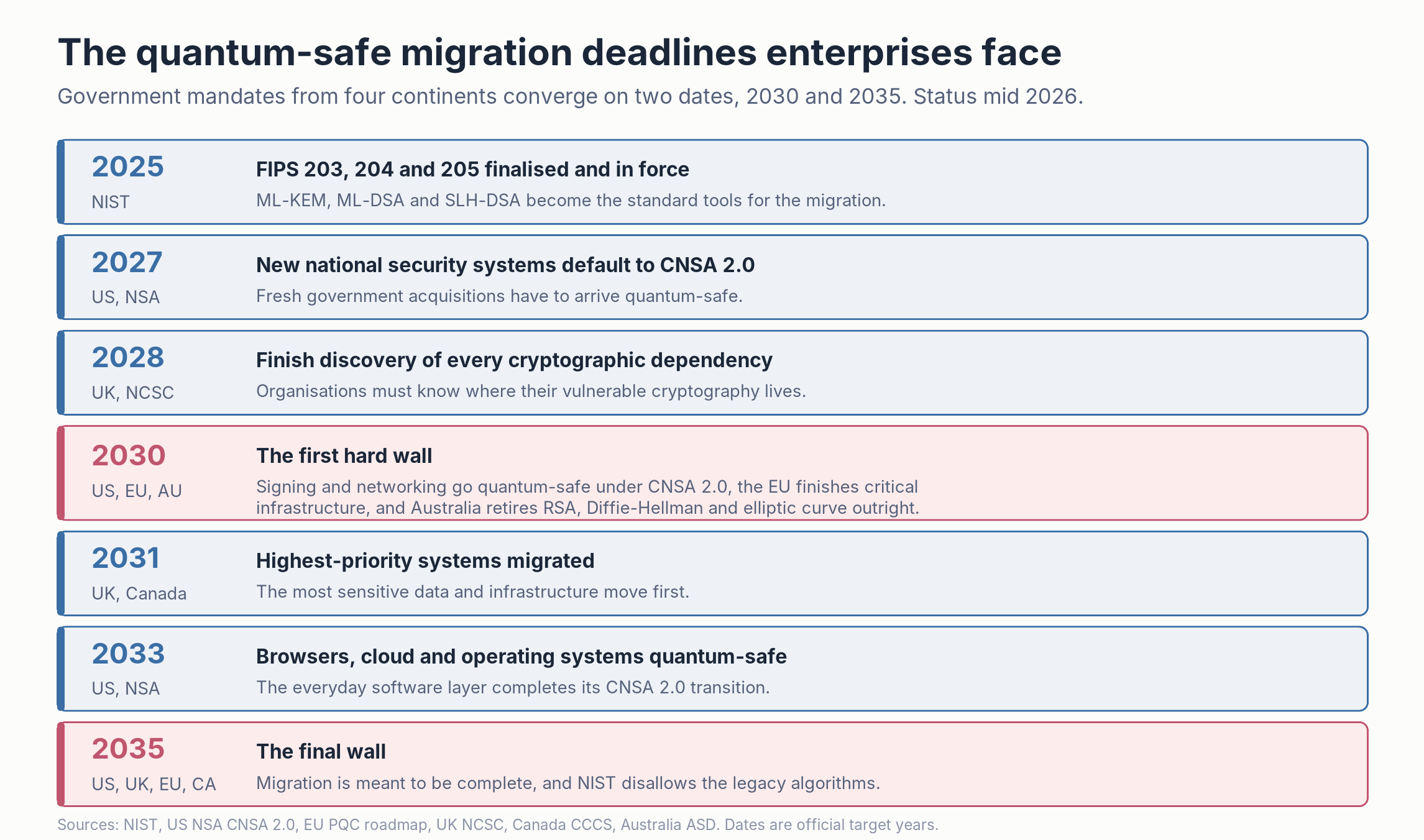
The deadlines are now regulatory. The United States, European Union, United Kingdom, Canada and Australia have all set migration dates that converge on 2030 and 2035, and some carry the force of law.
Harvest now, decrypt later means the clock started already. Data with a long shelf life that is intercepted today can be stored and decrypted after a quantum computer exists, so waiting is not a neutral choice.
Crypto-agility is the real deliverable. The lasting goal is not one swap of algorithms but the ability to change them again, which starts with knowing where all your cryptography lives.
Real firms have already migrated. Apple, Signal, Google, Cloudflare, Amazon and Microsoft have shipped post-quantum key exchange in production, which proves the transition is practical rather than theoretical.
What enterprise quantum cybersecurity means
Enterprise quantum cybersecurity is the practice of protecting a large organisation against the day its current encryption stops being trustworthy. It differs from ordinary security work in scale and in time horizon, because an enterprise runs thousands of systems with cryptography buried inside them, and because the risk it manages will not fully land for years. That combination of a huge surface and a slow fuse is exactly what makes the problem hard to govern.
The distinction matters because most security spending answers threats that are already active, from ransomware to phishing to misconfigured cloud. The quantum threat is different in kind, since it targets the cryptographic foundation that every other control quietly depends on. A firewall, a zero-trust identity system and an encrypted backup all assume that the underlying key exchange cannot be broken, and enterprise quantum cybersecurity is the work of making sure that assumption survives the next decade.
It is also a data problem before it is a cryptography problem. The first move in any serious programme is to learn what you are actually protecting and for how long it has to stay secret, because a session token that expires in an hour carries almost no quantum risk while a medical record or a state secret carries a great deal. Framing the effort around data lifetimes keeps enterprise quantum cybersecurity anchored to business value rather than to algorithm names.
What a quantum computer breaks, and what it does not
The single most useful fact in this whole field is that the quantum threat is narrow. Two quantum algorithms matter for cryptography, and they do very different things. Peter Shor’s algorithm efficiently factors large numbers and solves discrete logarithms, which is precisely the hard mathematics that public-key cryptography relies on, so it breaks RSA, Diffie-Hellman, and the elliptic-curve schemes ECDSA and EdDSA outright. The mathematics is not new, since Shor set it out in the 1990s, but the hardware to run it at scale is only now coming into view.
Lov Grover’s algorithm is the other one, and it is far less dramatic. It speeds up brute-force search, but only quadratically, which means it roughly halves the effective strength of a symmetric cipher rather than shattering it. Against AES-256 that leaves an effective 128 bits of security, which is still out of reach, and NIST has gone further and judged that Grover parallelises so poorly that AES-256 should stay secure for decades. The practical rule for enterprise quantum cybersecurity is that symmetric encryption and hashing survive with larger sizes, while public-key cryptography has to be replaced.
| Algorithm | Where it is used | Quantum attack | Verdict |
|---|---|---|---|
| RSA | TLS, code signing, VPNs, PKI | Shor’s algorithm recovers the private key from the public key. | Broken |
| Diffie-Hellman and ECDH | Key exchange in TLS, SSH and VPNs | Shor’s algorithm solves the discrete logarithm behind it. | Broken |
| ECDSA and EdDSA | Certificates, signatures, blockchains | Shor’s algorithm forges signatures once the curve is solved. | Broken |
| AES-256 | Bulk data encryption | Grover’s algorithm only halves the effective key length to 128 bits. | Safe |
| SHA-256 and SHA-384 | Hashing and integrity | Grover gives a quadratic speedup only, mitigated by longer digests. | Safe |
| ML-KEM (FIPS 203) | Post-quantum key exchange | No known quantum attack breaks the lattice problem it rests on. | Adopt |
| ML-DSA and SLH-DSA (FIPS 204, 205) | Post-quantum signatures | No known quantum attack, one lattice-based and one hash-based. | Adopt |
The table makes the shape of the work concrete. Everything a quantum computer breaks is used to establish trust between parties, to exchange a key or to sign a message, and everything it leaves standing is used to protect bulk data once trust exists. That is why the migration is often described as replacing the handshakes rather than re-encrypting the world, and why an accurate map of where those handshakes happen is worth more than any single product.
Harvest now, decrypt later
The reason this cannot wait for a working quantum computer is an attack strategy the security community calls harvest now, decrypt later. An adversary records encrypted traffic or steals encrypted archives today, stores them cheaply, and simply waits until a quantum computer can open them. The Global Risk Institute describes it plainly, noting that adversaries can already intercept, duplicate and archive encrypted communications for eventual later decryption.
For an enterprise the implication is uncomfortable but clear. Any secret that must stay confidential past the arrival of a capable machine is arguably exposed the moment it crosses a network in today’s cryptography, which is the heart of the harvest now, decrypt later problem. Long-lived data is the obvious casualty, including health records, financial histories, intellectual property, government secrets and the root keys that anchor a public-key infrastructure.
It is worth being precise about the evidence rather than dramatic. Intelligence agencies frame harvest now, decrypt later as a credible risk and a reason to act, using careful language about what adversaries may be doing rather than published proof that a named state is hoarding a specific dataset. That is the right posture for enterprise quantum cybersecurity too, since the case for migrating rests on the shelf life of your own data, not on a headline about anyone else’s.
How close Q-Day really is
Q-Day is the informal name for the moment a quantum computer can break the cryptography the world runs on, and estimating it is genuinely hard. The honest answer is a range rather than a date, and the range has been moving in one direction. In 2019 Craig Gidney and Martin Ekera estimated that factoring a 2048-bit RSA key would take about twenty million noisy qubits running for eight hours, a number that felt comfortably far off.
In 2025 Gidney revised that estimate down to fewer than one million noisy qubits in under a week, a roughly twenty-fold reduction driven by better algorithms and error correction rather than by bigger hardware. That kind of paper progress is why timelines keep compressing, and why the gap between today’s machines and a cryptographically relevant quantum computer is measured in engineering milestones rather than decades of certainty. It is important to keep logical qubits, which number in the thousands for such a task, separate from the physical qubits, which number in the hundreds of thousands or more.
Expert opinion tracks the same unease. The Global Risk Institute surveys leading researchers each year, and its 2024 report put the likelihood of a quantum computer breaking RSA-2048 within a single day at roughly a fifth to a third over a ten-year horizon, rising past even odds as the horizon stretches to fifteen. Michele Mosca’s simple inequality captures why that matters for planning, since if the years your data must stay secret plus the years your migration will take exceed the years until Q-Day, you are already late. For most enterprises with long-lived data, that sum is uncomfortably close.
The standards that define quantum safe
The good news underneath the threat is that the replacement cryptography is ready. After an eight-year global competition, NIST finalised its first post-quantum standards in August 2024, publishing FIPS 203 for key exchange, FIPS 204 for signatures and FIPS 205 for a hash-based signature scheme. These are the algorithms that enterprise quantum cybersecurity programmes are expected to deploy, and they run on ordinary hardware.
The three algorithms to build on
FIPS 203 defines ML-KEM, a lattice-based key-encapsulation mechanism derived from the scheme formerly called Kyber, and it is the workhorse for protecting key exchange in protocols like TLS. FIPS 204 defines ML-DSA, a lattice-based signature scheme from the design once called Dilithium, while FIPS 205 defines SLH-DSA, a conservative hash-based signature that trades larger signatures for security resting only on hash functions. Having both a lattice and a hash-based signature gives defenders mathematical diversity, so a future break in one family does not undo everything.
The set is still growing, which is a feature rather than a delay. In March 2025 NIST selected HQC, a code-based scheme, as a backup key-exchange standard built on different mathematics from the lattices, with standardisation expected around 2027. A Falcon-based signature is also on the way as a future FIPS, and it remains in draft rather than final as of mid-2026, so an enterprise planning today should build on the three finalised standards and treat the rest as welcome additions.
The deadlines are now the law
What turns enterprise quantum cybersecurity from prudent to mandatory is that governments have attached dates to it. In the United States the National Security Agency’s CNSA 2.0 suite requires new national security systems to default to quantum-safe algorithms from 2027, brings software signing and networking equipment to exclusive quantum-safe use by 2030, and completes the transition across all such systems by 2035. Federal civilian agencies march to a parallel drum, with Executive Order 14412 and the accompanying OMB memo M-26-15 in June 2026 pushing a government-wide migration and a target to mitigate as much risk as feasible by the end of 2030.
The same pattern repeats across the democracies. The European Union agreed a coordinated roadmap through its NIS Cooperation Group in 2025, asking member states to begin in 2026, secure critical infrastructure by 2030 and finish by 2035. The United Kingdom’s National Cyber Security Centre published a three-phase timeline that requires organisations to complete discovery of their cryptographic dependencies by 2028, migrate priority systems by 2031 and finish by 2035.
| Jurisdiction | What it requires | Key deadline |
|---|---|---|
| United States, NSA CNSA 2.0 | Quantum-safe algorithms across national security systems. | New systems 2027, signing and networking 2030, full transition by 2035. |
| United States, federal civilian | Executive Order 14412 and OMB memo M-26-15 drive a government-wide migration. | Mitigate as much quantum risk as feasible by the end of 2030. |
| European Union | A coordinated post-quantum roadmap agreed by the NIS Cooperation Group. | Members begin in 2026, critical infrastructure by 2030, complete by 2035. |
| United Kingdom, NCSC | A three-phase migration covering every system, service and product. | Finish discovery by 2028, priority systems by 2031, everything by 2035. |
| Canada, CCCS | A migration roadmap for government systems with annual reporting. | Departmental plans in 2026, high-priority systems by 2031, complete by 2035. |
| Australia, ASD | Retire classical public-key cryptography outright rather than layer over it. | Cease RSA, Diffie-Hellman and elliptic curve by the end of 2030. |
Two features of that table deserve emphasis for anyone planning enterprise quantum cybersecurity. First, the dates cluster, so a multinational cannot satisfy one regulator and ignore the rest, since 2030 and 2035 recur almost everywhere. Second, Australia is deliberately stricter than the pack, choosing to retire RSA, Diffie-Hellman and elliptic curve entirely by the end of 2030 rather than run them in hybrid, which is a useful signal of where the direction of travel ultimately points.
The United States also legislated the groundwork earlier than most realise. The Quantum Computing Cybersecurity Preparedness Act became law in December 2022 and directs federal agencies to inventory vulnerable systems and prioritise migration, while the earlier OMB memo M-23-02 set the expectation of cryptographic inventories. For a private enterprise these government timelines are not binding in themselves, yet they set the market clock that auditors, insurers and enterprise customers will increasingly measure suppliers against.
The layers of a quantum-safe enterprise
A migration this broad only stays manageable if it is organised by layer rather than tackled as one monolithic project. Identity and access is the natural starting point, because the certificates, tokens and key exchanges behind single sign-on and zero trust all use the vulnerable algorithms, and federated protocols are beginning to support hybrid post-quantum key exchange that can be enabled without rewriting applications. Getting the identity layer agile pays off everywhere else.
Data protection is the layer where harvest now, decrypt later bites hardest, so long-lived encrypted data and the key-management systems that guard it deserve early attention. Network and cloud is the layer where most public-key handshakes actually happen, in TLS sessions, VPN tunnels and service-to-service traffic, which makes it the largest and most visible part of the work. Endpoints and workloads add firmware and device identities that are signed with algorithms Shor’s algorithm can forge, and application security adds the hard-coded libraries and pinned certificates that make change slow.
Underneath all of them sits the cryptographic substrate, the actual algorithms and sources of randomness, and this is where post-quantum cryptography does most of the heavy lifting. Sitting alongside those technical layers is governance, the risk registers, board reporting and audit trails that turn enterprise quantum cybersecurity from an engineering task into a programme with an owner and a budget. Naming a single accountable leader for quantum readiness is one of the highest-value early moves an organisation can make.
Why crypto-agility is the real deliverable
The most important idea in modern enterprise quantum cybersecurity is that the migration should not be the last one. Cryptography has been changed before and will be changed again, and NIST itself frames post-quantum as a step in a continuing process rather than a final destination. Crypto-agility is the capability to swap algorithms across protocols, software and hardware without re-architecting everything each time, and it is the deliverable that outlasts any single standard.
You cannot migrate what you cannot see, so agility begins with a cryptographic inventory. That inventory is increasingly captured as a cryptographic bill of materials, a structured list of the algorithms, key lengths, certificates and dependencies an organisation runs, standardised as the CBOM extension to the widely used CycloneDX format. Treating the CBOM as a living artefact, updated as systems change, is what lets a security team answer the question every regulator will eventually ask, which is simply where all your vulnerable cryptography is. The United States has published a working blueprint for enterprise quantum cybersecurity through its national cybersecurity center, and it puts this inventory step first for exactly this reason.
Hybrid deployment is the pattern that makes agility safe in the transition. Running a classical algorithm and a post-quantum one together, so that a session stays secure as long as either holds, protects against both the quantum threat and any early weakness in the newer schemes. It is the approach that Google, Cloudflare and Amazon chose for their own rollouts, and it lets an enterprise adopt post-quantum key exchange without betting everything on cryptography that is only a few years old.
Post-quantum cryptography, QKD and quantum randomness
Buyers are often confused by three quantum-flavoured security technologies that solve different problems, and clarity here saves money. Post-quantum cryptography is software, a set of new mathematical algorithms that run on existing hardware and replace the vulnerable public-key schemes, and it is what every major standards body and the finalised NIST FIPS documents point to as the primary answer. For almost every enterprise it is the core of the plan.
Quantum key distribution is a different beast, using the physics of light over dedicated fibre or free-space links to share a key whose interception would be detectable. It offers a real property that mathematics cannot, but it needs special hardware, does not authenticate the sender on its own, and is limited by distance and cost. Both the United States National Security Agency and the United Kingdom’s National Cyber Security Centre explicitly recommend post-quantum cryptography over quantum key distribution for general government and enterprise use, which is a strong steer for anyone weighing the two.
Quantum random number generation is the third, and it solves yet another problem, supplying high-quality randomness from a physical quantum process to seed keys. Good randomness genuinely matters, since predictable keys undermine even perfect algorithms, but it is a complement to a migration rather than a substitute for one. The practical reading for enterprise quantum cybersecurity is that post-quantum cryptography is the mandatory core, while quantum key distribution and quantum randomness are optional additions for the highest-assurance links.
The migration is already happening
The strongest argument that this is practical rather than theoretical is that some of the largest technology companies have already shipped it to billions of users. Apple rebuilt iMessage in early 2024 on a protocol called PQ3 that uses the standardised ML-KEM key exchange in a hybrid with classical cryptography, and Signal added a post-quantum layer called PQXDH to its handshake in late 2023. These are not pilots, they are defaults running in consumer products at global scale.
From messaging apps to cloud platforms
The infrastructure layer followed quickly. Google enabled hybrid post-quantum key exchange in Chrome and across its services, Cloudflare rolled it out across its network and out to origin servers, and Amazon Web Services added ML-KEM-based key exchange to its Key Management Service, Certificate Manager and Secrets Manager in 2025. Microsoft has brought ML-KEM and ML-DSA to Windows and its cryptographic libraries, which means the building blocks are now arriving inside the platforms enterprises already run.
Regulated industries are moving too, if more cautiously. Telecom operators have trialled quantum-safe connectivity, with Vodafone and SandboxAQ demonstrating a post-quantum virtual private network on ordinary smartphones, and financial and government bodies have run their own pilots. The lesson for enterprise quantum cybersecurity is that the reference implementations exist, the interoperability problems are being found and fixed in public, and a team starting now is following a path rather than clearing one. The post-quantum cryptography companies building tooling around these standards make that path shorter still.
A practical roadmap for the enterprise
A credible programme breaks into three moves that map neatly onto the regulators’ own phases. The first is to discover and quantify, which means building the cryptographic inventory, classifying data by how long it must stay secret, and translating the resulting quantum risk into the language of the enterprise risk register. This is also the moment to name a programme owner and to put a short, honest paper in front of the board, since the migration needs a budget and a mandate before it needs a single new algorithm.
The second move is to pilot and prove. A sensible pilot picks two or three high-value, low-complexity systems, often internal service-to-service TLS, and runs hybrid post-quantum key exchange in production to surface the real interoperability and performance issues before they matter. It is also the point to update vendor due-diligence questions so that suppliers must show a post-quantum roadmap, because much of an enterprise’s cryptography lives in software it buys rather than writes.
The third move is to scale and certify, extending hybrid post-quantum protection across customer-facing services, VPNs and email, integrating the cryptographic bill of materials into continuous compliance, and testing the plan against the assumption that a chosen algorithm might later need replacing. Done in that order, enterprise quantum cybersecurity becomes a rolling programme with a defensible story for auditors and customers, rather than a panic in 2034. The organisations that begin discovery now are the ones that will still have slack when the 2030 deadlines arrive.
What it costs to wait
The economics favour early movers for a reason that has nothing to do with quantum computers arriving on schedule. Migrations of this size are slow, and cryptography is notoriously hard to find and change once it is embedded across microservices, devices and third-party integrations, so the work takes years whatever the threat timeline. NIST’s own guidance already schedules the retirement of RSA and elliptic curve, deprecating them around 2030 and disallowing them after 2035, which sets a hard boundary independent of any single machine.
The cost of getting security wrong more broadly is well measured, even if the quantum-specific bill is not. IBM’s 2025 Cost of a Data Breach study put the global average breach at about 4.44 million dollars and the United States average at over ten million, which is the scale of loss that a broken cryptographic foundation could expose at once rather than one incident at a time. Set against numbers like those, the investment in enterprise quantum cybersecurity reads less like insurance against an exotic risk and more like ordinary diligence on the controls a business already depends on.
There is also a competitive edge in moving first. Enterprise customers, insurers and regulators are beginning to ask suppliers for evidence of a post-quantum plan, and a firm that can show a cryptographic inventory and a dated roadmap will win trust that a laggard cannot. The clearest way to understand quantum readiness is as a capability you build once and reuse, which is why the sooner an organisation starts, the cheaper and calmer the whole transition becomes.
What is post-quantum cryptography
Harvest Now, Decrypt Later
What is Q-Day
The CRQC threshold
Post-quantum cryptography companies
Quantum key distribution
Frequently asked questions
What is enterprise quantum cybersecurity in one sentence?
It is the practice of protecting a large organisation against the day quantum computers can break its current public-key cryptography, by finding where that cryptography is used and replacing it with post-quantum algorithms before a capable machine exists. In practice it combines a cryptographic inventory, a migration to the new NIST standards, and the crypto-agility to keep changing algorithms in future.
Does a quantum computer break all encryption?
No, and this is the most important thing to understand. Shor’s algorithm breaks public-key cryptography such as RSA, Diffie-Hellman and elliptic curves, which are used for key exchange and signatures, but symmetric encryption like AES-256 and hashing like SHA-384 stay effectively safe because Grover’s algorithm offers only a quadratic speedup. The migration replaces the handshakes and signatures, not bulk data encryption.
When will quantum computers be able to break RSA?
Nobody knows precisely, but the credible expert range points to the early-to-mid 2030s rather than to today. Surveys of researchers give a roughly one-in-five to one-in-three chance of breaking RSA-2048 within a decade, and published resource estimates have fallen sharply, from twenty million qubits in 2019 to under a million in 2025. Because migration takes years and some data must stay secret for decades, the practical deadline to act is well before any machine arrives.
What is harvest now, decrypt later?
It is the strategy of recording encrypted data today and storing it until a quantum computer can decrypt it later. It matters because any secret with a long shelf life, such as health records, intellectual property or root keys, is effectively exposed the moment it travels in today’s cryptography. This is why enterprises with long-lived data cannot treat the quantum threat as a purely future problem.
Which algorithms should an enterprise adopt?
Start with the three finalised NIST standards, which are ML-KEM in FIPS 203 for key exchange, and ML-DSA and SLH-DSA in FIPS 204 and 205 for signatures. Deploy them in a hybrid with existing classical algorithms so a session stays secure if either holds, which is the pattern the major technology firms have chosen. A code-based backup called HQC and a Falcon-based signature are on the way to add mathematical diversity.
Is post-quantum cryptography or quantum key distribution the answer?
For almost every enterprise the answer is post-quantum cryptography, which is software that runs on existing hardware and is what NIST standardised. Quantum key distribution offers a physics-based property but needs dedicated hardware, does not authenticate the sender and is limited by distance and cost, and both the United States NSA and the United Kingdom NCSC recommend post-quantum cryptography over it for general use. Quantum key distribution can still suit a small number of very high-assurance links.
What deadlines does my organisation actually face?
It depends on where you operate, but the dates cluster tightly. United States national security systems must complete their transition by 2035 with major milestones in 2030, the European Union asks for critical infrastructure by 2030 and completion by 2035, the United Kingdom sets discovery by 2028 and completion by 2035, and Australia will retire classical public-key cryptography by the end of 2030. Even private firms are increasingly measured against these dates by auditors, insurers and enterprise customers.
Where should a security team start on Monday?
Begin with discovery, because you cannot migrate what you cannot see. Build a cryptographic inventory, capture it as a cryptographic bill of materials, and classify your data by how long it must remain confidential so you can prioritise the long-lived secrets. Then name an accountable owner and pilot hybrid post-quantum key exchange on a low-risk internal system to learn the practicalities before scaling.
What is crypto-agility and why does it matter?
Crypto-agility is the ability to change cryptographic algorithms across your systems without re-architecting them, and it matters because post-quantum will not be the last transition. Building agility now, through a maintained cryptographic inventory and clean abstractions around cryptography, means the next change is a configuration update rather than another multi-year project. It is the capability that turns a one-off migration into lasting resilience.




See today’s quantum computing news on Quantum Zeitgeist for the latest breakthroughs in qubits, hardware, algorithms, and industry deals.