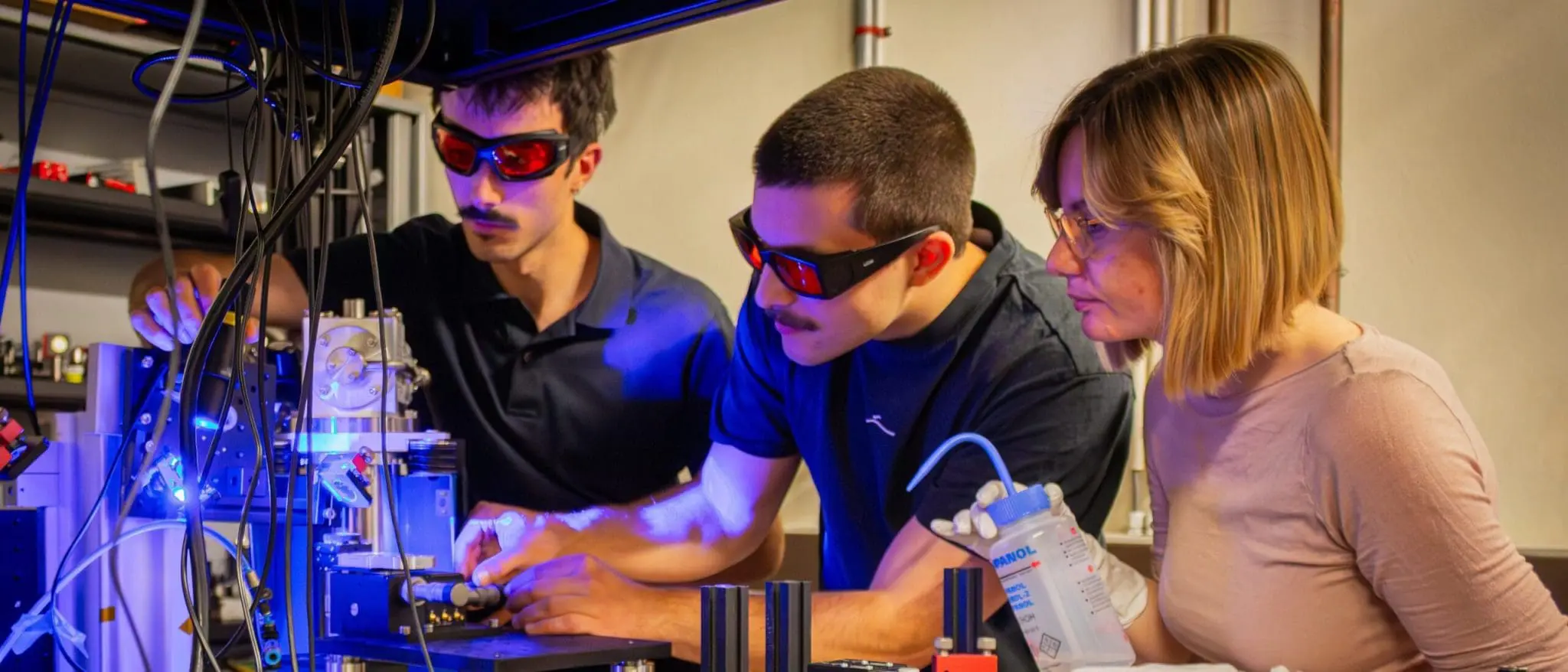
QuTech researchers have demonstrated a crucial step toward faster, more reliable quantum networks by efficiently coupling a diamond-based quantum emitter to a nanoscopic optical cavity. The team measured 327 devices with a high average quality and yield, signaling a promising path toward scaling up these networks, a key hurdle for practical implementation. This interface combines the ability of diamond to store and process quantum information with photons for long-range links between nodes, addressing a fundamental challenge in quantum internet development. Achieving coherent interaction between the emitter and light was particularly critical, and the researchers demonstrated near-complete control over transmitted light, which could enable powerful quantum protocols.
Diamond SnV Centres Integrated with Nanophotonic Cavities
Hundreds of nanoscale optical cavities fabricated with high yield represent a significant advance in the pursuit of practical quantum networks. The team’s work, published in PRX, addresses a key challenge in building a quantum internet: efficiently interfacing stationary qubits with photons for long-distance transmission of quantum information. Future quantum networks will depend on reliable handshakes between two different carriers of quantum information: solid-state qubits that can store and process information, and photons that can carry it between distant nodes. A promising approach utilizes colour centres in diamond, specifically tin-vacancy centres, or SnV, which act as atom-like quantum systems with an inherent connection to light. By integrating SnV centres with optical cavities that trap light, researchers aim to facilitate protocols for linking network nodes.
Maintaining coherence, ensuring the photon and emitter remain synchronized, has proven difficult, particularly in nanoscale devices susceptible to noise. The QuTech team constructed diamond photonic crystal cavities and embedded SnV centres within the strongest points of trapped light. In highlighted devices, the cavity significantly amplified the SnV’s photon emission into the desired optical mode, and a single SnV could almost completely shut off light transmission through the cavity, demonstrating strong control over light particles. They report a scalable fabrication outcome: across two separate chips they measured 327 devices with a high average quality and yield, important because future quantum networks will need many such devices, not just one.
Ronald Hanson, who supervised the research, explains that this result signals useful quantum interactions can dominate over dephasing noise, opening the door to faster and more reliable entanglement generation between remote nodes. He also notes this result is important for efficiently linking qubit modules into one large computer, in collaboration with Fujitsu. The team achieved coherent cooperativities above one, a threshold indicating suitability for high-fidelity quantum operations.
Coherent Coupling Achieved with Above-Unity Cooperativity
The pursuit of a functional quantum internet increasingly focuses on bridging the gap between stationary qubits and flying photons, demanding robust interfaces capable of both storing and transmitting quantum information. Researchers are now refining methods to couple solid-state qubits with photons, and a recent demonstration from QuTech details a significant advance in achieving coherent control over this interaction. The team fabricated diamond photonic crystal cavities, nanoscale structures designed to trap and concentrate light, and embedded tin-vacancy (SnV) centres within these cavities to serve as the material qubit interface. This approach yielded a scalable fabrication outcome, with the researchers reporting measurements from 327 devices with a high average quality and yield across two separate chips. This is a crucial step, as future quantum networks will require a multitude of these devices, not simply a single proof-of-concept. Beyond fabrication success, the team demonstrated near-complete control over transmitted light, a necessity for reliable quantum information transfer and minimizing errors. The achievement extends beyond simply emitting light; the researchers quantified the coherence of the interaction using optical linewidths, demonstrating coherent cooperativities above one. This threshold is widely recognized as indicating a regime suitable for high-fidelity quantum operations. Ronald Hanson, who supervised the research, explains that this result signals useful quantum interactions can dominate over dephasing noise, opening the door to faster and more reliable entanglement generation between remote nodes. Ronald Hanson notes the importance of this result for efficiently linking qubit modules into one large computer, in collaboration with Fujitsu.
This research benefitted from financial support from the joint research program “Modular quantum computers” by Fujitsu Limited and Delft University of Technology co-funded by the Netherlands Enterprise Agency under project number PPS2007, from the Dutch Research Council (NWO) through the Spinoza prize (project number SPI ), from the Dutch Ministry of Economic Affairs and Climate Policy (EZK) as part of the Quantum Delta NL programme , from the Quantum Internet Alliance through the Horizon Europe program (grant agreement No. ) and from The Kavli Foundation through the Kavli Institute Innovation Award “Quantum Materials for Broad-Band Quantum Transduction”.
Scalable Fabrication Yields High-Quality Devices
The pursuit of practical quantum networks received a boost from work at QuTech, where researchers are refining the fabrication of diamond-based quantum devices. This achievement addresses a key hurdle in translating laboratory demonstrations into deployable networks, as numerous high-performance devices will be required, not isolated successes. These SnV centres, acting as material qubits, offer a potentially stable platform for quantum information storage and processing due to their unique atomic-like properties within the diamond lattice. The team reports measuring 327 devices with a high average quality and yield. Future quantum networks will depend on reliable handshakes between two very different carriers of quantum information: solid-state qubits that can store and process information, and photons that can carry it between distant nodes.
Ronald Hanson, who supervised the research, explains that this result signals useful quantum interactions can dominate over dephasing noise, opening the door to faster and more reliable entanglement generation between remote nodes. He further notes the importance of this result for efficiently linking qubit modules into one large computer, in collaboration with Fujitsu. This scalable approach and demonstrated control represent a significant step toward realizing robust and efficient quantum networks.



See today’s quantum computing news on Quantum Zeitgeist for the latest breakthroughs in qubits, hardware, algorithms, and industry deals.