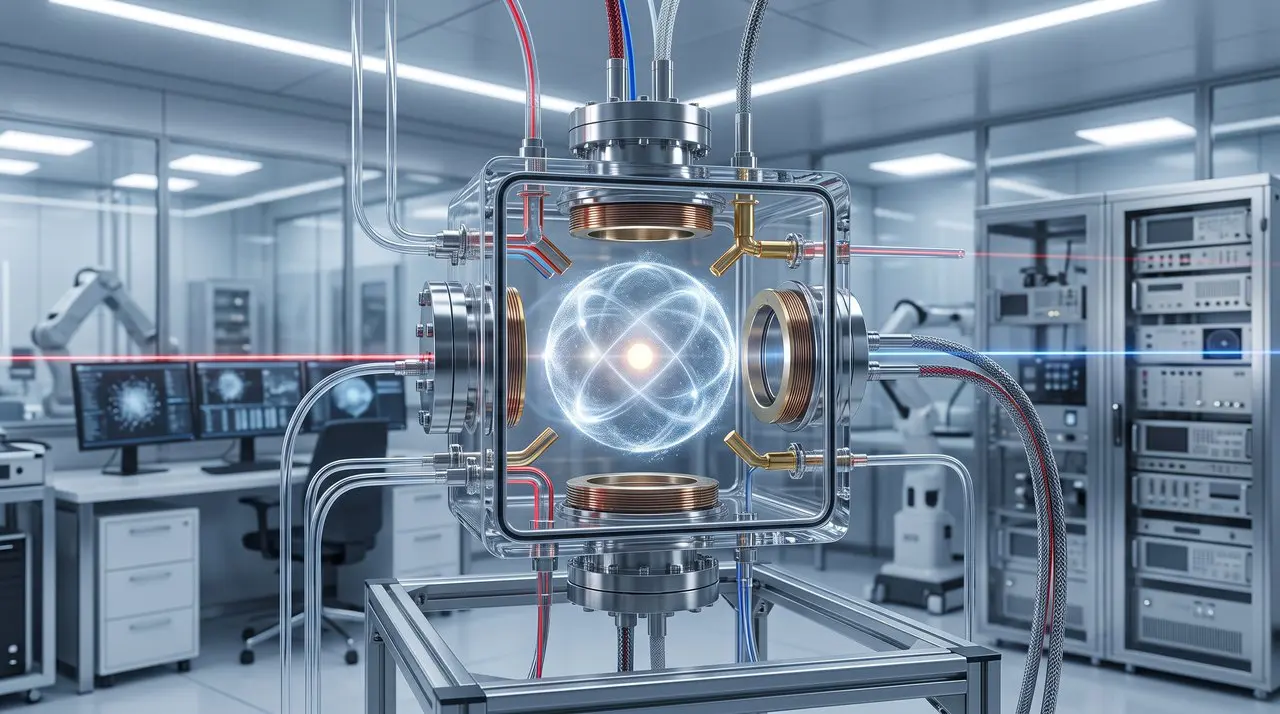
Until now, calibrating nitrogen-vacancy (NV) centres in diamond for precise magnetic field sensing has relied on extensive data collection and been hampered by inaccuracies arising from real-world conditions. A physics-guided machine learning framework developed at California State University and Ulsan National Institute for Science and Technology embeds known physical relationships into the calibration process, representing a substantial leap forward. Researchers have created a new calibration method for diamond sensors that measure magnetic fields with high sensitivity.
This technique merges established physics principles with machine learning; it allows accurate readings even when only limited experimental data exists. The team’s approach addresses challenges faced by these sensors when deployed outside controlled laboratory settings due to signal fluctuations and noise. By incorporating known physical relationships into the training process, the framework significantly improves precision compared to conventional methods reliant on large datasets.
The researchers and Ulsan National Institute for Science and Technology have developed a new calibration method to improve the accuracy of diamond-based sensors used for detecting magnetic fields. These sensors rely on tiny defects within diamonds, nitrogen-vacancy (NV) centres, which act like miniature compass needles exceptionally sensitive to magnetism.
A key principle behind their operation is Zeeman splitting; imagine tuning forks vibrating at slightly different frequencies when exposed to a magnet, this describes how a magnetic field alters energy levels within atoms detected by these sensors. The team’s approach tackles issues arising from signal fluctuations in real-world conditions, processing optical detection of magnetic resonance data akin to isolating faint radio signals amidst static noise.
Physics-informed machine learning enhances diamond nitrogen-vacancy centre magnetic field calibration
Scientists and Ulsan National Institute for Science and Technology have achieved a 372-fold precision improvement in tracking error when calibrating nitrogen-vacancy (NV) centres in diamond compared with standard statistical methods. The new framework functions effectively even with sparse empirical measurements, combined with synthetically generated datasets to overcome previous limitations requiring vast amounts of data. This physics-guided hybrid machine learning approach embeds known physical relationships, specifically Zeeman splitting, the alteration of energy levels within atoms exposed to magnetism, directly into the calibration process, enabling strong magnetic field sensing.
Incorporation of these principles addresses discrepancies between simulations and real-world conditions that previously limited deployment of sensitive vector magnetometry devices. As a result of this physics-guided framework, average tracking error reduced sharply, demonstrating a 372-fold precision improvement over purely statistical baselines which initially exhibited an error rate of 0.189 Gauss. Further refinement using an ensemble architecture compressed the average error down to 0.00051 Gauss while also restricting standard deviation to 0.0153 Gauss; this indicates increased reliability in readings across varying magnetic fields.
The original statistical approach saw a cumulative precision improvement of 99.73%, culminating in the reported 372-fold enhancement validated by comparing predicted and measured values from one thousand independent samples. Translating performance from controlled settings to real-world environments has long been a persistent challenge for nitrogen-vacancy (NV) centre magnetometry, despite its promise for advances in areas like geological mapping and medical diagnostics. The team acknowledges that defining these relationships requires some initial physical understanding, meaning it is not a fully automated solution applicable where data may be extremely limited or absent altogether. However, achieving this nearly four-hundredfold improvement represents substantial progress towards practical applications outside highly controlled laboratory conditions such as geological surveys and medical imaging. It overcomes limitations inherent in statistical methods reliant on extensive datasets by seamlessly integrating limited physical measurements with synthetically generated data accounting for real-world hardware imperfections.
The research demonstrated a 372-fold precision improvement in tracking error when measuring magnetic fields using nitrogen-vacancy centres in diamond. By combining sparse physical measurement with synthetic data generation, the framework addresses discrepancies between simulations and experimental results which previously hindered sensor calibration. The resulting system accurately decoded raw experimental data, reducing average error from 0.189 Gauss to 0.00051 Gauss; authors suggest this method is applicable to other systems where obtaining large datasets proves difficult.
👉 More information
🗞 Physics-guided machine learning for sim-to-real calibration of NV diamond magnetometers
✍️ Jonathan Daniel, Martin Y. Kim, Jesse Hernandez, Emanuel Suarez, Sangwoo Lee, Jinhee Lee and Je-Hyung Kim
🧠 ArXiv: https://arxiv.org/abs/2608.19582



See today’s quantum computing news on Quantum Zeitgeist for the latest breakthroughs in qubits, hardware, algorithms, and industry deals.