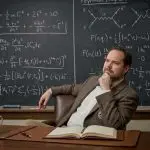
A physicist by training who became co-founder and chief executive of Anthropic, one of the leading laboratories building frontier artificial intelligence.
He is a physicist who ended up running an AI laboratory. Dario Amodei trained in physics and computational neuroscience before moving into machine learning. The empirical habits came with him.
He was vice president of research at OpenAI before leaving. The scaling-law work he was part of shaped how the whole field now spends money. He left OpenAI at the end of 2020 and co-founded Anthropic the following year.
Anthropic was founded around a safety argument. The stated reason for starting a new laboratory was that frontier systems needed to be built differently. Whether that holds is a fair question to keep asking.
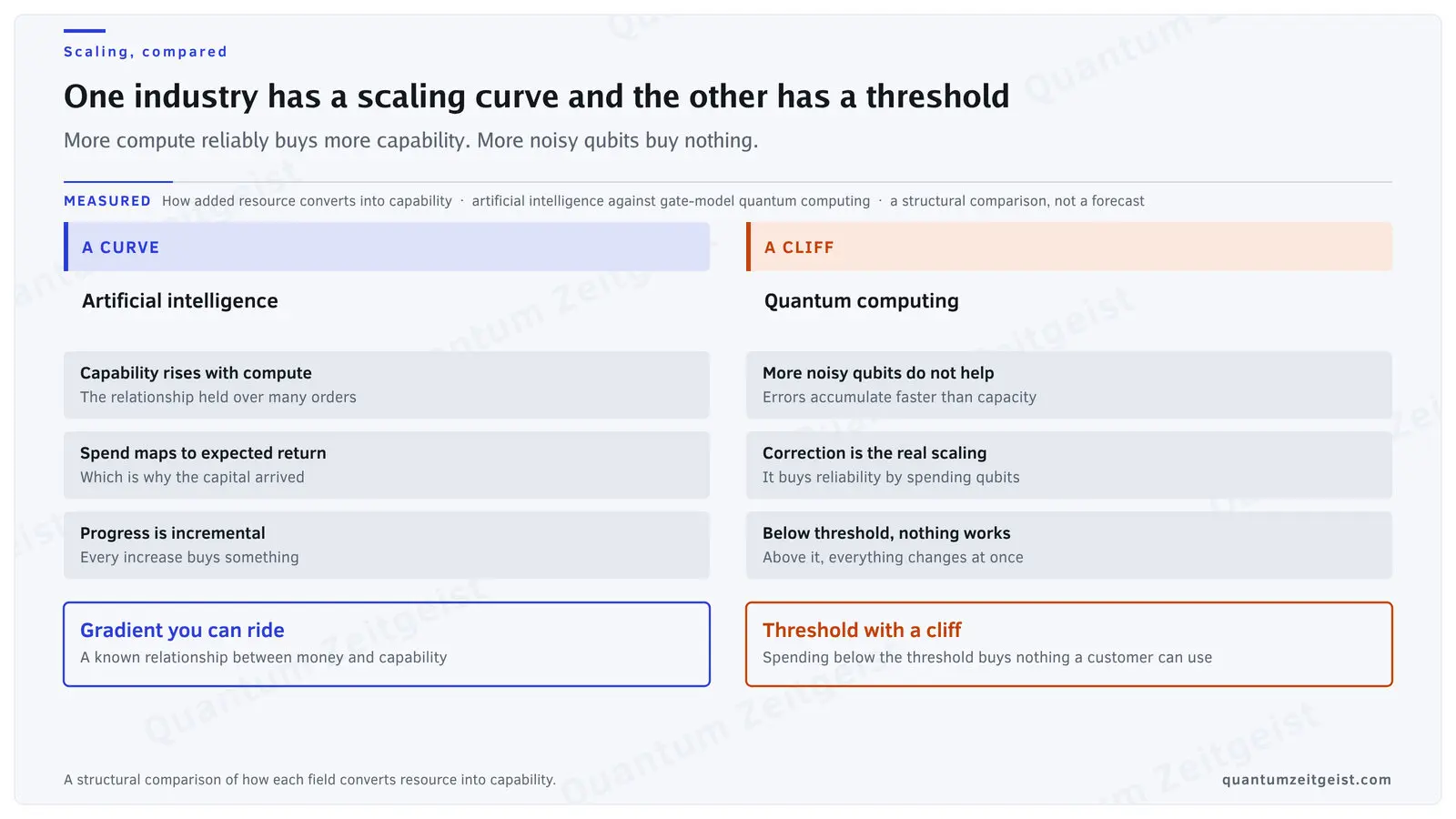
Quantum and AI are on opposite scaling curves. AI capability has followed compute reliably for a decade. Quantum computing has not, and the two industries are not comparable on that axis.
Quantum machine learning claims less than the name suggests. Most published speedups rest on assumptions about loading classical data into a quantum machine. That step is usually the bottleneck.
Both fields keep running into the same compute question. Training runs and error-corrected quantum machines both need capital before they return anything. That shapes who can compete in either.
- A physicist and neuroscientist running an AI company
- From physics to artificial intelligence
- The OpenAI years and scaling laws
- Founding and leading Anthropic
- A public voice on AI safety
- Where AI meets quantum computing
- The empirical mind behind the work
- He builds no quantum machines and competes for the same people
- What quantum machine learning can and cannot claim
- Two industries with opposite scaling curves
- Why one of these technology risks is tractable
- The compute question both fields keep running into
- The empirical style that both fields ended up adopting
- Frequently asked questions
A physicist and neuroscientist running an AI company
Dario Amodei is an American AI researcher and entrepreneur who co-founded and now leads Anthropic, an AI safety and research company that builds the Claude family of models. He was born in San Francisco in 1983, and his path to the top of artificial intelligence ran through physics and neuroscience rather than through computer science alone. That unusual route shapes how he thinks about scale, measurement, and the behaviour of complex systems.
Within the AI community, Amodei is known for combining technical depth with a public voice on safety and policy. He argues that powerful AI systems can bring large benefits while also carrying serious risks, and he has built a company explicitly around that tension. His prominence has grown alongside the rapid rise of large language models since 2020.
An entrepreneur with a scientist’s instincts
Before he was a chief executive, Dario Amodei was a working scientist who published peer-reviewed research. He carries that empirical habit into business decisions, favouring careful measurement of how AI systems improve as they grow. This profile sets out what is firmly known about his career and explains, honestly, where his work touches the quantum computing world and where it does not.
His public stature has risen sharply as large language models have moved from research curiosities to widely used tools. Major outlets have repeatedly named him among the most influential people in technology, and his company sits at the centre of debates about the future of computing. For quantum readers, he is a useful figure to understand because his decisions ripple across the whole frontier-technology sector.
From physics to artificial intelligence
Amodei studied physics as an undergraduate at Stanford University, having begun his university studies at Caltech before transferring. He then earned a PhD in biophysics from Princeton University, where his doctoral work concerned the electrophysiology of neural circuits. He went on to a postdoctoral fellowship at the Stanford University School of Medicine, working on computational methods for biological data.
This grounding in physics and quantitative biology matters for understanding him. Physics trains people to look for simple laws that govern messy systems, and that mindset later proved central to how he and his colleagues studied artificial intelligence. The same instinct for finding underlying regularities reappears in his most influential technical contributions.
Why a physics background still counts
It would be inaccurate to call Amodei a quantum physicist, and this profile does not claim that. His doctoral and postdoctoral research sat in biophysics and computational neuroscience, not in quantum information or quantum hardware. What he carries from physics is a way of thinking about complex systems and scaling behaviour, and that is the honest bridge between his training and the frontier sciences that include quantum computing.
The OpenAI years and scaling laws
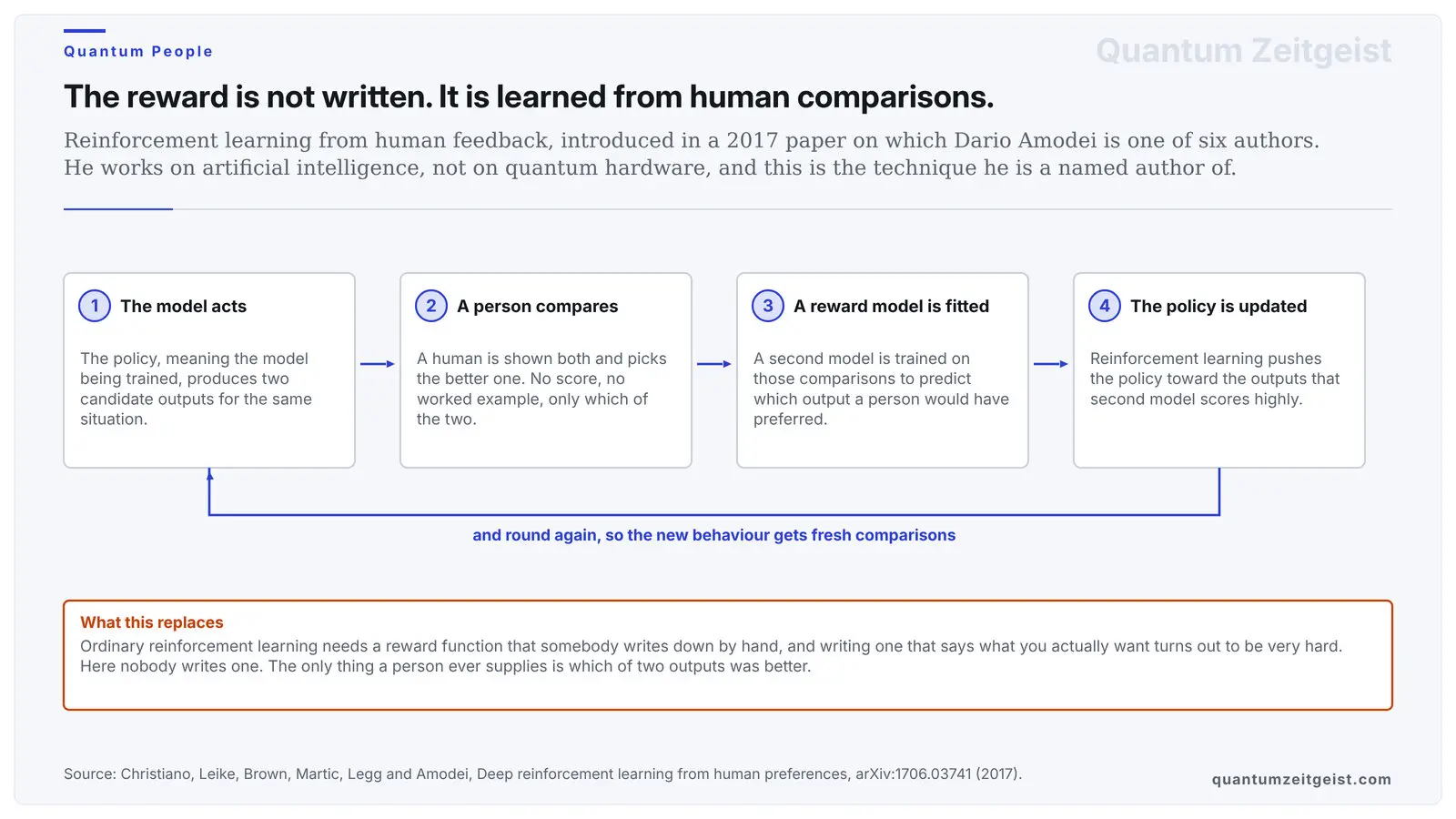
Before founding his own company, Amodei served as Vice President of Research at OpenAI. He is a senior author on both the GPT-2 and the GPT-3 papers, and by his own account he led the development of those models. He had earlier worked at Baidu and then at Google, and he is one of six authors of the 2017 paper Deep reinforcement learning from human preferences, which introduced the technique now generally called reinforcement learning from human feedback.
His best known scientific contribution is his role in documenting the scaling laws of AI. These laws describe how AI systems get predictably better at a wide range of cognitive tasks as you add more compute and data. The discovery of such regularities echoes the kind of empirical lawfinding that physics has long pursued.
Predictable progress from added compute
The scaling insight reshaped how the whole field plans its research. If capability rises in a measurable way with scale, then progress becomes something to forecast rather than merely hope for. That perspective informs how Amodei now runs Anthropic and how he talks publicly about where AI is heading.
Founding and leading Anthropic
In 2021 Amodei co-founded Anthropic together with his sister Daniela Amodei and a group of former OpenAI colleagues. The company is structured as a public benefit corporation and frames its mission around building AI systems that are steerable, interpretable, and safe. Its flagship products are the Claude models, which compete at the frontier of large language models.
As chief executive, Amodei has overseen Anthropic’s growth into one of the most closely watched AI companies in the world. Anthropic raised $65 billion in a Series H round announced on 28 May 2026, at a $965 billion post-money valuation. Four days later it confidentially submitted a draft S-1 to the Securities and Exchange Commission. Both figures are the company’s own announcements. He continues to combine the roles of research leader and business builder.
Anthropic invests heavily in interpretability research, which tries to understand what is happening inside neural networks rather than treating them as black boxes. That emphasis reflects Amodei’s view that safety and capability should advance together. It also keeps the company close to fundamental science even as it ships commercial products.
Building a frontier lab from scratch
Starting a frontier AI lab in 2021 meant competing for scarce talent, compute, and capital against far larger incumbents. Under Dario Amodei the company chose to make safety and interpretability part of its identity rather than an afterthought. That decision has shaped both its research agenda and the way it presents itself to regulators and the public.
A public voice on AI safety
Amodei has become one of the more prominent voices arguing that advanced AI deserves serious caution as well as ambition. He writes and speaks regularly about both the benefits and the risks of powerful systems, and he has engaged with policymakers on questions of governance and security. His positions place him among the leaders who take long-term AI risk seriously while still building the technology.
In October 2024 he published a long essay titled Machines of Loving Grace, which describes an optimistic vision of what powerful AI could achieve if it is developed safely, and in January 2026 he followed it with The Adolescence of Technology, which works through five categories of risk. The essay sketches possible gains in biology, neuroscience, economic development, and human wellbeing within a relatively short horizon. It is widely cited as a clear statement of his worldview.
Optimism paired with caution
What stands out in his public writing is the pairing of hope and restraint. He argues that the upside of AI is enormous, yet he insists that the path there must be managed carefully. That stance has made him a notable figure in debates that reach well beyond engineering.
Where AI meets quantum computing
Amodei’s direct contributions are to artificial intelligence rather than to quantum hardware, and it is worth stating that plainly. He has not built quantum processors, designed error-correcting codes, or published quantum algorithms. His relevance to the quantum world is conceptual and contextual rather than hands-on, and any honest profile should keep that distinction clear.
Even so, the AI frontier that Dario Amodei helps lead and the quantum computing frontier increasingly run alongside each other. Both are frontier technologies that demand enormous research investment, specialised talent, and long planning horizons, and the two communities watch each other closely. At times they compete for attention and capital, and at other times they look complementary, with quantum machines potentially accelerating parts of computation that classical AI systems find hard.
The competition is real and worth naming clearly. Investment that flows toward one frontier can pull resources and headlines away from the other, and quantum research has long had to make its case against the louder momentum of AI. Understanding leaders like Amodei helps quantum readers read that competitive map accurately rather than guessing at it.
Quantum machine learning as a meeting point
One concrete place the fields overlap is quantum machine learning, where ideas from AI are applied to quantum systems and quantum resources are explored for learning tasks. Researchers in that area draw on the same statistical thinking that powers modern AI, the kind of thinking Amodei helped advance. His physics training also means he speaks a language that overlaps with the quantum research community, even though his own output sits firmly on the AI side.
The empirical mind behind the work
A recurring theme across Amodei’s career is a preference for measurement over speculation. From neural electrophysiology to AI scaling laws, his work has centred on finding patterns in data and then testing how far those patterns hold. This is the same empirical temperament that drives experimental physics, and it explains why a physicist’s habits keep showing up in his approach to AI.
That mindset has practical consequences for how Anthropic operates. The company treats capability and safety as things to be measured and tracked rather than asserted, which keeps its research grounded in evidence. For readers coming from the quantum side, this is a familiar stance, since quantum experiments live or die by careful measurement too.
Dario Amodei’s story is therefore a useful reminder that the frontier sciences share more than rivalry. The skills of careful experiment, honest uncertainty, and respect for scale travel between AI and quantum research. He embodies that shared scientific culture even while working squarely in artificial intelligence.
This is also why a quantum audience can learn from how he frames technological progress. He treats capability as something that grows in measurable steps, and he insists that uncertainty be stated rather than hidden. Those are the same disciplines that keep quantum experiments honest, and they make his thinking legible to physicists even when the subject is AI.
He builds no quantum machines and competes for the same people
Dario Amodei matters to a quantum computing audience not because he builds quantum machines, but because he leads one of the two great computing frontiers of this era. Artificial intelligence and quantum computing are reshaping how we think about computation, and decisions made by figures like Amodei influence the talent, funding, and public attention that flow to all of frontier technology. Following his work helps quantum readers understand the wider competitive and scientific environment they operate in.
His career also models a kind of cross-disciplinary movement that the quantum field increasingly values. A physics training carried him into biology, then into AI, and along the way he helped find lawlike regularities that govern complex systems. That same blend of physics intuition and computational rigour is exactly what quantum machine learning hopes to cultivate.
There is a practical lesson here for anyone planning a research career near these frontiers. The boundaries between physics, computation, and biology are more porous than they appear, and Dario Amodei has moved across them while keeping a consistent empirical method. Quantum scientists who add machine-learning skills, or AI researchers who learn quantum principles, are following a similar path between fields.
For all these reasons, Amodei belongs in a broad map of the people shaping frontier computing, with his role described accurately as an AI leader. He is not a quantum physicist, and this profile has been careful to say so. He is, however, a figure whose decisions and ideas sit close enough to the quantum world that understanding him sharpens our understanding of the larger contest between AI and quantum technologies.
The funding round and the initial public offering filing are taken from Anthropic’s own announcements of the Series H and of its confidential draft S-1. His doctorate, postdoctoral work and OpenAI role are as described on Amodei’s own site; the remaining biographical details follow published accounts of his career. His essays are published on his personal site, and the reinforcement learning paper is available on arXiv. Quantum Zeitgeist notes that Anthropic builds the Claude models.
What quantum machine learning can and cannot claim
The two technologies are named together constantly and the honest account of their overlap is narrower than the pairing suggests. Quantum machine learning is a real research area, and most of its results concern algorithms that would run on machines nobody has built, on data that would first have to be loaded into a quantum state by a process that is itself expensive.
That loading step is the constraint people underestimate. A classical dataset has to be encoded into amplitudes before a quantum algorithm can touch it, and for a large dataset the encoding can cost as much as the calculation was meant to save. Several early speedup claims in quantum machine learning were shown to evaporate once the cost of getting the data in was counted properly, or once someone found a classical algorithm inspired by the quantum one that did the same job.
What survives is more specific and less dramatic. Quantum computers are good at problems with the structure of quantum mechanics, which is why simulation is the strongest application, and machine learning on classical data does not obviously have that structure. Where the data is itself quantum, produced by a quantum sensor or experiment, the argument is much stronger and the applications are correspondingly narrower.
The more immediate relationship runs the other way. Machine learning is being used to control quantum hardware, calibrating qubits, designing pulse sequences and decoding error-correction syndromes faster than hand-written methods manage. That is a working application today, it is unglamorous, and it is the direction in which the two fields genuinely help each other now.
Two industries with opposite scaling curves
The more interesting comparison between these industries is not technical but strategic, and it concerns what each has discovered about making a system bigger. Modern artificial intelligence was reshaped by the observation that performance improved predictably with more compute, more data and larger models, and that the relationship held over several orders of magnitude.
Quantum computing has no equivalent and the difference is instructive. Adding qubits to a noisy machine does not improve what it can do, because the errors accumulate faster than the capability grows, so there is no curve to ride. The field’s version of scaling is error correction, which improves reliability by spending qubits rather than by getting more capable as it grows.
That asymmetry explains a good deal about how the two industries behave. An artificial intelligence company can justify enormous capital spending against a measurable expected return, since the relationship between spend and capability is known. A quantum company spending the same money is buying a step towards a threshold, and below that threshold the extra spend buys nothing a customer can use.
It also explains why the fields attract different investors and different risk appetites. One is a scaling bet with a visible gradient and the other is a threshold bet with a cliff before it, and someone comfortable with the first is not automatically comfortable with the second. Anyone reading across from one industry to the other should hold that difference firmly.
Why one of these technology risks is tractable
Two technologies with little technical overlap have converged on a similar public argument, and the shape of it is worth setting out. In each case a small group of people building the technology have argued publicly that it could cause serious harm, which is unusual, since the more common pattern is that concern comes from outside and is resisted by the industry.
The quantum version is concrete and bounded. A sufficiently large quantum computer would break the public-key cryptography protecting most digital communication, the harm is specific, the timeline is uncertain, and the mitigation exists and is being deployed. Almost everyone in the field agrees on all four of those statements, which makes it a manageable problem rather than a contested one.
The artificial intelligence version is far less settled. The claimed harms range from the immediate and measurable to the speculative and existential, there is no agreement on which are real, and no equivalent of a standards body publishing a fix. A field where the people building the systems disagree fundamentally about what could go wrong is in a different position from one where the risk has a name and a remedy.
The comparison is useful because it shows what a tractable technology risk looks like. Post-quantum cryptography is what happens when a hazard is specific enough to standardise against, and the reason it is often held up as a model is that most technology risks are not that well behaved.
The compute question both fields keep running into
There is one resource these industries genuinely compete for, and it is not talent or attention. Both are constrained by access to specialised hardware, and in each case the constraint has become a strategic matter rather than a procurement one. Artificial intelligence needs accelerators produced by a very small number of suppliers, and quantum computing needs dilution refrigerators, control electronics and specialised lasers made by an even smaller number.
The consequences differ because the scale differs. A shortage of accelerators moves the timetable of a well-funded company by months and raises its costs. A shortage of cryogenic equipment can stop a quantum programme outright, since there is no substitute and no ability to rent capacity from a cloud provider who already bought some.
Both fields have responded the same way, by trying to bring the bottleneck in house. Artificial intelligence companies have designed their own chips, and quantum companies have moved to building their own control electronics and in some cases their own refrigeration. Vertical integration is what happens when a supply chain is too thin to rely on, and it is a recognisable stage in a young hardware industry.
The strategic reading is that both technologies have become subject to industrial policy for the same reason. A government that believes a technology is decisive and that its supply chain sits in a few places will act on that, whether the object is a lithography machine or a dilution refrigerator, and the export controls covering both fields follow from exactly that judgement.
The empirical style that both fields ended up adopting
There is a methodological similarity between these fields that is easy to miss and explains why people move between them. Both stopped being subjects where you could reason your way to the answer and became subjects where you have to build the thing and measure it. That is a bigger change than it sounds, particularly for people trained in theoretical physics.
In quantum computing the shift arrived with the machines. Nobody could predict from first principles which qubit technology would scale, because the answer depends on materials defects, fabrication variation and control electronics rather than on the physics of a two-level system. The field became experimental in a way its founding theory did not anticipate, and the results that matter now come from characterising real devices.
Artificial intelligence went through the same transition with larger models. The behaviours that turned out to matter were not derived and were observed, and much of the field’s recent progress has come from careful measurement of systems whose internals nobody fully understands. Researchers in both fields spend their time on instrumentation and evaluation rather than on derivation.
This is the honest connection between the two, and it is a connection of practice rather than of subject matter. Someone who is good at getting a signal out of a noisy experimental system is useful in either, which explains the movement of people far better than any claim about quantum computers accelerating machine learning does.
Frequently asked questions
Who is Dario Amodei?
What is Dario Amodei known for?
What is Dario Amodei’s academic background?
Is Dario Amodei a quantum physicist?
What company did Dario Amodei found?
What did Dario Amodei do at OpenAI?
What is the essay Machines of Loving Grace?
How does Dario Amodei relate to quantum computing?
Why include an AI leader in a quantum profile series?
Legal disclaimer
Quantum Zeitgeist does not provide personal investment or financial advice, and does not act as a personal financial, legal, or institutional investment adviser. We do not individually advocate the purchase or sale of any security or investment, or the use of any particular financial strategy, and all investment strategies carry the risk of loss for some or even all of your capital.
Before pursuing any financial strategy discussed here, or relying on information within this website, you should always consult a licensed financial adviser. Any analysis we provide is for informational purposes only, does not take your circumstances into account, and should not be treated as an individualised recommendation, since the securities mentioned may not be suitable for all investors.



See today’s quantum computing news on Quantum Zeitgeist for the latest breakthroughs in qubits, hardware, algorithms, and industry deals.