Researchers at Cornell University, NTT Research, and Yale University have achieved quantum frequency conversion with a bandwidth exceeding 45 terahertz, enabling measurement of visible light with standard electron-multiplying CCD spectrometers without cryogenic cooling. The work centers on generating highly multimode squeezed light in the infrared and then efficiently converting it to visible wavelengths using adiabatic frequency conversion.
This process yielded an average of approximately 700 visible photons per shot, originating from the parametric amplification and conversion of over 400 frequency modes, with photon statistics consistent with squeezing. This demonstration shows a method for generating, manipulating, and measuring many-mode quantum states with improved hardware efficiency, motivating the use of frequency encoding in quantum optics.
Multimode Squeezed State Generation at Near-Infrared Wavelengths
Highly multimode squeezed vacuum was generated within a degenerate optical parametric amplifier (OPA) at near-infrared wavelengths, with the squeezed modes occupying orthogonal frequency spectra, a key element in manipulating quantum states of light. This approach uses frequency encoding, offering potential advantages over spatial or temporal encoding by reducing hardware complexity and loss, and enabling operation on numerous frequency modes within a compact system. The extremely broad bandwidth of light is central to this efficiency, allowing for systems to operate on many frequency modes simultaneously.
The realization of a reconfigurable, frequency-domain unitary transformation operating across optical bandwidths exceeding one terahertz has been a significant challenge, particularly at scales beyond just a few modes. Measurement of the resulting quantum state, typically achieved through photon counting, also presents difficulties for many multimode architectures.
The team generated squeezing at wavelengths centered near 1550 nanometers, a choice also influenced by the availability of established optical components from telecommunications technologies. This work demonstrates a sub-shot-noise intensity correlation between groups of entangled modes, corroborating the creation of lossy squeezed vacuum. These experiments used the OPA output. The conversion efficiency achieved is pump-power limited, suggesting that near-unity efficiency over these bandwidths is attainable without requiring phase-locking. These three experiments collectively support the prediction that the OPA is a source of highly multimode squeezed light, spanning hundreds of frequency modes.
Adiabatic Frequency Conversion to Visible Light at 45 THz Bandwidth
Achieving quantum frequency conversion across a bandwidth exceeding 45 terahertz enabled direct measurement of the squeezed state using an electron-multiplying CCD (EMCCD) camera, eliminating the need for cryogenic cooling typically required for single-photon detectors. This advance streamlines the process of characterizing complex quantum states and broadens accessibility to researchers lacking specialized cryogenic infrastructure. The conversion process itself relies on adiabatic frequency conversion (AFC), a technique that efficiently transforms near-infrared light into visible wavelengths while simultaneously manipulating the light’s spectral properties.
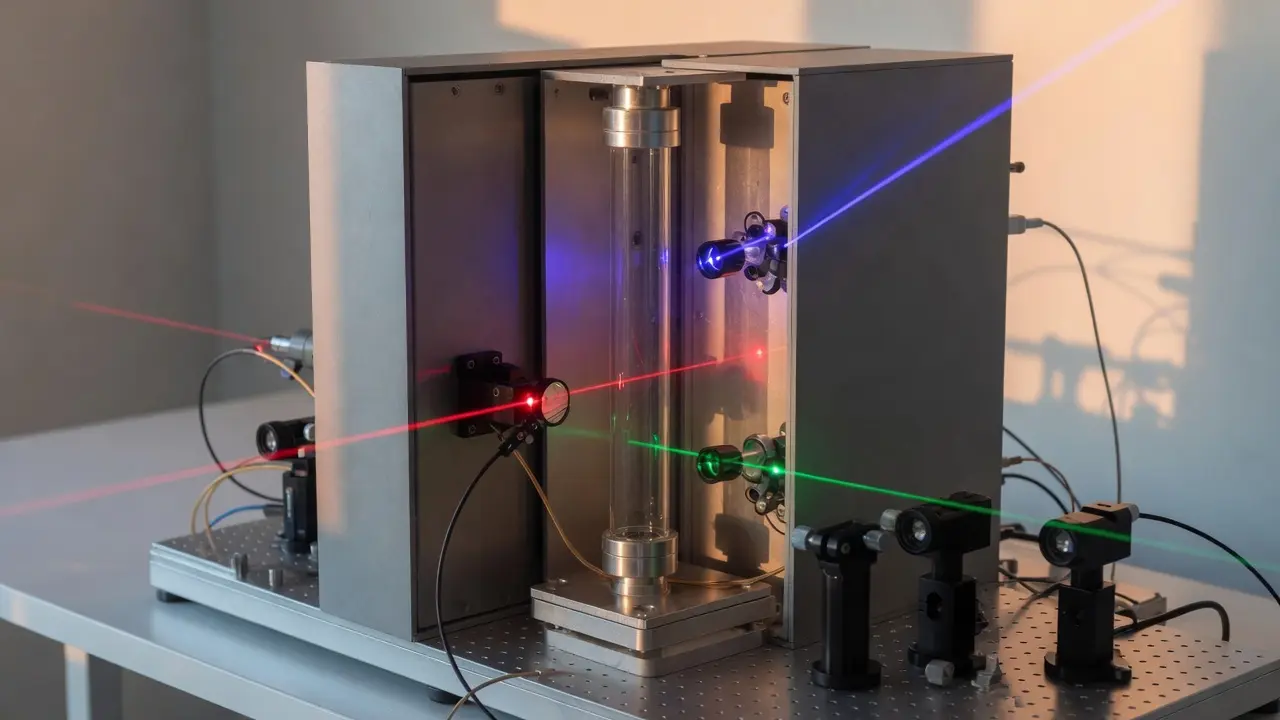
This manipulation isn’t merely a byproduct of the conversion. It’s a deliberate feature, allowing researchers to realize a configurable many-port frequency-domain-beamsplitter, a unitary transformation that shapes the quantum light’s spectrum. The process begins with squeezing light at approximately 1550 nanometers, then uses a pump pulse centered at 1033 nanometers to generate light at 620 nanometers, effectively shifting the quantum state to the visible spectrum.
This AFC pump pulse’s temporal profile is carefully shaped to control the conversion, providing a means to steer the process and tailor the resulting spectral correlations. The ability to program these frequency correlations within the multimode squeezed light represents a step toward more complex quantum information processing. “We have experimentally demonstrated efficient, broadband, quantum frequency conversion of highly multimode squeezed light generated in the near infrared into the visible using adiabatic frequency conversion,” the researchers state, highlighting the efficiency of the technique.
The use of an EMCCD camera as an array of high-quality photodetectors allowed for parallel photon counting across these numerous modes, a feat previously challenging due to detector limitations. This work demonstrates the generation of these states and their manipulation and efficient detection. The ability to efficiently convert and manipulate quantum states across a broad bandwidth offers a pathway toward scaling up quantum technologies and exploring new applications.
Configurable Frequency-Domain Beamsplitter Unitary Transformation
Adiabatic frequency conversion enabled the creation of a configurable many-port frequency-domain-beamsplitter unitary transformation, allowing manipulation of the quantum state’s joint spectrum during conversion to visible wavelengths. This process doesn’t simply shift frequencies; it actively reshapes the quantum light, offering a degree of control previously unavailable in these types of experiments. The ability to program this reshaping stems from varying the spectro-temporal profile of the pump used in the conversion process, effectively acting as a control knob for the resulting quantum state.
The transformation between infrared and visible frequencies is mathematically represented as a linear unitary transformation, U, acting on the infrared and visible fields. By carefully shaping the pump pulse, researchers can modify this transformation, directly influencing the final state and the resulting spectral photon-number correlations.
“By pulse shaping the AFC pump A(ω_p), we can modify the linear unitary transformation U performed by the AFC process, hence the state and the measured spectral photon-number correlations,” explains the research team. The final state is split into frequency modes using a diffraction grating before frequency-resolved photon counting is performed with the EMCCD camera, generating photon-number sequences whose probability distributions reveal the characteristics of the manipulated quantum state.
Photon Statistics Confirm Visible Squeezing with 700 Photons Per Shot
This broad bandwidth allows for the capture of a substantial portion of the quantum state’s spectral profile with readily available detector technology, bypassing the limitations of traditional low-temperature measurements. The conversion process itself demonstrated near-unity efficiency, maximizing the number of visible photons available for analysis. This high photon count, coupled with observed photon statistics, supports the creation of a highly multimode quantum state, a resource increasingly vital for advanced quantum technologies.
Researchers verified the number of modes by analyzing how the output energy scaled with pump energy, providing a robust method for characterizing the complexity of the generated state. The observed “X” shape in photon-number covariance plots, mirroring previous findings, further confirmed the presence of non-classical frequency correlations inherent in entangled photons.
While direct verification of quadrature squeezing remained beyond the scope of these experiments due to challenges in creating a matching local oscillator, the observed photon statistics strongly indicated non-classical correlations. The team emphasized the distinction, referring to the generated light as “quantum light” to acknowledge the evidence of non-classicality without definitively confirming squeezing.
This approach acknowledges the practical limitations of current measurement techniques while still highlighting the significant progress made in generating and characterizing multimode quantum states. The ability to manipulate the spectral properties of the light through adiabatic frequency conversion, realizing a configurable many-port frequency-domain-beamsplitter, provides a pathway toward more complex quantum signal processing and potentially wavelength multiplexing for quantum networking. This achievement stems from a process generating highly multimode squeezed vacuum in the near infrared, where squeezed modes occupy distinct frequency spectra, and subsequent conversion to visible wavelengths.
Nonlinear Wave Mixing for Programmable Frequency-Domain Unitaries
Unitary operations acting on the frequency modes of light can now be implemented in hardware with greater efficiency, enabling parallel operation across a broad spectrum of frequencies. This advancement bypasses limitations previously imposed by microwave bandwidths of around 100 gigahertz. Researchers have demonstrated a method for realizing programmable unitaries using nonlinear wave mixing, a technique that converts photons between frequency modes within a compact waveguide structure.
The ability to shape the classical fields driving this wave mixing allows for precise control over the quantum state of the light, effectively creating a programmable transformation. By manipulating the phase of the pump frequency, the conversion process can be tuned to promote or suppress the transfer of signals between specific frequencies, forming a network of frequency-domain interferometers.
This approach contrasts with spatial or temporal encoding methods, which often require a trade-off between programmability and signal loss. “Shaping the AFC pump pulse affects the nonlinear dynamics, changing which wavelengths convert to which,” explained the research team, highlighting the level of control achieved. The team overcame this obstacle by using nonlinear optical materials that perform optimally at longer wavelengths, specifically around 1550 nanometers, a standard in telecommunications.
This allowed for the generation of squeezed vacuum states at these wavelengths, which were then converted to visible light while simultaneously manipulating the spectral correlations. The researchers developed and applied calibration methods to characterize the broadband, frequency-multimode pulsed squeezed light. These methods allowed for precise determination of wavelength correlations, effective transmission efficiency and the number of supermodes comprising the quantum state.
F.P. performed the simulations and built the experiment, with assistance from L.G.W., while S.-Y.M. evaluated and calibrated the photon-counting cameras used for detecting the squeezed light. T.W. designed and tested the EMCCD-camera spectrometer, an important component in the measurement process. P.L.M. and L.G.W. conceived and supervised the project, ensuring its successful execution and contributing to the preparation of the manuscript.
Silicon Camera Detection Streamlines Multimode Quantum Measurement
This achievement bypasses a significant hurdle in multimode quantum optics, where efficient state measurement typically requires specialized, low-temperature equipment. Researchers verified the broad bandwidth by performing spectrum measurements and parametric gain analysis, confirming predictions of a highly multimode squeezed light source. These experiments, using a lithium niobate waveguide optical parametric amplifier, revealed behavior consistent with squeezing across hundreds of frequency modes. Confirmation of the squeezed light’s properties came through spectrum measurement, parametric gain measurement and coincidence detection.
This approach represents a departure from traditional methods, offering a potentially more accessible and scalable solution for characterizing complex quantum states. Beyond simply generating and detecting the squeezed light, the work details a method for manipulating its spectral properties.
By altering the pulse shape of the pump laser used in the adiabatic frequency conversion process, researchers can effectively reshape the quantum light’s spectrum. This level of control is important for applications requiring precise frequency encoding, such as multiplexing information across multiple wavelengths.

See today’s quantum computing news on Quantum Zeitgeist for the latest breakthroughs in qubits, hardware, algorithms, and industry deals.