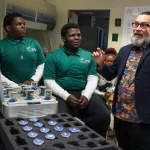
Columbia University physicist Sebastian Will and his lab have achieved a high level of stability in ultracold sodium-cesium (NaCs) molecules, suppressing loss processes to below the detection limit even while maintaining strong dipolar interactions. These NaCs molecules, possessing a slight positive charge at one end and negative at the other, offer unique potential for quantum simulation due to their long-range interactions, a feature previously hampered by rapid molecular decay. The team’s technique, detailed in Science, utilizes protective microwave shields to minimize destructive collisions and precisely control molecular interactions.
“For a long time, it seemed almost impossible to stabilize ultracold molecules. Loss processes and chemical reactions severely limited the lifetime of molecules at ultracold temperatures,” said Will, “Now, we have not only been able to suppress such processes below the detection limit, but also show that this is possible even in the presence of strong dipolar long-range interactions.”
Microwave Dressing Stabilizes Ultracold NaCs Molecules Against Loss
The Columbia University team extended the lifespan of ultracold sodium-cesium (NaCs) molecules to over six seconds, a dramatic improvement from the few milliseconds achieved previously without stabilization techniques. This achievement, detailed in Science, relies on a method to create protective shields around individual molecules, minimizing collisions and preserving the fragile quantum state necessary for advanced research.
Researchers reduced destructive collisions between pairs of molecules by a factor exceeding 10,000, and between three molecules by more than 1,000 demonstrating a high level of control over these complex systems. The stabilization process isn’t simply about preventing molecular decay; it also allows for precise manipulation of the interactions between molecules, including both dipolar and antidipolar forces.
This long-range interaction is a key feature for quantum simulation, but previously difficult to harness due to the molecules’ inherent instability. “The combination of extremely low losses with the ability to flexibly control the strength of dipolar interactions is really key to reaching the so-called ‘strongly interacting regime’ with ultracold molecules,” said Sebastian Will, Columbia Professor of Physics.
The microwave dressing technique developed by Sebastian Will and Tijs Karman utilizes microwave fields to effectively shield the molecules, enabling the tuning of interactions with high precision. This builds on prior work by Will and his lab, which successfully created the first molecular Bose-Einstein Condensates and observed the formation of molecular droplets, hinting at the potential for novel quantum phases.
The current research confirms that this level of stability can be maintained even when the dipolar interactions are strong, a result that was previously uncertain. “Remarkably, our data showed that this extremely high stability could be retained, even in regimes where the dipolar interactions were strong. Whether that would work was completely unclear before,” points out Weijun Yuan, a graduate student and first author of the Science paper.
Columbia University’s commitment to quantum research is evident in its Department of Physics and quantum engineering programs, which focus on advancing quantum computing, materials, and technologies. The university hosted a workshop on August 15, 2026, to connect quantum research with industry, reflecting a broader trend of translating academic discoveries into practical applications.
This work aligns with Columbia’s broader research portfolio, which includes contributions to quantum algorithms, quantum hardware, and quantum applications, positioning Columbia as a key player in the US quantum technology ecosystem. The ability to create and maintain these ultrastable molecular gases opens doors to exploring entirely new systems, such as droplets and droplet arrays, driven by dipolar interactions and potentially revealing enigmatic quantum states like supersolids.
The implications extend beyond fundamental physics; the ability to precisely control and manipulate these molecules could revolutionize quantum simulation. Researchers can now explore complex quantum phenomena, such as high-temperature superconductivity, with a level of detail previously unattainable.
The team plans to investigate the behavior of these ultrastable molecules within optical lattices, potentially simulating magnetism and realizing elusive spin liquids. “I am most excited to see whether molecular systems can reveal new types of quantum order that we did not have on the radar before,” Will stated. This breakthrough not only overcomes a long-standing obstacle but also enables new exploration in the realm of quantum physics and materials science.
The combination of extremely low losses with the ability to flexibly control the strength of dipolar interactions is really key to reaching the so-called ‘strongly interacting regime’ with ultracold molecules. The regime of strong interactions is often where new quantum states of matter can be found.
Sebastian Will, Professor of Physics at Columbia University




See today’s quantum computing news on Quantum Zeitgeist for the latest breakthroughs in qubits, hardware, algorithms, and industry deals.