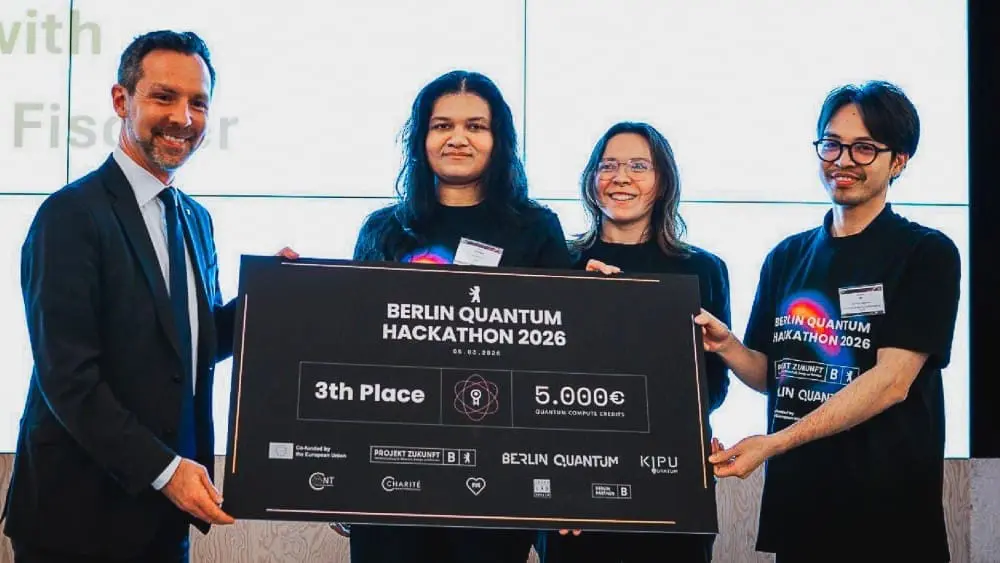
Berlin’s public transit operator, BVG, faces a looming workforce crisis; projections indicate over 4,300 employees will retire by 2026, a loss intensified by ongoing voluntary attrition. The team’s classical-quantum-classical pipeline, utilizing Kipu Quantum’s technology, demonstrated a credible path from TRL 4 to a production pilot at TRL 6 within 24 months, and a conservative 2% scheduling efficiency gain at BVG’s scale translates to roughly €18 million per year.
Bus Crew Scheduling as a Quadratic Unconstrained Binary Optimization
A scheduling problem involving 150 drivers and multiple bus lines has revealed a promising application for quantum computing, demonstrating a potential pathway toward optimizing complex logistical challenges beyond theoretical exercises. Classical scheduling approaches often overlook individual driver preferences, accelerating this trend, but the Beerantum team aimed to integrate these “human layer” considerations into the optimization process. Their solution employed Kipu Quantum’s Bias-Field DCQO algorithm, running on the Kipu Quantum Hub, alongside a pre-processing stage that leveraged DBSCAN clustering to identify driver archetypes, reducing API calls by 80%. The resulting classical-quantum-classical pipeline, incorporating an Uncertainty Adapter combining an Isolation Forest anomaly detector with a Gaussian Process demand predictor, demonstrated a potential for substantial economic gains. This project demonstrated a credible path from TRL 4 to a production pilot at TRL 6 within 24 months, aligning with Kipu’s hardware roadmap and suggesting a future where quantum solutions underpin critical infrastructure.
Kipu Quantum’s DCQO Algorithm and Pipeline Design
Beyond simply demonstrating quantum capability, the Berlin Quantum Hackathon showcased a practical application of quantum optimization with Beerantum’s project addressing bus crew scheduling for BVG, Berlin’s public transit operator. This wasn’t merely about solving a complex mathematical problem; it was about acknowledging the human element within a large-scale logistical operation, particularly crucial given BVG’s projected loss of over 4,300 employees by 2026 due to retirement and attrition. This compression of the preference space was vital, as classical approaches often fail to integrate individual driver needs. An adapter combining an Isolation Forest anomaly detector with a Gaussian Process demand predictor dynamically determined when a fresh quantum re-optimization was necessary, optimizing resource allocation. The project’s architecture is broadly applicable, mapping naturally to scenarios like hospital shift scheduling and last-mile logistics, aligning with Kipu’s hardware roadmap.
The experience reinforced something important: quantum systems that work in practice are systems designed with both operational rigor and human complexity in mind.
The team tackled bus crew scheduling for Berlin’s BVG, a problem complicated by the impending retirement of over 4,300 employees by 2026, alongside additional voluntary attrition. Their solution, framed as a Quadratic Unconstrained Binary Optimization (QUBO) problem and solved using Kipu Quantum’s Bias-Field DCQO algorithm, wasn’t solely reliant on quantum processing.




See today’s quantum computing news on Quantum Zeitgeist for the latest breakthroughs in qubits, hardware, algorithms, and industry deals.