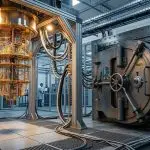
Researchers have achieved testing accuracy near 80% with the NPQK and approximately 70% accuracy with the QCNN in classifying events detected by neutrino telescopes using a quantum computer, a result comparable to traditional methods. Pablo Rodriguez-Grasa, University of the Basque Country UPV/EHU and colleagues demonstrated this capability by investigating neural projected quantum kernels and quantum convolutional neural networks.
This work, published August 21, 2026, in Quantum Science and Technology, Number 4, establishes the feasibility of applying quantum machine learning to astronomical data analysis with current hardware. The study explores how quantum computers can distinguish between different types of neutrino events, crucial for understanding rare cosmic phenomena.
NPQK and QCNN Approaches to Neutrino Event Classification
Achieving testing accuracy near 80%, the neural projected quantum kernel (NPQK) approach demonstrated a capacity to classify neutrino events directly on both simulators and the IBM Strasbourg quantum processor. This result suggests a shift toward practical quantum applications in astrophysics. Researchers led by Pablo Rodriguez-Grasa at the University of the Basque Country UPV/EHU detailed this performance in a study published August 21, 2026, in Quantum Science and Technology, Number 4, focusing on distinguishing between muon tracks and hadronic/electromagnetic cascades, key signatures within neutrino telescope data.
This direct implementation on quantum hardware bypasses the need for purely simulated results, validating the methodology against the inherent noise and limitations of current quantum systems. The team addressed a critical challenge in applying quantum machine learning to high-energy physics: the encoding of large feature spaces.
Traditional methods struggle with the vast amounts of information generated by neutrino telescopes like IceCube, limiting the feasibility of quantum graph neural networks. To address this, Rodriguez-Grasa and colleagues introduced a moment-of-inertia-based encoding scheme, a preprocessing strategy inspired by the underlying physics and geometry of the problem. This scheme was designed to reduce the dimensionality of the data while preserving essential physical characteristics. This innovative approach allowed them to work with a manageable number of qubits, making the classification task achievable on existing quantum hardware.
Alongside the NPQK method, the study also explored quantum convolutional neural networks (QCNNs), achieving approximately 70% accuracy in simulated tests across a wide energy range. While slightly lower than the NPQK performance, the QCNN results further demonstrate the potential of quantum machine learning for neutrino astronomy.
The researchers validated their approach through simulations and, importantly, by implementing it on the IBM Strasbourg quantum processor, confirming the robustness of the results above 1 TeV and showing close agreement between simulated and hardware performance. This direct comparison is significant because it establishes the reliability of quantum algorithms in a real-world experimental setting.
The classification task centers on separating muon events from those caused by hadronic and electromagnetic showers, a distinction vital for determining the flavor composition of incoming neutrinos. By simulating muon and electron neutrino event signatures, the team created a dataset for training and testing their quantum classifiers.
The paper reports that this success “marks, to the best of our knowledge, the first time this problem has been successfully addressed on a quantum computer.” This achievement allows for future advancements as quantum hardware continues to mature, potentially enabling more detailed and accurate analyses of neutrino data.
Moment-of-Inertia Encoding for Neutrino Astronomy Datasets
The classification of neutrino events has moved closer to quantum solutions with a new data encoding method detailed by Pablo Rodriguez-Grasa of University of the Basque Country UPV/EHU, Pavel Zhelnin of Harvard University, and colleagues. Their work centers on a method designed to efficiently prepare large datasets for quantum machine learning algorithms, a critical step toward real-time analysis of data from detectors like IceCube and KM3NeT. By focusing on the moment of inertia of the detected light patterns, they created a more manageable dataset suitable for quantum processing.
Quantum Kernel Methods Applied to Telescope Data
This result moves beyond theoretical modeling by directly applying quantum machine learning to astronomical observations, specifically data mimicking the IceCube Neutrino Observatory. Researchers tackled a significant hurdle in quantum machine learning: efficiently encoding the large feature spaces inherent in neutrino telescope data for processing on current quantum hardware. The primary goal of these quantum classifiers, the researchers explain, is to distinguish between muons and hadronic/electromagnetic showers, a crucial task for determining the origin and composition of high-energy cosmic neutrinos.
By accurately identifying these event types, scientists can better understand the sources of these elusive particles and unravel the mysteries of the cosmos. The NPQK method’s performance remained robust above 1 TeV, indicating its ability to handle high-energy events with precision. While graph neural networks currently dominate the field of neutrino event classification, their computational demands often preclude their use with the full complexity of detector data.
Simulated QCNN Accuracy for Neutrino Classification
Researchers employed Prometheus, an open source neutrino telescope simulation software, to generate realistic event data mirroring observations from instruments like IceCube. This simulated data was then processed using a QCNN, a type of neural network specifically designed for quantum computers, and compared against the performance of conventional machine learning techniques. Accurate identification of these event types is essential for understanding the origins and properties of these elusive particles, providing insights into cosmic phenomena such as supernovae and active galactic nuclei.
Classical-Quantum Comparison of Classification Performance
The ability of quantum computers to match the performance of established classical methods in classifying complex astronomical events has moved beyond theoretical prediction, as demonstrated by a recent study focusing on neutrino telescope data. Researchers from University of the Basque Country UPV/EHU, Harvard University, TECNALIA, IKERBASQUE, and BCAM achieved testing accuracy near 80% using a neural projected quantum kernel (NPQK) method, a result comparable to that of conventional machine learning techniques applied to the same data. This accomplishment signifies a shift from exploring the potential of quantum machine learning to actively applying it to real-world astrophysical challenges, specifically the identification of neutrino events.
Neutrino Telescope Classification with Quantum Machine Learning
This method drastically reduced the number of features needed for classification, enabling the use of a limited number of qubits and making the task feasible on existing quantum hardware. The simulation of muon and electron neutrino event signatures utilized Prometheus, an open-source neutrino telescope simulation software, generating realistic event data for training and testing.
The close agreement between simulation and hardware results validates the approach and demonstrates its potential for real-world application. This ability to accurately classify events, distinguishing between muons and hadronic or electromagnetic showers, provides neutrino telescopes with a valuable tool for determining neutrino flavor composition.

See today’s quantum computing news on Quantum Zeitgeist for the latest breakthroughs in qubits, hardware, algorithms, and industry deals.