

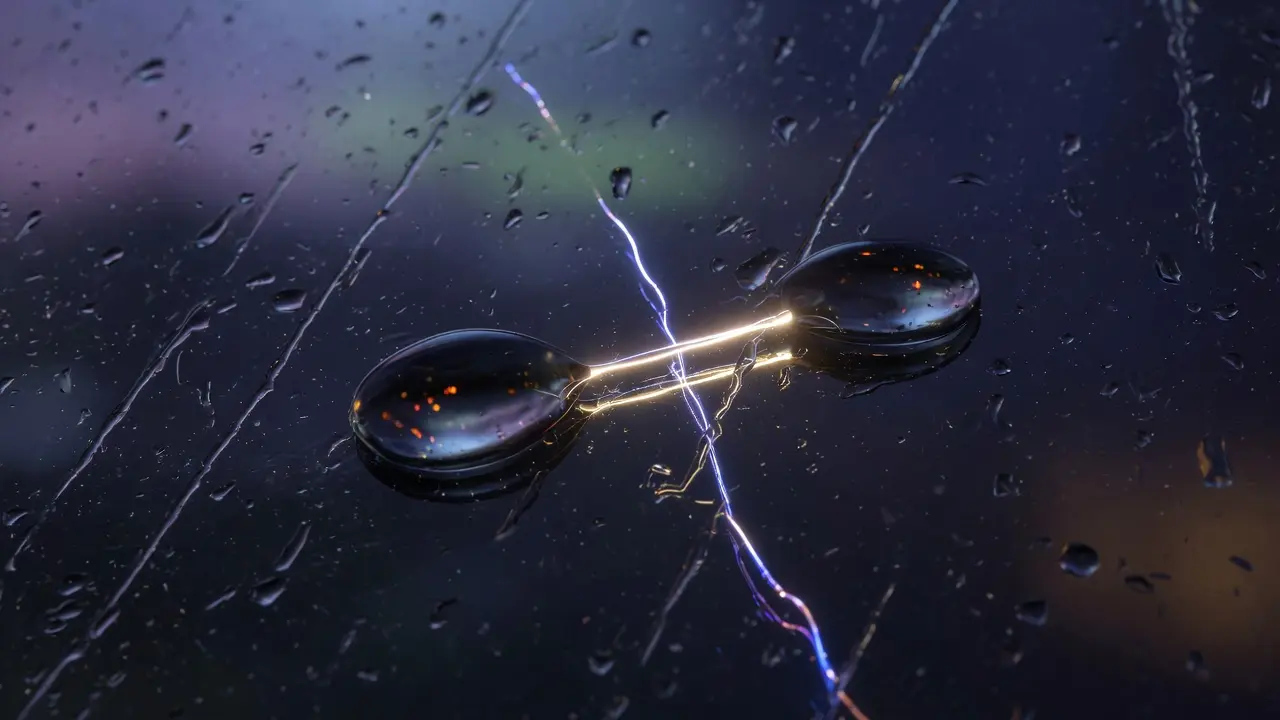
A polarization-entangled photon-pair source developed by researchers at zerothird GmbH and the University of Vienna generates over 4.24 x 10^6 photon pairs per second per mW per nm, a significantly high rate achieved with a compact, bulk optics system. The source maintains this constant generation rate even with pump powers up to 700 mW, demonstrating an unusual level of stability for these devices.
Its design incorporates an engineered base plate and simplified optical layout to minimize vibration and alignment complexity, and the team has successfully integrated it into a functioning quantum key distribution system. This work bridges the gap between laboratory quantum communication prototypes and practical hardware.
Telecom-Wavelength Entangled Photon Pairs via Type-0 SPDC
A spectral pair generation rate of 4.24 x pairs s -1 mW -1 nm -1 characterizes the output of a newly developed entangled photon source, demonstrating a substantial increase in efficiency for quantum technologies reliant on high-flux photon pairs. This performance stems from a bulk optics system using type-0 spontaneous parametric down-conversion, a process where a high-energy photon transforms into two lower-energy, entangled photons within a non-linear crystal.
The source operates at telecom wavelengths, specifically within the C-band, a range compatible with existing fiber optic infrastructure and long-distance quantum communication networks. The design prioritizes mechanical stability through an engineered base plate and a simplified optical layout, minimizing sensitivity to vibrations that could degrade entanglement quality. This robustness is critical for deployment outside of controlled laboratory environments, a long-standing challenge in the field of quantum key distribution.
The source achieves an intrinsic heralding efficiency of 59.8%, a measure of how reliably one photon signals the presence of its entangled partner, and a polarization contrast visibility of 99.6%. This exceptionally high visibility indicates a remarkably “clean” entangled state, reducing the potential for errors in quantum computations and communications protocols. Maintaining such a clear signal is paramount for practical applications demanding high fidelity. This sustained output is a direct result of operation within the low-gain regime, where the conversion efficiency remains linear with pump power.
At the maximum operating power, the generated photon pairs reach a flux of 2.79 x pairs per second per nanometer, a rate high enough to be directly measured by a conventional germanium photodiode optical power sensor. Already at 104 mW of pump power, the source produces an optical intensity of 2.49 nW, demonstrating its sensitivity and efficiency.
The Sagnac interferometric configuration employed in the source contributes to its high visibility, using a common-path geometry that inherently stabilizes the interference between counter-propagating optical fields. This design minimizes the impact of environmental fluctuations and ensures a consistent entanglement quality. The source’s capabilities extend beyond fundamental research, having been successfully integrated into a deployed entanglement-based quantum key distribution system. The ability to generate a high flux of entangled photons at telecom wavelengths, coupled with the source’s mechanical stability, makes it well-suited for realistic fiber-based applications.
The underlying principle of the source relies on the second-order nonlinear susceptibility, denoted as , within a periodically-poled lithium niobate crystal. This crystal facilitates the SPDC process, converting a strong pump field into correlated signal and idler photon pairs.
Precise tuning of the pump laser to the quasi-phase-matching condition of the crystal, along with a narrow linewidth, ensures that the generated photons maintain phase coherence. The team’s work demonstrates a significant step towards realizing practical and scalable quantum communication networks.
High-Performance Metrics: Rate, Visibility, and Efficiency
This figure represents the number of entangled photons produced each second, for every milliwatt of pump power and nanometer of spectral bandwidth, and positions the source favorably among current implementations combining both metrics with high fidelity and polarization visibilities. The design achieves this high rate while maintaining a stable output, an important factor for practical applications demanding consistent performance over extended periods.
Beyond sheer generation rate, the source distinguishes itself with an intrinsic heralding efficiency of 59.8%, critical for minimizing losses in quantum communication protocols, as a higher heralding efficiency translates directly into a stronger and more reliable entangled signal. The source also achieves a polarization contrast visibility of 99.6%, indicating an exceptionally “clean” entanglement signal with minimal noise or unwanted polarization states. This level of clarity is essential for reducing error rates in quantum computation and communication, allowing for more complex and robust quantum operations.
The source’s performance is further emphasised by its long-term stability, maintaining approximately 98.4% polarization visibility after nine months of operation. This resilience is a significant advantage over systems prone to drift or degradation, which require frequent recalibration and limit their usability in real-world deployments. Measurements of the SPDC photon flux coupled into a fiber reached approximately 12. The source’s ability to operate at 700 mW of pump power without compromising stability demonstrates a robustness unusual for these types of devices, suggesting potential for sustained, reliable operation in demanding environments.
The source is mechanically designed for vibrational robustness, employing an engineered base plate and a reduced optical layout for less alignment sensitivity and complexity. It operates at telecom wavelengths in C-band with a typical type-0 SPDC spectral output of 70 nm width.
Mechanical Stabilization for Long-Term Source Stability
The source generates over 4. This performance stems from a design prioritizing mechanical robustness, allowing for continuous operation within a deployed entanglement-based quantum key distribution (QKD) system for 12 months without optical realignment. The extended deployment within the MadQCI ecosystem confirms the source’s suitability for real-world applications demanding consistent performance over time. Maintaining high fidelity is not solely dependent on initial performance metrics, but also on the ability to sustain those metrics under realistic operating conditions.
The source’s long-term stability was assessed through its integration into an eQKD system, where the quantum bit error rate (QBER) remained below the operating threshold of 4% throughout the deployment. This level of stability addresses a critical need for photon sources intended for practical applications, moving beyond laboratory demonstrations towards reliable, long-duration operation. The design’s success lies in a combination of established principles and careful engineering.
While spontaneous parametric down-conversion (SPDC) in periodically poled lithium niobate (ppLN) crystals is a well-established method for generating entangled photons, this work demonstrates how optical and mechanical design can combine high source performance with the stability required for deployed quantum communication systems. The source’s mechanical components were co-designed by Miklós Horváth, Sebastian Philipp Neumann and Thomas Heine, alongside Mirela Selimović, emphasizing a collaborative approach to achieving robust performance.
The source’s broad emission spectrum, approximately 70 nanometers at full width half maximum, also presents opportunities for future development. Narrowing the spectral filtering from the current 100 gigahertz bandwidth to 50 gigahertz could adapt the source for long-distance quantum key distribution, where narrower spectral modes improve achievable visibility. This adaptation could also enable the synchronization of multiple SPDC sources, potentially leading to the generation of four-photon states.
The researchers note that the key rate limitation in leading eQKD implementations originates from imperfect detection, not insufficient source brightness. Pumping the source harder to generate more pairs is not feasible because detectors cannot temporally resolve them. Mirela Selimović conceived the study, co-designed and constructed the source, performed the characterization, and wrote the manuscript, highlighting her central role in the project.
Josip Bajo and Sebastian Philipp Neumann contributed to the manuscript, while Josip Bajo and Mirela Selimović carried out the spectral measurements. Thomas Heine and Sebastian Philipp Neumann also co-designed the source, demonstrating a collaborative effort across multiple areas of expertise.
SPDC Process and Nonlinear Susceptibility in Photon-Pair Creation
Optimizing this conversion requires careful consideration of the interacting beam waists, the radii of the pump, signal and idler beams, to maximize the joint spectral density and, consequently, the photon-pair generation rate. This rate is directly linked to the precise control of these beam parameters and the quality of the periodically-poled lithium niobate (ppLN) crystal used in the SPDC process.
The design of the optical layout prioritizes both performance and mechanical robustness, addressing a common challenge in maintaining stable entanglement generation. A Sagnac interferometer configuration is employed, splitting the pump beam into two counter-propagating beams to enhance the efficiency of bidirectional SPDC, a technique that relies on aligning the polarization of the pump with the nonlinear axis of the ppLN crystal.
A half-wave plate (HWP) within the loop serves a dual purpose: aligning the pump beams and rotating the polarization of the generated photon pairs to create the desired orthogonal polarization entanglement. The source’s use of a single lens to both focus the pump and collimate the SPDC photons, positioned before a dichroic mirror, circumvents limitations found in designs requiring tighter beam focusing and maintains overall source performance.
Beyond maximizing the pair generation rate, the source’s design also focuses on maintaining a high degree of entanglement fidelity. The source’s performance was assessed through a 12-month deployment within a quantum key distribution (QKD) system, operating under realistic conditions within the MadQCI ecosystem. This level of performance is attributed to the careful balancing of spectral bandwidth and heralding efficiency, resulting in an intrinsic heralding efficiency of 59.8%.
The close agreement between two calculated coincidence counts, and , indicates that the observed QBER is primarily due to accidental coincidences, with no measurable excess error originating from the source itself. The broad emission spectrum of the source, currently at 100 GHz bandwidth, presents an opportunity for further refinement. This combination of high generation rates, long-term stability and potential for spectral refinement positions the source as a viable component for future quantum networks.
👉 More information
🗞 Compact and Long-Term Stable Polarization Entangled Photon-Pair Source
✍️ Mirela Selimović, Thomas Heine, Rupert Ursin and Sebastian Philipp Neumann (zerothird GmbH, Clemens-Holzmeister-Straße 6/6, Vienna, Austria); Josip Bajo and Philip Walther (University of Vienna, Faculty of Physics, Vienna Center for Quantum Science and Technology (VCQ), Boltzmanngasse 5, Vienna, Austria); Miklós Horváth (qtlabs GmbH, Clemens-Holzmeister-Straße 6/6, Vienna, Austria); Juan José Romero (Universidad Politécnica de Madrid, Madrid, Spain)
🧠 ArXiv: https://arxiv.org/html/2611.29046v1


See today’s quantum computing news on Quantum Zeitgeist for the latest breakthroughs in qubits, hardware, algorithms, and industry deals.
