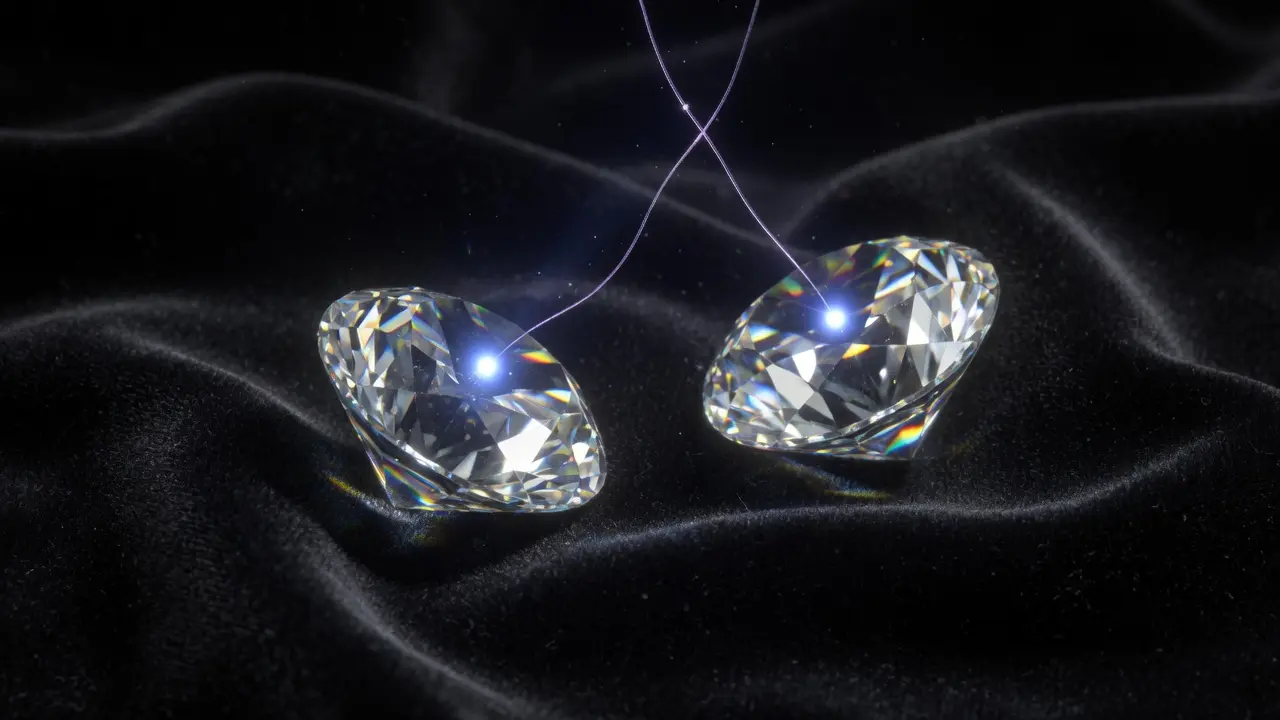
Researchers at the University of Delaware have predicted a level of 0.28 concurrence, a measure of long-range entanglement, between nitrogen-vacancy (NVC) centers in diamond using a novel approach to qubit interaction. Their work rigorously derives a quantum master equation to model two NVCs driven by microwave radiation and interacting through a synthetic antiferromagnet.
This calculation suggests the antiferromagnet is an optimal environment for stabilizing entanglement, differing from previous methods that required manipulating the system out of equilibrium. The team’s model allows for precise prediction of conditions needed for entanglement between the microscopic solid-state qubits, with potential applications in quantum sensing and computing.
Microwave Driving and Dissipation for NVC Entanglement
Microwave radiation, carefully tuned, modifies the rates at which nitrogen-vacancy (NVC) centers in diamond interact with a magnetic bath, enabling a predicted level of steady-state entanglement. This tunability stems from a newly derived quantum master equation that describes two NVCs driven by microwaves and dissipating energy into a magnetic bath maintained in thermal equilibrium. The equation, a Lindblad-type formulation, details how the microwave drive alters effective dissipation rates within the system, opening avenues for both robust entanglement and enhanced quantum sensing.
This approach differs from previous methods that required forcing the dissipative bath into a non-equilibrium state, simplifying experimental requirements and potentially improving stability. Fluctuations originating from excited magnons within a synthetic antiferromagnet (SAF) is the mechanism for coupling the two NVCs, inducing cooperative decay, pumping and dephasing rates.
These parameters are not fixed, but are instead adjustable through the microwave drive, a key feature allowing for the achievement of steady-state entanglement even over relatively long distances between the NVCs. The theoretical framework developed predicts that this system will not converge to a simple thermal equilibrium state, a common limitation in other qubit systems, because the pump and decay rates are no longer constrained by the fluctuation-dissipation theorem.
The researchers’ quantum master equation microscopically derives pump and decay rates that deviate from traditional constraints, offering high tunability of entanglement and the potential to resolve subtle spectral features of the magnetic bath. This capability extends beyond entanglement, suggesting a pathway for more precise quantum sensing using multiple, interconnected NVCs. Their analysis is broadly applicable, extending beyond specific bath choices and potentially adaptable to other optically addressable spin qubits.
The work predicts that steady-state entanglement can be achieved while the magnetic dissipative bath remains in thermal equilibrium, a departure from schemes that require finely tuned, non-equilibrium conditions. The derivation of the Lindblad quantum master equation relies on expressing jump operators in terms of Keldysh Green’s functions, which are correlators of dipolar field operators of the magnetic bath. By exploring a wide range of dissipative parameters, the model delineates sufficient conditions for maintaining entanglement, without being limited by the specific properties of any particular bath material.
The ability to achieve steady-state entanglement, rather than just transient entanglement, is an important advancement. Previous attempts to generate entanglement often resulted in a thermal Gibbs state in the long term, effectively destroying the quantum correlation. This new scheme, however, circumvents the Gibbs steady state by varying the Rabi frequency of the NVCs, controlled by the amplitude of the microwave drive.
This contrasts with a recent study that also sought to evade the Gibbs steady state, but required a non-equilibrium bath. The theoretical analysis is applicable to various dissipative magnetic baths, and it can easily be applied to other optically addressable spin qubits. The researchers emphasize that their approach is not restricted by the properties of any specific bath choice, offering flexibility in materials selection and experimental design.
The derived quantum master equation, expressed as equations (8)-(10) in the study, provides a detailed microscopic description of the driven-dissipative system of two NVCs interacting with a magnetic bath positioned below them. This equation predicts the possibility of their steady-state entanglement by no longer satisfying the detailed balance between cooperative pump and decay rates, sharing features with other recently employed quantum master equations.
By using realistic parameters from available experiments, they estimate steady-state concurrence reaching C≃ 0.28 for two NVCs separated by a distance. This level of entanglement, achieved through a combination of microwave driving and a carefully chosen dissipative environment, represents a step towards realizing practical quantum technologies based on NVCs in diamond. “Our scheme emanates from the analysis of the Lindblad-type quantum master equation,” the researchers state.
Synthetic Antiferromagnet as an Optimal Dissipative Bath
The research details a rigorously derived quantum master equation that predicts specific conditions for maximizing this interaction, offering a new pathway toward stable quantum bits for sensing and computation. The team’s model incorporates Keldysh Green’s functions to express jump operators within the Lindblad quantum master equation, a technique allowing for precise prediction of entanglement conditions. These functions describe correlations of dipolar field operators within the magnetic bath, enabling a microscopic understanding of how dissipation affects the NVCs’ quantum state.
The identification of a synthetic antiferromagnet as an optimal dissipative bath is a key finding, as it simplifies experimental requirements. Unlike previous methods, this approach allows for steady-state entanglement even when the magnetic environment remains at thermal equilibrium. The researchers emphasize that the parameters used in their calculations align with currently achievable experimental conditions.
The model predicts that entanglement can be sustained between NVCs separated by approximately 100 nanometers, with the entanglement building up over a timescale of milliseconds. These conditions are met in the NVCs + 2DQM system, where dissipative rates are on the order of 100 Hz, while characteristic Rabi and energy splitting frequencies for the NVCs are around 1 MHz. This separation of timescales is important for ensuring the validity of the Markovian approximation used in the derivation.
The researchers note that their approach can be generalized to other systems and parameter regimes, building on strategies detailed in previous publications. The team’s analysis reveals that the optimal conditions for entanglement can be tuned by adjusting the Rabi frequency and energy splitting of the NVCs. This tunability provides a degree of control over the entanglement process that is not typically available in other systems.
The researchers demonstrate that carefully tuning these parameters can overcome cooperative dephasing rates, further enhancing the stability of the entangled state. This robustness is particularly important for applications in quantum sensing, where maintaining coherence is essential for achieving high precision. The study also highlights the importance of considering the fluctuation-dissipation theorem when characterizing the magnetic bath. This theorem relates the absorption and emission rates of the bath, and it is important in determining the strength of the entanglement.
By accounting for these effects, the researchers were able to identify advantageous experimental conditions that had been overlooked in previous studies. The work demonstrates that the proposed system of NVCs coupled to a synthetic antiferromagnet is fully within the reach of present experimental capabilities. The ability to achieve stable entanglement without requiring complex environmental control represents an advancement in the field, potentially leading to new possibilities for quantum technologies.
Steady-State Concurrence of 0.28 in Distant NVCs
This level of steady-state entanglement was calculated using a quantum master equation that models microwave-driven NVCs interacting with a synthetic antiferromagnet, a material identified as particularly effective at maintaining the fragile quantum state. The model’s precision stems from its use of Keldysh Green’s functions to describe the interactions within the magnetic environment, allowing for accurate prediction of conditions conducive to long-range entanglement.
Unlike earlier approaches that relied on driving the system out of equilibrium to prevent the collapse of entanglement, this work demonstrates that a synthetic antiferromagnet can sustain entanglement while remaining in a stable, equilibrium state. This simplification is essential for practical applications, as maintaining a non-equilibrium environment introduces significant experimental complexity and potential for error.
Analysis of a wide range of dissipative parameters revealed key ratios governing entanglement generation, specifically the balance between nonlocal and local decay rates, pump rates and the interplay between these factors. The team’s calculations indicate that tuning these ratios, controlling the rates at which energy is exchanged between the NVCs and their environment, is essential for maximizing entanglement. The work also suggests that quantum spin liquids (QSLs), materials previously considered promising for entanglement, may not be suitable for this scheme due to the short range of their spin-spin correlations.
The theoretical framework developed allows for detailed exploration of how different bath properties influence entanglement, offering a pathway to optimize the system for specific applications. This approach contrasts with strategies requiring a non-equilibrium bath to achieve the same result.
The implications of this work extend beyond fundamental quantum physics, potentially enabling new avenues for quantum sensing with multiple coupled qubits. Such a system could resolve finer spectral features in the excitation spectrum of magnetic baths, enhancing the sensitivity of quantum sensors.
The long-range entangled NVCs could serve as microscopic gates for highly scalable quantum computing hardware, offering a pathway toward building more powerful and complex quantum processors. “Thus, steady state will not converge into the Gibbs thermal state of the isolated Hamiltonian of NVCs,” the researchers state, highlighting the stability of the achieved entanglement.
Long-Range Entanglement Limited by Dipolar Interaction
This figure, representing the strength of the quantum link, emerges from a rigorously derived quantum master equation detailing interactions between the NVCs and a specifically engineered magnetic environment. This mathematical technique allowed for precise prediction of conditions necessary for long-range, steady-state entanglement, an important step toward practical quantum technologies. The model accounts for microwave radiation driving the NVCs and dissipation occurring through the magnetic bath, maintained in a state of equilibrium.
This equilibrium approach simplifies potential experimental realization and enhances stability. The team’s analysis reveals specific requirements for the dissipative environment, namely the need for long-range cooperative pumping and decay rates. These rates are principal components in generating entanglement within the scheme.
The choice of 16 mT aligns the NVC energy splitting with the magnon band edges of the antiferromagnet, further enhancing entanglement. The theoretical framework also identifies certain bath-induced interactions as detrimental to entanglement generation. Bath-induced Dzyaloshinskii-Moriya interaction, arising from complex numbers within the model, should be minimized to maximize entanglement. Conversely, bath-induced Ising interaction is found to be irrelevant for entangling the NVCs, simplifying the design constraints for the magnetic environment.
The researchers note that enhanced entanglement is achieved at low temperatures, suggesting a need for cryogenic operation. The model highlights the importance of large nonlocal dephasing rates, which contribute to a decoherence-free subspace, a protected quantum state resistant to environmental noise.
This feature, however, relies on the assumption that these dephasing rates are real numbers, adding another layer of complexity to the material requirements. The researchers also examined the role of local intrinsic decoherence, detailing its effects in an appendix to their work. The study’s approach extends beyond simply demonstrating the possibility of long-range entanglement. It provides a pathway to predict the precise conditions needed to achieve it.
The derived quantum master equation is not limited to this specific system, offering a versatile tool for exploring entanglement in other optically addressable spin defects and parameter regimes. The team’s work builds on earlier analyses of magnon-NVC coupling, moving beyond transient entanglement to demonstrate a pathway toward a stable, steady-state entangled system.
While previous work relied on stray magnetic fields from magnons, this model focuses on a more controlled and sustained interaction mediated by the synthetic antiferromagnet. The researchers found that the long-range nature of the cooperative dissipative couplings can be enhanced by simultaneously considering larger interlayer stiffness and setting the NVC energy splitting close to the magnon band edges.
👉 More information
🗞 Long-range and steady-state entanglement of nitrogen vacancy centers using microwaves as a drive and synthetic antiferromagnet as a dissipator
✍️ Federico Garcia-Gaitan and Branislav K. Nikolić
🧠 DOI: http://link.aps.org/doi/10.1103/3524-86sk

See today’s quantum computing news on Quantum Zeitgeist for the latest breakthroughs in qubits, hardware, algorithms, and industry deals.