Researchers from seven institutions across Germany, the UK and Spain, including Technische Universität Darmstadt and Imperial College London, detailed improvements to quantum sensing sensitivity using nonlinear interferometers in the journal Quantum on November 18, 2026. These interferometers offer two key advantages in imaging and sensing by enabling efficient probing at one wavelength while detecting light at another.
The work compares three quantum-imaging configurations, finding that differential intensity detection in a Mandel interferometer provides the highest and most robust phase sensitivity, reaching but not surpassing the shot-noise limit even with signal loss. This approach constitutes the most robust method for phase estimation in high-gain regimes.
Nonlinear Interferometers Enable Bicolor Quantum Imaging and Sensing
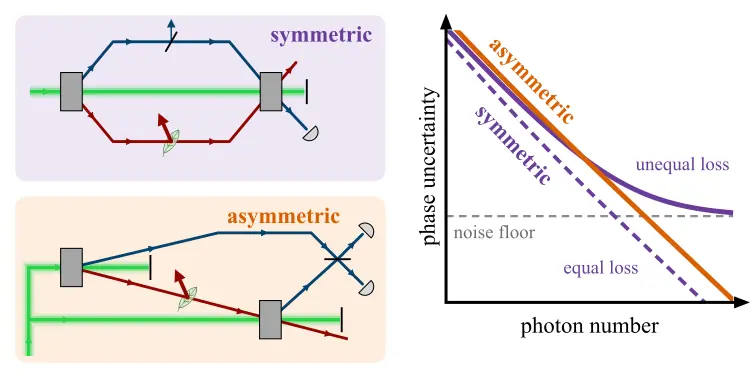
The research, detailed in volume 10 of Quantum journal on November 18, 2026, demonstrates that asymmetric configurations within nonlinear interferometers consistently reach the shot-noise limit, even when signal and idler photons experience differing levels of loss. This robustness is important because realistic imaging scenarios often involve asymmetric loss, where the sample itself absorbs light intended for detection. Previous symmetric designs suffered a saturation effect, diminishing sensitivity as loss increased and even performing worse than classical methods.
The findings directly address a practical limitation hindering the widespread adoption of bicolor quantum imaging and sensing. Nonlinear interferometers have been explored for a decade as a means of achieving quantum-enhanced sensitivities in imaging and sensing. This work focuses on optimizing phase estimation using only intensity-based measurements.
The study reveals that the asymmetric configuration, where signal and idler photons experience different loss rates, consistently outperforms its symmetric counterparts in the presence of loss. “Because the sample absorbs idler light, loss in realistic imaging configurations is asymmetric, making this configuration the more reliable choice,” the authors state. This improved reliability helps realize the potential of nonlinear interferometers for metrological applications. The team’s results suggest a path toward realizing a genuine quantum advantage in bicolor imaging, moving beyond theoretical possibilities to practical utility.
Yurke vs. Mandel Interferometer Configurations for Phase Estimation
Intensity-based measurements within a Mandel interferometer offer the most reliable phase sensitivity among the configurations tested, reaching the shot-noise limit even when signal loss occurs. Consequently, the Mandel configuration emerges as the most robust approach for phase estimation in these practical scenarios. The experimental setup uses a pump laser to create photon pairs of differing colors, with one color probing the sample. A key aspect of the asymmetric configuration involves a second nonlinear crystal acting as a further light source, rather than reversing the initial process.
M. Gené, M. H. Passos, D. F. Urrego, and J. P. Torres are listed as contributors to an upcoming article detailing further refinements to SU(1,1) interferometer sensitivity, building on these findings.
Differential Intensity Detection Robust to Loss in Asymmetric Setups
Imaging with nonlinear interferometers relies on probing a sample with idler photons while detecting signal photons, generated by nonlinear crystals that create correlated photon pairs. The study highlights a key distinction in how these crystals are used; in the symmetric configuration, both signal and idler photons enter the second crystal, while in the asymmetric configuration, only idler photons do.
“In the presence of loss, the Heisenberg limit can become elusive,” the authors note, emphasizing the practical challenges of achieving ultimate quantum precision. This finding suggests a refinement of existing technology rather than a completely novel approach to quantum sensing, with implications for applications requiring precise phase measurements in challenging environments.
Heisenberg Scaling Limitations with Realistic Detection Constraints
While ideal Yurke interferometers theoretically demonstrate Heisenberg scaling, this performance diminishes under realistic conditions, particularly as gain increases. The asymmetric configuration, however, remains bounded by shot noise, yet exhibits a critical advantage. Specifically, the phase uncertainty of the symmetric configuration saturates with increasing loss, while the asymmetric configuration maintains robust scaling to the shot-noise limit, as detailed on Volume 10, page 2272 of Quantum journal.
Asymmetric Configuration Achieves Shot-Noise Limited Phase Sensitivity
This robustness contrasts with symmetric interferometers, where phase uncertainty saturates as loss increases, diminishing their effectiveness in practical imaging scenarios. The work demonstrates a critical advantage for the asymmetric design in high-gain regimes, where performance typically degrades. Specifically, the researchers found that unequal loss between the signal and idler beams causes the symmetric interferometer’s sensitivity to plateau, performing worse than its asymmetric counterpart. This distinction arises from the differing paths of signal and idler photons within the two interferometer designs.
This seemingly minor difference has a substantial impact on noise scaling; the asymmetric configuration consistently reaches the shot-noise limit, even when loss is present. The team’s findings provide a clear advantage for the asymmetric configuration in scenarios where loss is unavoidable, a common challenge in real-world quantum sensing.

See today’s quantum computing news on Quantum Zeitgeist for the latest breakthroughs in qubits, hardware, algorithms, and industry deals.