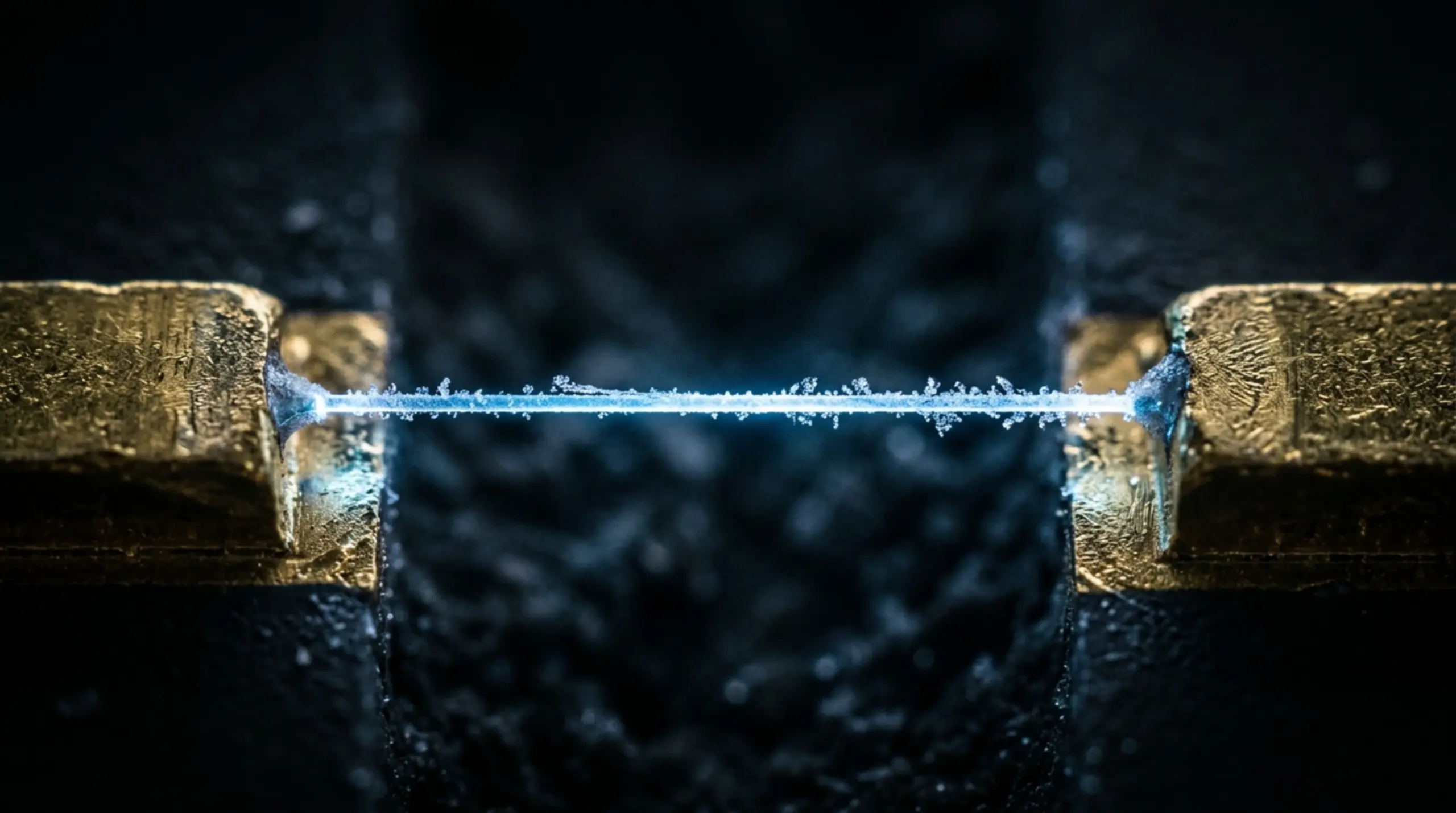
Researchers from Clemson University and the University of Maryland have demonstrated a method to reliably distinguish genuine topological behavior in Majorana nanowires from misleading signals caused by disorder. The work centers on quantum inductance, a property used in one-dimensional semiconductor-superconductor nanowire setups, to differentiate true fermion-parity crossings from “avoided crossings” or “narrow double crossings” that can mimic the presence of Majorana zero modes.
The team applied a Lehmann framework alongside microscopic simulations with disorder to show that only a true fermion-parity switch produces a characteristic inductive response. These combined measurements of quantum capacitance and quantum inductance offer a robust way to identify these switches, allowing for the development of topological quantum information processing systems.
Quantum Inductance Distinguishes Majorana from Trivial States
Quantum inductance measurements reveal distinct responses at avoided crossings and true fermion-parity switches in Majorana nanowires, offering a new method to verify the existence of these elusive quasiparticles. While quantum capacitance can indicate a change in fermion parity, it cannot reliably confirm a protected parity switch, a key indicator of non-trivial topological behavior, because disorder can create misleading signals.
The ability to differentiate between these scenarios relies on the unique sensitivity of quantum inductance to the phase structure of the low-energy spectrum. Researchers found that even when quantum capacitance curves appear similar, the corresponding quantum inductance curves exhibit markedly different features.
Specifically, extrema appear in the quantum inductance at the same flux values where avoided crossings occur in the capacitance curves, while a true fermion-parity switch shows a crossing between parity sectors in both measurements. “These extrema provide a clear diagnostic that distinguishes the avoided crossings present here from the true crossings observed in the topological case,” demonstrating the potential of quantum inductance to reliably identify topological phases.
Simulations of both topological and trivial regimes further illustrate this distinction. In the topological regime, the simulations show well-separated Majorana zero mode wavefunctions alongside a consistent response between quantum capacitance and quantum inductance, confirming a fermion parity switch.
In contrast, the trivial regime exhibits partially separated Andreev bound states and a quantum capacitance with “narrow double crossings” near specific flux values, but no corresponding net interchange of parity branches over a full flux period. This combined measurement approach provides a robust way to identify genuine Majorana zero modes and distinguish them from false signals created by disorder, advancing the development of topological quantum computing.
Majorana Nanowires Coupled to Quantum Dots for Parity Control
Microscopic modeling reveals that disorder within nanowires can generate false positives, mimicking the expected signals of true Majorana states. The team’s approach centers on a one-dimensional semiconductor-superconductor nanowire coupled to a quantum dot, forming an interferometric loop threaded by magnetic flux. In contrast, topologically trivial scenarios yield markedly different quantum inductance signatures, allowing for clear differentiation.
Specifically, the researchers found that quantum inductance exhibits h/e periodic crossings at the same flux values where genuine parity switches occur, but with parity curves out of phase by h/2e. “These results represent an important step toward nondestructive parity readout in high-quality InAs-Al hybrid platforms,” the researchers state, highlighting the potential for more reliable quantum computing architectures.
Flux-Dependent Quantum Capacitance Enables Parity Readout
While quantum capacitance can rapidly indicate fermion parity, it alone cannot definitively confirm a protected fermion-parity switch, a hallmark of non-trivial topology and the presence of Majorana zero modes. The potential for false positives arises because disorder within these nanowires can generate “avoided crossings” that mimic the expected behavior of a true parity switch, obscuring the existence of actual Majorana zero modes. Analysis of interferometric nanowire setups reveals that the low-energy spectrum becomes sensitive to both magnetic flux and the potential applied to a coupled quantum dot.
This geometry allows for radio frequency measurements of quantum capacitance, but interpreting crossing-like features in capacitance traces as protected crossings can be unreliable without additional verification. Researchers found that the flux dependence of quantum capacitance reverts to an effectively h/2e-periodic profile when parity assignment is not explicitly controlled, complicating the identification of genuine topological states.
Examining representative gate voltages within dominant resonance regions, the team observed level crossings in the energy spectrum at specific flux values. Specifically, the team examined scenarios with and without disorder, revealing that the absence of a true crossing in the low-energy spectrum, indicating no fermion-parity switch, corresponds to capacitance curves displaying avoided crossings. This distinction is vital for accurately identifying and using the potential of Majorana-based quantum technologies.
Disorder Mimics Topological Parity Switching
Quantum inductance exhibits pronounced extrema at magnetic flux values where disorder-induced, non-topological crossings occur in nanowire capacitance measurements, offering a new method to differentiate these false signals from genuine topological parity switches. This distinction provides a “clear diagnostic” for identifying trivial versus topological parity switching, demonstrating quantum inductance’s capacity to discriminate between these states.
Lehmann Framework Models Disorder Effects on Inductance
Researchers demonstrate that only a true fermion-parity switch generates a specific inductive response, while trivial crossings produce markedly different quantum inductance signatures. Effective models provide a framework for understanding how the low-energy spectrum influences both quantum capacitance and quantum inductance responses, revealing that protected crossings cause simultaneous sign changes in both measurements.
Avoided or narrow double crossings in capacitance, conversely, create pronounced extrema in quantum inductance, establishing the latter as a complementary diagnostic tool. This distinction is important because disorder within the nanowire can create these false signals, potentially leading to incorrect identification of Majorana zero modes. Therefore, the combined measurements of quantum capacitance and quantum inductance provide a robust and experimentally accessible means to identify true fermion-parity switches, corresponding to a nontrivial Pfaffian invariant.
Topological Invariants and Nontrivial Fermion Parity
Quantum inductance, when paired with quantum capacitance, offers a more reliable method for identifying genuine fermion-parity crossings, a key indicator of Majorana zero modes. The research demonstrates that parameter points classified as topologically trivial or nontrivial exhibit markedly different responses in both capacitance and inductance measurements, providing a robust diagnostic tool. Specifically, the team found that the combined analysis can discern true parity switches from misleading signals created by disorder within the nanowire.
The study details how the quantum capacitance and inductance respond to changes in magnetic flux, revealing distinct patterns for topological and trivial states. These results build on previous work establishing the h/e-periodic quantum capacitance as a means for fast fermion parity readout, but emphasize that capacitance alone cannot definitively confirm a protected parity switch.
The researchers further highlight that the absence of an idealized crossing structure, or the presence of both true crossings and narrow double crossings, does not automatically indicate a topologically trivial system. In conjunction with h/e-periodicity of individual parity sectors and a characteristic h/2e flux shift between them, the combined analysis of quantum capacitance and quantum inductance yields a robust signature of a true fermion parity switch.
Quantum Inductance Probes Low-Energy Spectrum Phase
Quantum inductance offers a new method for discerning genuine topological behavior in semiconductor-superconductor nanowire devices, specifically by differentiating true fermion-parity crossings from misleading signals created by disorder. The computed quantity, , directly reflects the inductive component of the linear response admittance, mirroring features accessible through existing experimental techniques. Corresponding quantum inductance measurements reveal similar h/e-periodic behavior, but with parity curves shifted by h/2e. These results highlight the complementary nature of capacitance and inductance measurements, with inductance probing the phase derivatives of the Hamiltonian, providing information about the curvature of the low-energy spectrum.
“Because it probes the low energy derivatives with respect to flux induced phase of the Hamiltonian distinct from the capacitance response, it encodes complementary information about the change in curvature of the low energy spectrum,” the researchers write. This work establishes flux-dependent quantum inductance as a robust diagnostic for identifying fermion parity switches in nanowire-quantum dot interferometric systems.
The team’s findings demonstrate that capacitance-based signatures alone are insufficient to unambiguously distinguish true topological crossings from those arising from hybridization effects, disorder, or smooth confinement. Without additional information, such features can lead to false-positive interpretations of a fermion parity switch, a problem quantum inductance directly addresses.
Andreev Bound States vs. Majorana Zero Modes
The simulations reveal that in topologically trivial regimes, quasi-Majorana modes, resulting from smooth confinement or finite size effects, can mimic the behavior of true Majorana modes, creating near-zero energy features that mislead conventional analysis. These states can be localized near one end of the wire or distributed throughout, presenting a challenge for unambiguous identification of genuine topological states.
The team’s work highlights the importance of differentiating between these scenarios, as relying solely on energy gap measurements can lead to false positives in detecting Majorana zero modes. To address this, the study focuses on the inductive response of the system, specifically the quantum inductance, as a means to discern true fermion-parity crossings from these misleading trivial crossings.
👉 More information
🗞 Quantum inductance as a phase-sensitive probe of fermion parity switching in Majorana nanowires
✍️ Binayyak B. Roy, Jay D. Sau and Sumanta Tewari
🧠 DOI: http://link.aps.org/doi/10.1103/x5ts-xw51



See today’s quantum computing news on Quantum Zeitgeist for the latest breakthroughs in qubits, hardware, algorithms, and industry deals.