Avani Vivrekar, Benjamin D. Woods and Mark Friesen of the University of Wisconsin-Madison report that spin splitting in a planar germanium Josephson junction unexpectedly remains consistent regardless of the junction’s width, a departure from behavior observed in indium arsenide nanowires. This finding is significant because germanium-based structures are promising candidates for Andreev spin qubits, devices that could combine the strengths of both superconducting and semiconducting qubits.
The researchers explored whether this stability could suppress the effects of disruptive charge traps, but found those traps also influence the chemical potential, complicating qubit control. Their results offer insights into optimizing spin qubits in materials exhibiting cubic spin-orbit coupling.
Gate-Tunable Josephson Junctions for Andreev Spin Qubits
This independence stems from the cubic nature of spin-orbit coupling in germanium, a fundamental difference from the linear coupling found in materials like indium arsenide, and has implications for suppressing decoherence. Researchers at the University of Wisconsin-Madison investigated how geometrical properties and gate-tunable chemical potential influence operations of Andreev spin qubits (ASQs) within these germanium-based structures. While isotopic purification can eliminate nuclear spins that cause decoherence in germanium, the cubic spin-orbit coupling introduces a challenge for ASQ design.
The work clarifies the robustness of tunable spin splitting in germanium-based ASQs, offering guidance for optimizing these architectures in experimental settings. However, the potential for exploiting this width-independence to mitigate charge trap effects is complicated by the fact that these same traps also influence the chemical potential, creating a dual impact on qubit control.
Charge traps affect both the channel width and the chemical potential, diminishing the possibility of isolating and suppressing decoherence through geometrical tuning alone. “Ge quantum wells are an important new platform for several types of spin qubits,” the study concludes, noting that germanium offers natural immunity to hyperfine noise and strong tunability of its electronic properties.
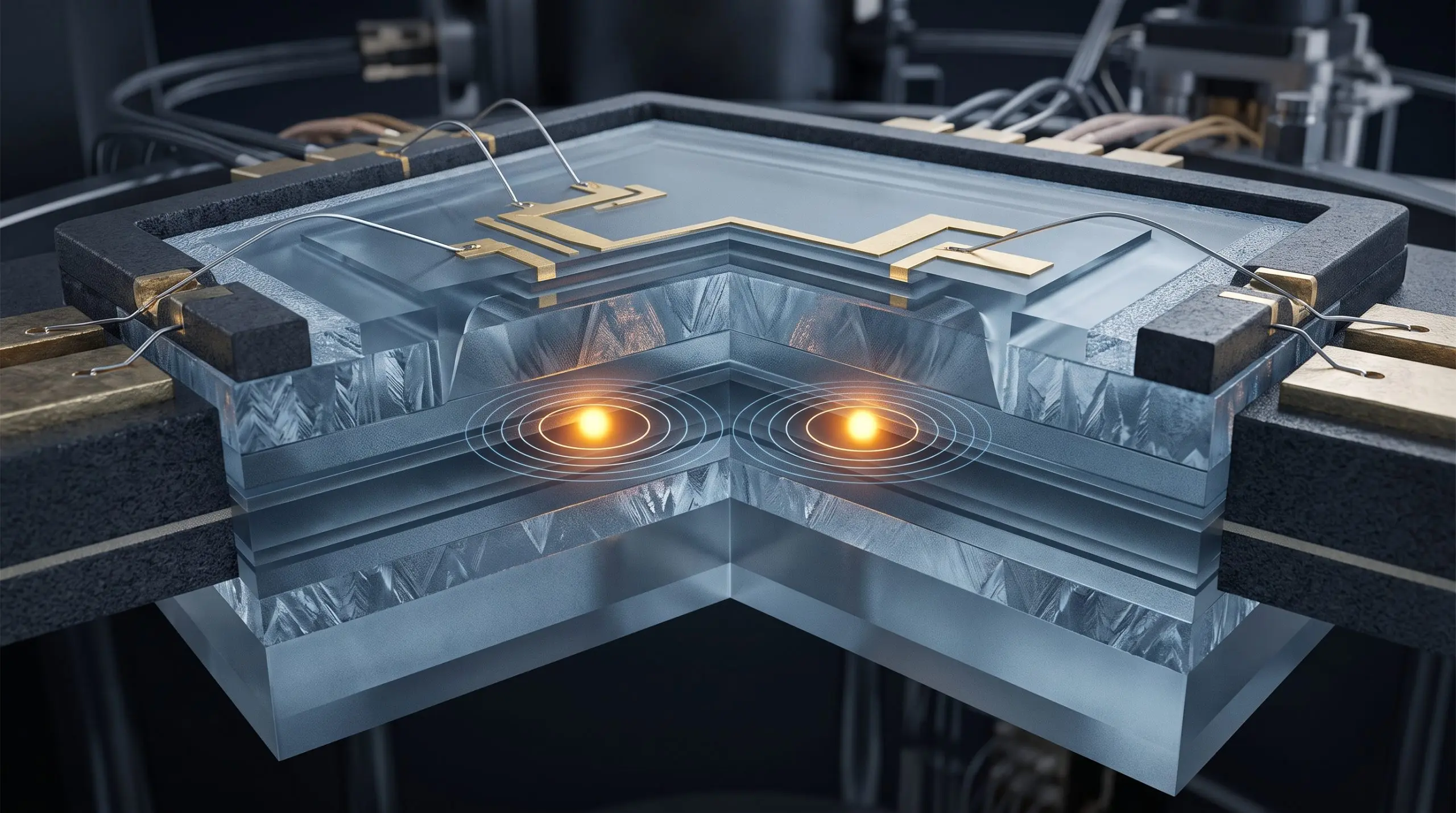
Their analysis focused on a specific materials stack, a thin strained germanium layer sandwiched between thicker layers of strain-relaxed silicon germanium. The energy dispersion of the Andreev bound states it hosts. The findings emphasize that while germanium provides a promising platform, further research is needed to address the limitations of smaller spin splittings and the detrimental effects of charge traps on chemical potential.
Ge Quantum Well Heterostructure Design and Materials
The heterostructure design of germanium quantum wells incorporates layers of aluminum oxide and nanofabricated metal top gates to precisely control carrier accumulation, a feature that allows for manipulation of spin qubits. These gates modify the electrostatic landscape within the germanium, enabling researchers to tune the properties of the two-dimensional hole gas forming at the interface between germanium and silicon-germanium layers. This layered approach allows for the creation of type-I quantum wells, specifically designed to capture holes, which are essential for Andreev spin qubit operation.
Simulations reveal that a trapped charge between superconducting leads alters the accumulation of these charge carriers, effectively reshaping the Josephson junction. The location of this charge, defined by its position along the y-axis, influences the junction’s width, a parameter typically linked to spin splitting behavior in materials like indium arsenide. This width-independence presents a potential pathway for enhancing qubit stability by mitigating the disruptive effects of charge traps.
Andreev Bound States in Planar Ge Josephson Junctions
While indium arsenide exhibits a linear relationship between SOC and momentum, germanium’s SOC increases with the cube of momentum, creating unique challenges for controlling spin states within Josephson junctions. Researchers are actively exploring these consequences to refine the physics of ABSs, particularly given the difficulty in resolving spin-splitting spectra in germanium due to its weaker SOC compared to indium arsenide.
Simulations using germanium quantum wells reveal a surprising independence of spin splitting from the junction width, a departure from observations in indium arsenide nanowires. The team modeled the energy dispersion of these ABSs, employing harmonic confinement along the transverse axis to simplify calculations and focus on the core physics.
Cubic Spin-Orbit Coupling in Germanium ASQs
This decoupling arises from the unique cubic relationship between spin-orbit coupling (SOC) and momentum in germanium, a characteristic that distinguishes it from materials like indium arsenide where SOC is linear. Researchers investigated how this property might suppress the disruptive effects of charge traps, a common source of decoherence in quantum systems, but found the issue more complex than initially anticipated. This interplay complicates efforts to isolate and mitigate decoherence, as a change in either parameter affects the qubit’s behavior.
The team’s work demonstrates that subband couplings, interactions between energy levels within the quantum well, also influence spin splitting, though to a lesser extent in materials exhibiting cubic SOC compared to those with linear SOC. This difference in sensitivity to subband couplings suggests a potential pathway toward designing more robust qubits in germanium-based heterostructures. The findings offer guidance for optimizing ASQs in materials with cubic SOC, highlighting the need to address the combined influence of geometrical and gate-tunable properties to achieve stable qubit operation.
Impact of Channel Width on Spin Splitting
The spin splitting within planar germanium structures remains unaffected by variations in channel width, a finding that diverges from observations in indium arsenide nanowires. Simulations reveal that the scaled spin splitting, represented as E_S/E_(S0) (where is the spin splitting without a charge trap), exhibits similar behavior for both linear and cubic spin-orbit coupling when a charge trap is present.
This occurs because the trap modifies the effective channel width while simultaneously shifting the chemical potential. The team modeled this effect by plotting the scaled spin splitting as a function of , the position of the charge trap, and observed consistent responses regardless of the spin-orbit coupling type.
The study demonstrates that even with cubic spin-orbit coupling, complete immunity to charge fluctuations is not achievable. The researchers derived an effective one-dimensional model by projecting a two-dimensional Hamiltonian onto harmonic-oscillator eigenstates, allowing for a detailed examination of the spin splitting’s dependence on channel width.
Their results, presented in the paper, show that distortions in the dispersion arise when subband couplings are activated, leading to differing Fermi velocities ( ≠ v_(F2)) and a resulting spin splitting. The team also investigated the scaled spin splitting, , as a function of relative energy, defined as [(μ-μ_0)^2 + (ℏω_y-ℏω_0)^2]^(1/2), across various points in the (μ,ℏω_y) parameter space. This analysis revealed that the charge trap’s influence extends beyond simply altering channel width, impacting the chemical potential and thus the overall spin splitting.
Charge Trap Effects on Ge ASQ Operations
Simulations reveal that the impact of a charge trap on spin splitting in germanium quantum wells is unexpectedly complex, extending beyond simple alterations to channel width. The location of the trap, modeled as a point charge situated between superconducting leads, influences spin-state energies and resulting spin splitting, a phenomenon explored through detailed computational analysis. The study demonstrates that charge traps do not merely modify the effective channel width, but also significantly affect the chemical potential within the germanium structure.
This dual influence complicates efforts to suppress decoherence, a major obstacle in quantum computing. To further understand this interplay, the scaled spin splitting was plotted against relative energy, examining variations across different parameter spaces. The simulations considered a heterostructure comprised of a strained germanium quantum well sandwiched between germanium-rich silicon germanium layers, mirroring common device construction.
The electrostatic potential created by the trapped charge was modeled with appropriate screening effects from the top gate and dielectric materials. This model allowed for an examination of how the charge trap alters charge carrier accumulation in the quantum well, effectively reshaping the Josephson junction. The team’s work highlights the importance of exploring the competition between variations in chemical potential and channel width to determine the true significance of the observed flat behavior in spin splitting.
Spin Splitting Analysis via One-Subband Modeling
This characteristic offers a potential, though complex, avenue for enhancing the stability of Andreev spin qubits (ASQs) by minimizing the impact of geometrical variations. The simulations employed an effective one-subband model to explain the observed power-law dependence of spin splitting on spin-orbit coupling constants, providing a framework for understanding these quantum phenomena. The study further clarifies the relationship between spin splitting and subband physics, detailing how the energy dispersions for spin states differ with linear spin-orbit coupling.
Researchers found that the chemical potential, rather than the junction width, exerts a dominant influence on spin splitting, a finding that complicates efforts to achieve complete immunity from charge fluctuations. Variations in the bottom of the transverse subband, due to potential energy fluctuations, impact the Fermi velocity and, consequently, the spin splitting, as detailed in the supplementary material.
A key consideration in these simulations was the definition of the Fermi energy, with the team holding the chemical potential difference fixed relative to the subband bottom. However, realistic devices experience local variations in this potential due to charge disorder, creating a subtle interplay between channel width and chemical potential. “Such variations affect the Fermi velocity and therefore the spin splitting,” the paper notes, highlighting the sensitivity of the system to external factors.
The work focused on planar silicon germanium/germanium/silicon germanium quantum wells with proximitized superconducting leads, a materials system where natural carriers are heavy holes exhibiting cubic-in-k spin-orbit coupling. The team’s analysis demonstrates that the strong dependence of spin splitting on the chemical potential largely overrides any potential immunity to charge noise, a finding that highlights the complexity of achieving stable qubit operation in this system.
👉 More information
🗞 Gate tunable spin splitting for Andreev spin qubits in Ge quantum well heterostructures
✍️ Avani Vivrekar and Benjamin D. Woods (Department of Physics, University of Wisconsin-Madison, Madison, Wisconsin, USA); Mark Friesen (Contact author:)
🧠 ArXiv: http://arxiv.org/abs/2611.18888v1


See today’s quantum computing news on Quantum Zeitgeist for the latest breakthroughs in qubits, hardware, algorithms, and industry deals.