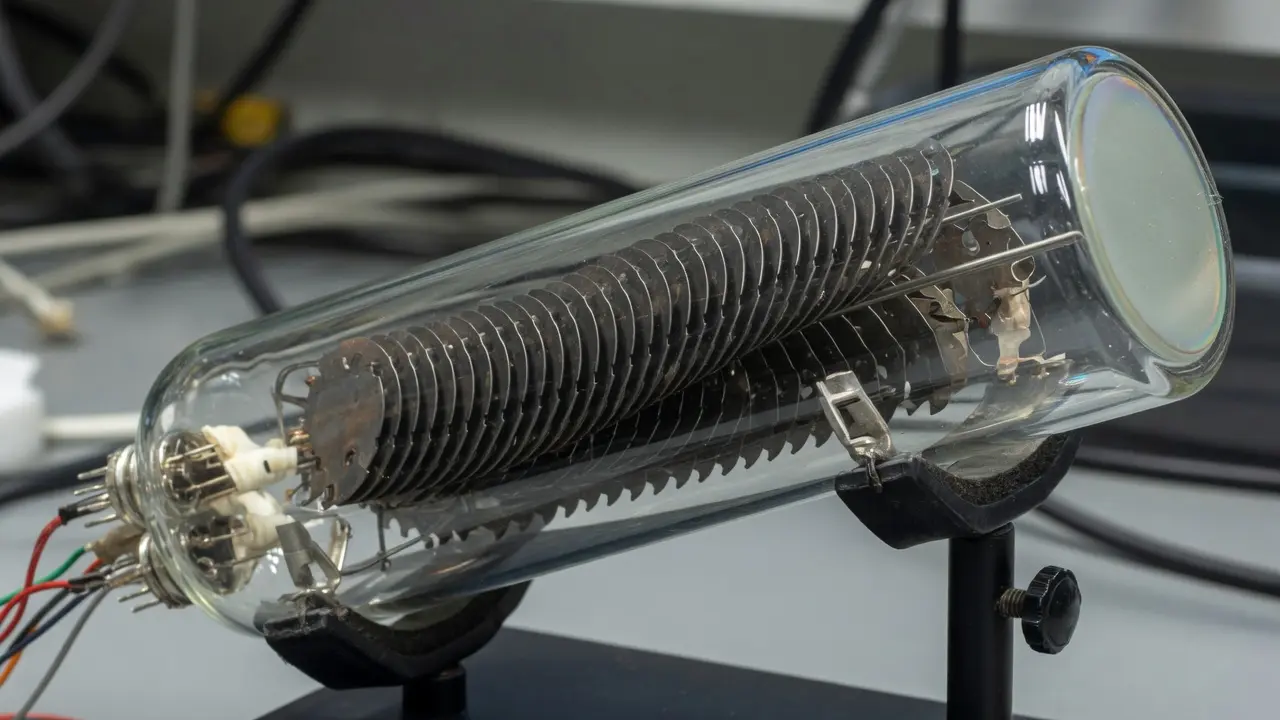
After five years of development, Euclid, in collaboration with Fermilab and Argonne National Laboratory, has achieved the first beam from a conduction-cooled superconducting radio frequency (srf) photogun. The system operates at 1.3 GHz and uses niobium-tin coatings and conduction cooling, advancements that dramatically reduce the cost of srf technology, historically too costly for industrial deployment.
This breakthrough enables ultrastable electron beams for ultrafast electron microscopy and diffraction, designed to deliver continuous wave operation while dissipating only approximately 2 watts of radio frequency power. The results, published in Beams, detail the system’s cooldown performance and initial beam parameters.
Euclid Lab Demonstrates First Conduction-Cooled Nb3Sn Photoinjector Beam
The 1.3 GHz photogun, a 1.5-cell structure, incorporates a novel design featuring a raised-back wall as the photocathode, eliminating the need for a removable insert and simplifying maintenance procedures. This design choice, coupled with the niobium-tin coating, allowed the entire cryomodule to be cooled using a commercial cryocooler, a departure from the liquid helium systems historically required for superconducting radio frequency devices. The team’s success in achieving stable operation at this frequency is particularly relevant for applications demanding high beam energy and low energy spread, such as ultrafast electron microscopy and diffraction.
Prior to the first beam, extensive radio frequency testing confirmed the system’s capabilities, with measurements taken both in a vertical test stand and at Euclid itself. These tests revealed cavity power dissipation curves and slopes that supported operation before reaching the cooling capacity of the cryocooler.
The ability to operate at these parameters represents a substantial cost reduction, as researchers noted that “These developments open the possibility of deploying srf photoinjectors outside large accelerator facilities and integrating them into laboratory-scale scientific instruments.” The first beam was successfully observed on a downstream YAG screen after a brief tuning period, confirming the functionality of the entire system. Table III in the published paper details the photogun’s design parameters and compares them to the performance achieved during vertical testing, conduction-cooled radio frequency operation, and the initial beam experiment.
Future development efforts will prioritize improving the quality of the niobium-tin coating and restoring the designed accelerating gradient, with the ultimate goal of achieving fully characterized beam operation. The team also plans to upgrade the laser-radio frequency synchronization system to enable stable phase locking and facilitate systematic beam-dynamics measurements.
These enhancements will support subsequent high-repetition-rate beam studies and move the system closer to practical application in MeV UEM/UED, as outlined in the paper. “We have demonstrated the first beam from the world’s first conduction-cooled superconducting rf photogun,” the researchers conclude, establishing Euclid Beamlabs as a leader in this emerging technology.
MeV-Scale srf Photogun Design for Ultrafast Electron Microscopy
The Euclid collaboration successfully achieved stable cryogenic operation with radio frequency dissipation levels compatible with its existing cryocooler capacity, a critical step in generating the first photoemitted electron beam. The system’s 1.3 GHz operating frequency, a standard within accelerator physics, is optimized for generating electron beams suited to the precise demands of ultrafast electron microscopy and diffraction.
The development of the photogun itself involved a 1.5-cell, 1.3 GHz superconducting structure designed for high-repetition-rate UED and UEM applications. Unlike many photoinjector designs prioritizing maximum accelerating gradient, this system aims to simultaneously achieve high beam energy and extremely low energy spread, critical parameters for preserving temporal and spatial resolution in UED/UEM experiments.
Radio frequency power is coupled into the cavity via a fixed coaxial fundamental power coupler, while an independent pickup probe provides the cavity field signal for the low-level radio frequency control system, ensuring stable beam production. The team’s work builds on earlier demonstrations of conduction-cooled operation, establishing a foundation for future improvements. While achieving MeV beam energy, high-repetition-rate operation and the stringent emittance, energy-spread, and stability requirements for practical UED/UEM remain ongoing objectives, the initial beam generation represents a substantial technological advancement. The team also intends to integrate the photogun into a dedicated MeV-UED/UEM beamline.
Nb3Sn Coating and Conduction Cooling Reduce srf System Complexity
The shift toward Nb3Sn coatings and conduction cooling represents a fundamental change in superconducting radio frequency (srf) system design, moving away from reliance on costly and complex liquid helium infrastructure. Historically, srf systems were too costly for industrial deployment, but these two advancements have dramatically reduced both system complexity and operating costs. This simplification stems from the ability of Nb3Sn-coated cavities to maintain high quality factors at temperatures achievable with commercially available cryocoolers, while conduction cooling eliminates the need for liquid helium by extracting radio frequency losses through highly conductive thermal links.
Engineering the thermal interface between the cavity and the cryocooler required precise fabrication techniques. Niobium cooling rings were welded around the cavity equators to provide these interfaces, connecting the cavity to external, high-conductivity thermal links attached to the cryocooler’s cold head.
The cryomodule housing the photogun was specifically designed for conduction-cooled operation, using a commercial two-stage cryocooler as its sole refrigeration source, a departure from conventional srf photoinjectors dependent on liquid helium. The cylindrical geometry of the cryomodule maximized structural rigidity while minimizing material usage and fabrication complexity, a critical consideration for laboratory-scale ultrafast electron microscopy and diffraction (UEM/UED) facilities. Thermal management within the cryomodule was carefully engineered to maximize cooling efficiency.
A copper thermal shield operating near 30 Kelvin surrounds the cold mass, thermally anchored to the cryocooler’s first stage to minimize radiative heat transfer to the superconducting cavity. Multilayer insulation and thermal intercepts were incorporated throughout the system, reducing conductive heat leakage through the beamline, support structures and radio frequency cables. Following removal of the degraded first coating, the cavity underwent a second coating process.
Beam-dynamics simulations predicted a maximum beam energy of approximately 400 keV for an appropriate laser injection phase. The developed system, combining a 1.3 GHz Nb3Sn-coated srf photogun, a compact cryogen-free cryomodule, and an integrated beamline, demonstrates that photoemission from a fully conduction-cooled srf photoinjector is achievable without liquid-helium infrastructure. Throughout the project, several technical challenges emerged, including those related to Nb3Sn coating, cryogenic integration, thermal management, magnetic shielding and beamline assembly.
These were systematically addressed. The successful operation of the photogun validates the combination of Nb3Sn cavity technology with cryocooler-based conduction cooling for compact accelerator applications, suggesting a future where such systems are more accessible and versatile.
Initial Photoemission Beam Parameters and Characteristics
The Euclid lab’s 1.3 GHz superconducting photogun successfully generated a photoemission beam, marking the first such demonstration from a conduction-cooled system and validating a design intended for high-resolution ultrafast electron diffraction and microscopy. The accelerating structure, a 1.3-GHz superconducting photogun, combines a photocathode half-cell with a TESLA-type full cell, a configuration optimized for both beam energy and minimal energy spread, critical parameters for UED and UEM applications.
Electromagnetic simulations predicted an accelerating field on axis of 27.7 MV/m, corresponding to a peak surface electric field of 54.7 MV/m and a peak surface magnetic field of 43.3 mT, parameters detailed in Table I within the published work. The final cavity design incorporates a shorter half-cell geometry with a raised-cathode structure, a feature intended to enhance performance in these demanding applications. Following a standalone cooldown test confirming proper cryocooler function, the cavity was integrated into a cryomodule and subjected to further evaluation.
A mechanical imbalance, identified during photogun integration due to the weight of a valve and beam pipe assembly, required modification of the support structure. This structure employed low-thermal-conductivity materials with a small cross-sectional area to minimize parasitic heat load to the cold mass, a critical consideration for maintaining stable cryogenic operation. Table III provides a detailed comparison of the photogun design parameters, vertical-test performance, best conduction-cooled rf performance and first-beam operating conditions, highlighting the progress achieved during the project.
👉 More information
🗞 First beam demonstration of a conduction-cooled Nb₃Sn superconducting rf photoinjector
✍️ Chunguang Jing et al.
🧠 DOI: http://link.aps.org/doi/10.1103/bgwr-36wy

See today’s quantum computing news on Quantum Zeitgeist for the latest breakthroughs in qubits, hardware, algorithms, and industry deals.