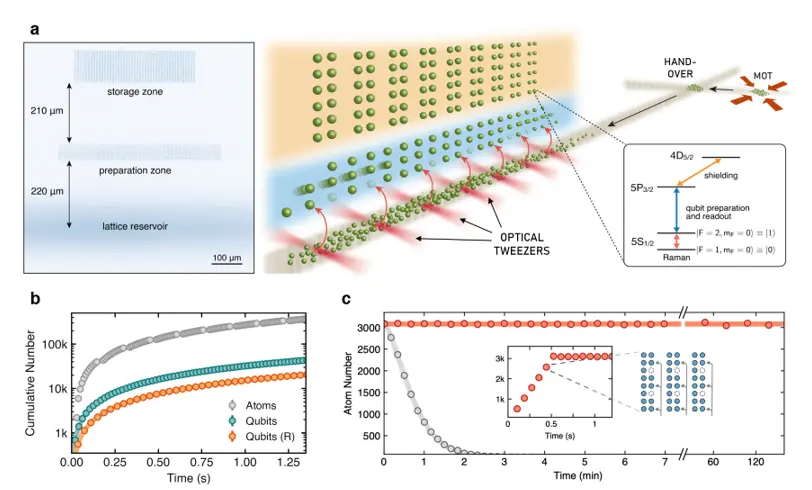
Researchers at the MIT-Harvard Center for Ultracold Atoms have achieved continuous operation of a quantum system containing over 3,000 qubits, a milestone enabled by a reloading rate of 300,000 atoms moved into the system using optical tweezers per second. The team maintained this array of over 3,000 atoms for more than two hours, overcoming a key limitation of neutral atom quantum computing that typically restricts operation to pulsed mode. This architecture persistently replenishes qubits in either spin-polarized or coherent superposition states without disturbing existing quantum information.
Lukin Lab Demonstrates 3,000-Qubit Continuous Operation
The Lukin lab demonstrated a qubit creation rate exceeding 30,000 per second, achieving a reloading rate of 300,000 atoms in tweezers per second. This rapid replenishment is central to their demonstration of sustained quantum operations, allowing for the continuous assembly and maintenance of a sizable qubit array. The team’s architecture uses two optical lattice conveyor belts to transport reservoirs of rubidium-87 atoms into the experimental region, effectively circumventing the limitations imposed by atom loss that typically restrict neutral atom quantum computing to pulsed operation.
This persistent replenishment is achieved through a cyclical process where the oldest subsection of the array is replaced every 80 milliseconds, extending operational duration far beyond the natural 60-second lifetime limited by tweezer stability. Over the course of 2.3 hours, the system cycled through more than 50 million individually imaged and rearranged atoms within the storage array, demonstrating a level of stability essential for complex calculations.
The researchers report this capability enables the realization of continuously operated atomic clocks, sensors and fault-tolerant quantum computers. The team’s approach addresses a fundamental challenge in scaling quantum systems; the ability to maintain a large number of qubits for extended periods is essential for implementing quantum error correction protocols. The experimental setup divides the operational space into three zones: a preparation zone, a storage zone, and the atom reservoir.
Atoms entering the preparation zone undergo laser cooling and arrangement before being “shielded” and initialized into a qubit state. This iterative construction, completed in 0.5 seconds with six loading iterations, allows for the systematic assembly of the large-scale array. As stated in their recent publication, this method demonstrates cyclic replenishment and continuous maintenance, offering a pathway toward practical, utility-scale quantum computing.



See today’s quantum computing news on Quantum Zeitgeist for the latest breakthroughs in qubits, hardware, algorithms, and industry deals.