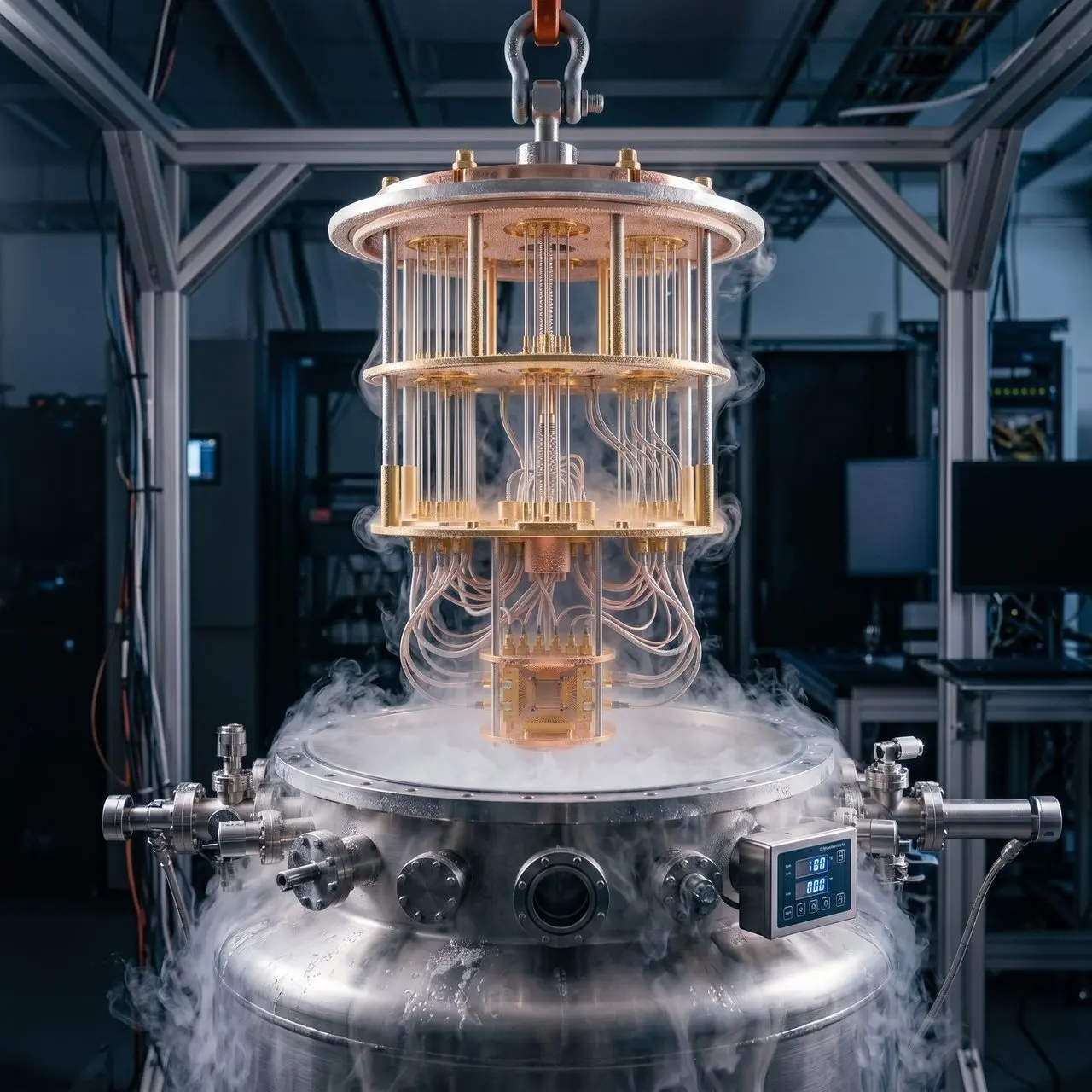
Researchers led by Eleanor Crane have developed a hybrid quantum processor framework that achieves a constant number of operations per gate as a function of the bosonic cutoff. The work pairs superconducting qubits with microwave cavities to simulate strongly correlated problems, those involving interacting fermions and bosons.
This approach enables the simulation of complex systems like (2+1)-dimensional gauge theories, previously inaccessible to both classical and existing quantum computers. This work establishes digital hybrid qubit-boson quantum simulation as a promising and advantageous method for solving many challenging, strongly correlated, fermion-boson models of relevance to science and technology.
Hybrid Qubit-Boson Framework Simulates Fermions and Bosons
This efficiency stems from encoding both bosonic matter and gauge fields directly in the native oscillator modes of the hybrid processor, bypassing the substantial overhead of converting bosons into qubits. By avoiding this conversion, the framework sidesteps a major bottleneck in simulating systems with both fermionic and bosonic components. These theories, which describe fundamental interactions, have previously been studied using methods like Euclidean lattice gauge theory and quantum Monte Carlo, but these techniques face limitations when dealing with continuous gauge fields or real-time scattering scenarios.
The framework’s ability to address these challenges is due to the native availability of bosonic gate sets, a key component for simulating Hamiltonians containing bosons that is costly to implement on qubit-based hardware. The framework’s design allows for the implementation of time-evolution operators using a gate known as SNAP, which further streamlines calculations.
Applications extend beyond fundamental physics, potentially impacting fields like materials science, drug discovery and energy technology by enabling better understanding of phenomena such as electricity transmission without loss and efficient solar energy conversion. The framework is adaptable to superconducting, trapped-ion, and neutral-atom hardware, broadening its potential for implementation.
Hybrid quantum processors offer a distinct advantage in simulating complex systems, requiring fewer computational resources than purely qubit-based approaches for certain models. This difference in gate count is particularly pronounced as the local Hilbert space cutoff increases, demonstrating a potential pathway to scaling simulations beyond the reach of current digital quantum computers. This framework enables the simulation of a wide range of models involving bosons, fermions and gauge fields.
Variational Quantum Eigensolvers & Signal Processing Implementation
Researchers demonstrate the compilation of dynamics, error detection and observable measurements using both variational quantum eigensolvers and quantum signal processing within this hybrid architecture. A digital approach to implementation offers flexibility in studying diverse Hamiltonians and measuring long-range observables like the string-order correlator. Existing quantum simulation algorithms, including Trotterization, phase estimation and quantum signal processing, can be adapted for use on this qubit-boson platform, with potential for straightforward expansion into higher-dimensional systems.
This work establishes digital hybrid qubit-boson quantum simulation as a promising and advantageous method for solving the many challenging, strongly correlated, fermion-boson models of relevance to science and technology.
However, to reach the same circuit fidelity as qubit-boson hardware with 99.9% per-gate fidelity, a qubit quantum computer using the best-known method would still need fidelities of at least 99.9999%, likely requiring substantial error correction.
To demonstrate practical application, the team applied these compilation methods to variants of the -Higgs model, containing bosonic matter and the quantum link model, featuring fermionic matter, both in.
These models serve as specific examples of more general LGT Hamiltonians, with detailed implementation specifics outlined in the study. The researchers benchmarked near-term algorithms, Trotter and variational approaches and longer-term techniques like quantum signal processing for both dynamics and ground-state preparation, including methods for measuring Hamiltonian expectation values.
“We introduce a ‘post-qubit quantum advantage’ experiment which is out of reach for both near-term qubit-only quantum computers and classical computers,” the paper states, highlighting the potential for simulations beyond the capabilities of current technology. The work also presents a technique using quantum signal processing to ensure provable success probabilities in ground-state preparation.
The team designed an experiment intended to showcase capabilities beyond the reach of current near-term qubit-only quantum computers and classical computational methods.
Optimized Qubit Algorithm for Beam Splitter Simulation
A new qubit algorithm reduces the computational load for simulating beam splitters, achieving a scaling of approximately 𝑁1+𝑜(1)max, a performance edge over existing qubit methods, by using a boson number cutoff of 𝑁max. This optimization addresses a critical bottleneck in simulating quantum systems, as traditional qubit-based approaches demand increasingly high fidelities to match the performance of hybrid qubit-boson hardware. To reach 99.9% per-gate fidelity comparable to the hybrid system, a qubit quantum computer would require fidelities of at least 99.9999%, a threshold likely necessitating substantial error correction.
Bosonic Gate Fidelity Estimates via Lindblad Simulation
Lindblad simulation estimates suggest a hybrid qubit-boson system could achieve 99.9% per-gate fidelity, a threshold that currently demands 99.9999% fidelity from purely qubit-based approaches. This discrepancy highlights a potential advantage for the hybrid framework in simulating complex systems without relying on extensive error correction. Implementation of on-site bosonic interactions requires only a single selective number-dependent arbitrary phase (SNAP) gate, using a single ancilla, which can be removed when simulating lattice gauge theory.
Researchers also demonstrated a planar dual-rail architecture for mapping fermions to qubits, employing a gate introduced earlier in the study. For a single Trotter step, all-qubit architectures would require more than entangling gates to achieve comparable fidelity.
While the paper centers on superconducting hardware, the underlying algorithms and techniques are platform agnostic, allowing for implementation in systems like trapped ions and neutral atoms. Pairing superconducting qubits with microwave cavities could reduce the hardware requirements for quantum simulations of fundamental physics.
Strongly Correlated Fermion-Boson Systems in Physics & Chemistry
Simulating strongly interacting fermionic and bosonic particles, such as electrons, quarks and lattice vibrations, presents a challenge beyond the reach of both conventional computers and current, uncorrected quantum systems. A newly developed hybrid quantum-simulation framework pairs qubits with bosonic oscillators to tackle these complex problems, potentially even without the need for error correction. This approach offers a pathway to modeling systems previously inaccessible to existing computational methods.
The framework’s versatility extends beyond superconducting hardware, with potential implementation in trapped-ion and neutral-atom platforms, broadening its applicability to diverse experimental setups. A key advantage of this digital hybrid approach lies in its ability to address the rapid growth in computational demands associated with bosonic systems, as the number of amplitudes that must be calculated increases quickly with the size of the system.
👉 More information
🗞 Hybrid Oscillator-Qubit Quantum Processors: Simulating Fermions, Bosons, and Gauge Fields
✍️ Eleanor Crane et al.
🧠 DOI: http://link.aps.org/doi/10.1103/s5bn-z4jq




See today’s quantum computing news on Quantum Zeitgeist for the latest breakthroughs in qubits, hardware, algorithms, and industry deals.