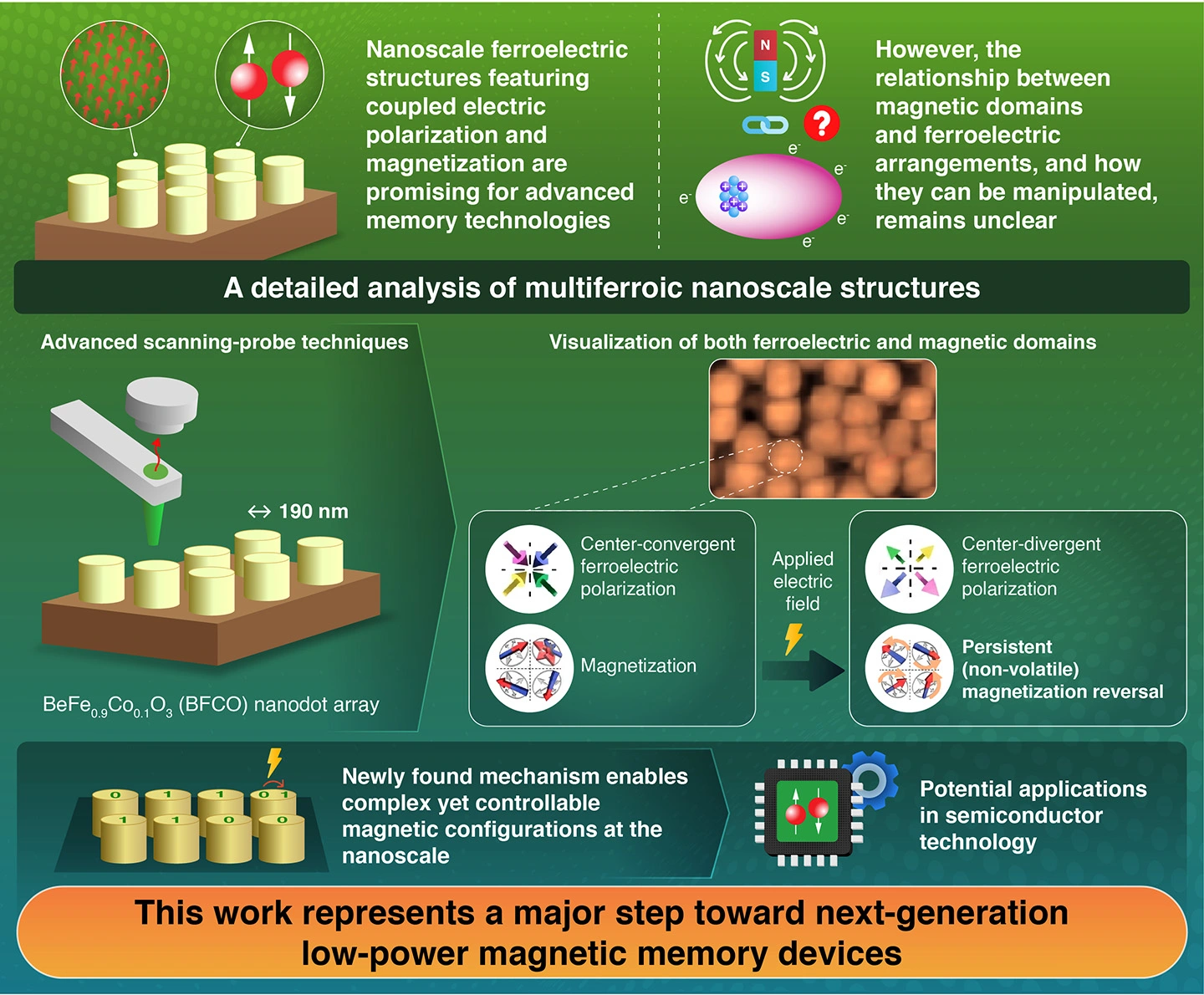
Researchers from Science Tokyo have fabricated BFCO nanodots to directly observe how electric fields restructure polarization and reverse magnetization, a key step toward lower-energy data storage. The team reports demonstrating reliable magnetization reversal using electric fields instead of current, potentially solving a growing energy challenge posed by cloud computing, artificial intelligence, and data centers. Magnetic memories using this method are non-volatile, retaining information without power, and avoid the energy-dissipating Joule heat of current-based writing. This research offers a pathway to significantly more energy-efficient memory devices.
Piezoresponse Microscopy Maps Polarization Switching in BFCO Nanostructures
Piezoresponse force microscopy revealed a distinct shift in electric polarization within 190 nm BiFe 0.9 Co 0.1 O 3 (BFCO) nanodots when subjected to an electric field, directly visualizing the mechanism behind magnetization reversal. Researchers observed an initial polarization structure transform into a center-divergent structure, a change that helps control magnetic properties at the nanoscale. This restructuring wasn’t a simple spin flip, but a rotation of the magnetic moment within the material’s easy plane, responding directly to the altered polarization.
The team’s imaging combined piezoresponse force microscopy, mapping electric polarization, with scanning nitrogen-vacancy center magnetometry, detecting magnetic fields to correlate the two phenomena. The observed link between polarization switching and magnetization direction is significant because it demonstrates a pathway to manipulate magnetic states without relying on electric current. The researchers report highlighting the potential for more efficient memory devices.
This control at nanoscale dimensions, roughly one-thousandth the width of a human hair, is particularly relevant to the ongoing miniaturization of semiconductor devices. The ability to reliably reverse magnetization using electric fields, rather than current, circumvents the energy losses associated with Joule heating, a major concern in high-density data storage.
This precise control over magnetic configuration has implications for addressing the increasing energy demands of modern technologies. Published in Science Advances on June 17, 2026, the findings detail a method for creating memory that avoids the continuous power draw of traditional volatile RAM, offering a potential solution for sustainable data storage.
This mechanism enables complex yet controllable magnetic configurations at nanoscale dimensions relevant to semiconductor devices.
Shigematsu, the complex domain structure of a single nanodot could in principle encode multiple magnet
Electric Polarization Restructuring Enables Controllable Nanoscale Magnetic Configurations
Applying an electric field to BFCO nanodots, the team’s imaging revealed a transformation of the initial polarization structure into a center-divergent structure where polarization vectors point outward from a central point. This precise control over magnetic configuration, achieved through electric field manipulation, offers a pathway toward miniaturizing memory technology beyond current limitations.
This level of control is particularly relevant for semiconductor devices, according to Shigematsu, who explains, “This mechanism enables complex yet controllable magnetic configurations at nanoscale dimensions relevant to semiconductor devices.” The observed magnetic moment rotation distinguishes this method from conventional magnetization reversal techniques, offering a more nuanced approach to data writing. The researchers demonstrated reversal in both in-plane and out-of-plane directions, indicating a comprehensive manipulation of the magnetic state within the nanodots.
The potential impact extends to addressing the escalating energy demands of modern computing infrastructure. “Compared to current-based technologies such as spin-transfer torque magnetic RAM, this approach could significantly reduce energy consumption,” remarks Shigematsu, highlighting the efficiency gains possible by using electric fields instead of electrical current.
By enabling magnetic information to be written electrically and read magnetically, these devices could offer non-volatile operation, retaining data without continuous power input, and circumvent the energy-dissipating Joule heat associated with traditional methods. This offers a potential solution to the increasing energy footprint of cloud computing, artificial intelligence, and the expanding network of data centers globally.
Compared to current-based technologies such as spin-transfer torque magnetic RAM, this approach could significantly reduce energy consumption.
Shigematsu, the complex domain structure of a single nanodot could in principle encode multiple magnet


See today’s quantum computing news on Quantum Zeitgeist for the latest breakthroughs in qubits, hardware, algorithms, and industry deals.