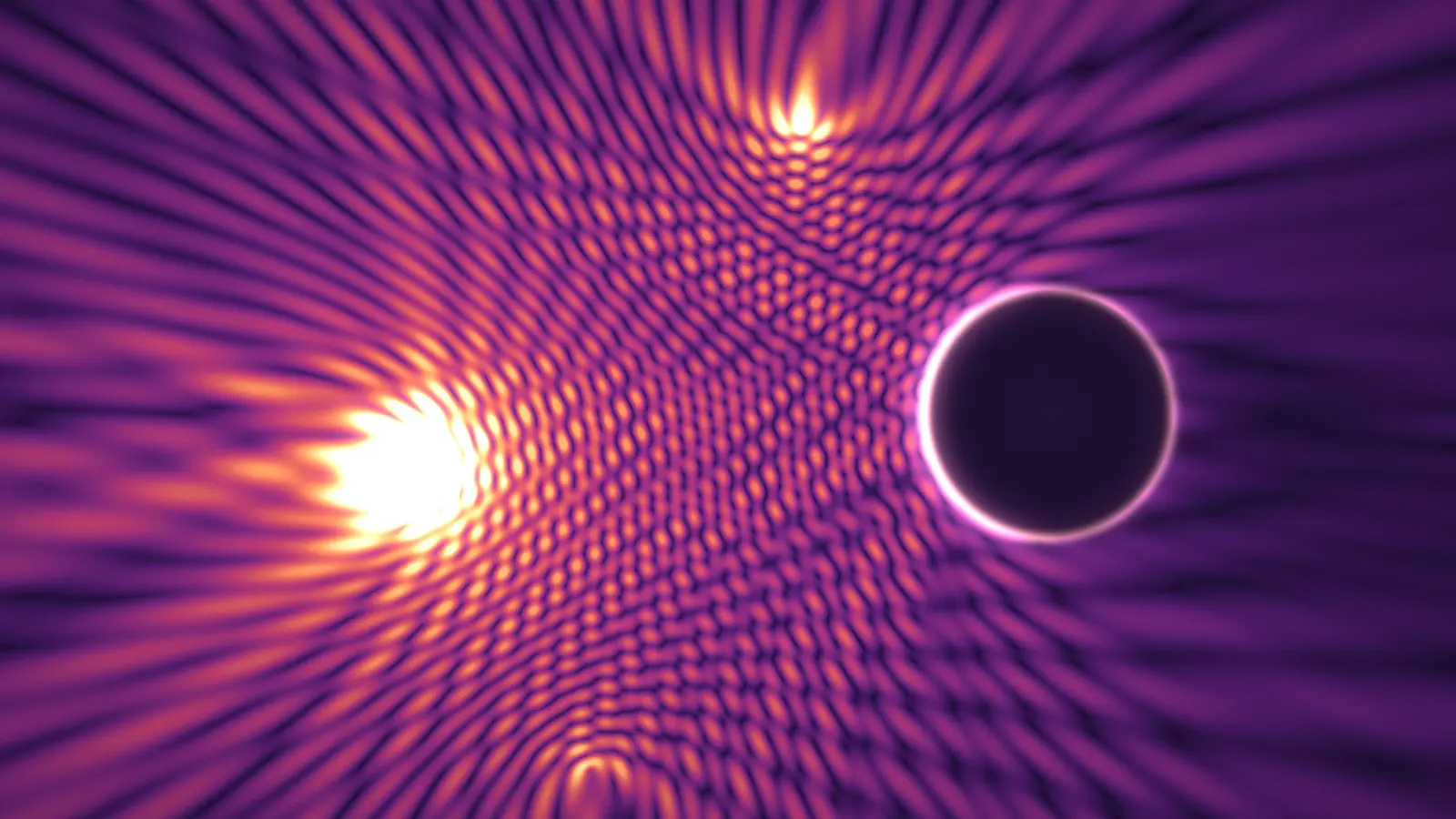
Researchers from seven institutions, including the University of Marburg, Forschungszentrum Jülich, and University of Graz, have directly imaged the quantum behavior of excitons, correlated electron-hole pairs central to the function of organic semiconductors. The team employed femtosecond time-resolved photoemission orbital tomography to map exciton wave functions in α-sexithiophene thin films, a feat previously inaccessible to experimental observation.
This work, published August 28, 2026, reconstructs the exciton wave function in real space, revealing coherent delocalization across approximately three molecular units and a 25% contraction of the exciton radius within 400 femtoseconds, suggesting self-trapping driven by exciton-phonon coupling.
trPOT Imaging Reveals Exciton Momentum Distribution in α-Sexithiophene
Excitons, the fundamental particles responsible for light absorption and energy transport in organic semiconductors, have historically been difficult to observe directly due to their quantum behavior. A new imaging technique has provided insight into their momentum distribution and dynamics. Researchers successfully mapped these electron-hole pairs within α-sexithiophene thin films using a method called femtosecond time-resolved photoemission orbital tomography, or trPOT. This advancement overcomes limitations of conventional spectroscopy, which struggles to simultaneously capture both real-space and momentum-space profiles with the necessary speed to observe exciton behavior.
The reconstructed wave function demonstrates coherent delocalization extending across approximately three molecular units, a finding corroborated by calculations utilizing many-body perturbation theory. The method’s sensitivity extends to spatial, phase, and temporal characteristics, making it applicable to a wide range of molecular and low-dimensional materials.
Researchers utilized high-harmonic probe pulses combined with time- and momentum-resolved photoelectron spectroscopy to directly image the momentum-space distribution of excitons as they evolve over time. The data acquired through trPOT was then processed using a newly developed model, allowing for the reconstruction of the exciton’s wave function in real space. Visualizing the exciton’s phase structure is significant, as it provides insights into the quantum mechanical properties governing energy transfer within the material.
The observed phase modulation aligns with theoretical predictions, bolstering confidence in the accuracy of the reconstruction process. The observed contraction of the exciton radius within a few hundred femtoseconds suggests a dynamic interplay between the exciton and the surrounding molecular environment. This self-trapping phenomenon, driven by exciton-phonon coupling, could have important implications for optimizing the performance of organic optoelectronic devices.
The implications of this research extend beyond fundamental understanding; the team anticipates that trPOT will be a powerful framework for benchmarking theoretical descriptions of excitonic phenomena. By providing a direct experimental probe of exciton wave functions, the technique allows for rigorous validation of computational models and facilitates the design of materials with tailored optical and electronic properties. The researchers have made their data available for download as BibTeX and EndNote (RIS) files.
This analytical route for imaging electron-hole pairs across a broad range of low-dimensional semiconductor materials represents a step forward in the field of organic electronics. The team’s success in resolving the intricate details of exciton behavior opens new avenues for controlling and harnessing these fundamental particles, potentially leading to more efficient solar cells, light-emitting diodes, and other advanced technologies. The method detailed in the published work provides a foundation for future investigations into the complex interplay between excitons, molecular structure, and material properties.
Real-Space Reconstruction of Exciton Wave Function and Phase Structure
Directly visualizing the quantum behavior of excitons, bound pairs of electrons and holes, within organic semiconductors has been a significant challenge for physicists, but recent advances in photoemission techniques are beginning to yield detailed insights into these fundamental particles. Researchers have now successfully reconstructed the wave function of excitons in α-sexithiophene thin films, revealing both their spatial extent and internal phase structure with clarity. The team developed a computational model to translate the momentum-space data obtained through trPOT into a real-space representation of the exciton wave function.
This reconstruction demonstrates that excitons in α-sexithiophene are coherently delocalized across approximately three molecular units, indicating a surprisingly extended spatial distribution. Crucially, the reconstructed wave function also exhibits a distinct phase modulation, a characteristic pattern that confirms the accuracy of theoretical predictions derived from calculations using many-body perturbation theory.
Femtosecond Dynamics Show 25% Exciton Radius Contraction via Self-Trapping
This method allowed the team to map the momentum-space distribution of excitons within α-sexithiophene thin films and to track their evolution over incredibly short timescales. The analytical model developed by the researchers is crucial to interpreting the trPOT data. These calculations, which treat the interactions between electrons and the material’s lattice, provide a theoretical benchmark against which the experimental results can be validated. The close agreement between experiment and theory strengthens confidence in the accuracy of the trPOT technique and the underlying understanding of exciton behavior.
Beyond simply visualizing the exciton’s initial state, the time-resolved measurements revealed a dynamic change in its spatial extent. Within 400 femtoseconds, the exciton radius contracted by approximately 25%, a rapid compression suggesting a process known as self-trapping.
The team attributes this self-trapping to exciton-phonon coupling, where the exciton exchanges energy with lattice vibrations, leading to a distortion of the molecular structure and a reduction in the exciton’s spatial spread. Excitons are responsible for carrying energy through these materials, and their behavior directly impacts the efficiency of devices like organic solar cells and light-emitting diodes.
A localized exciton, as a result of self-trapping, may exhibit different transport characteristics than a delocalized one, potentially influencing the overall performance of the device. The researchers have made data from this study available for download in BibTeX and EndNote (RIS) formats.



See today’s quantum computing news on Quantum Zeitgeist for the latest breakthroughs in qubits, hardware, algorithms, and industry deals.