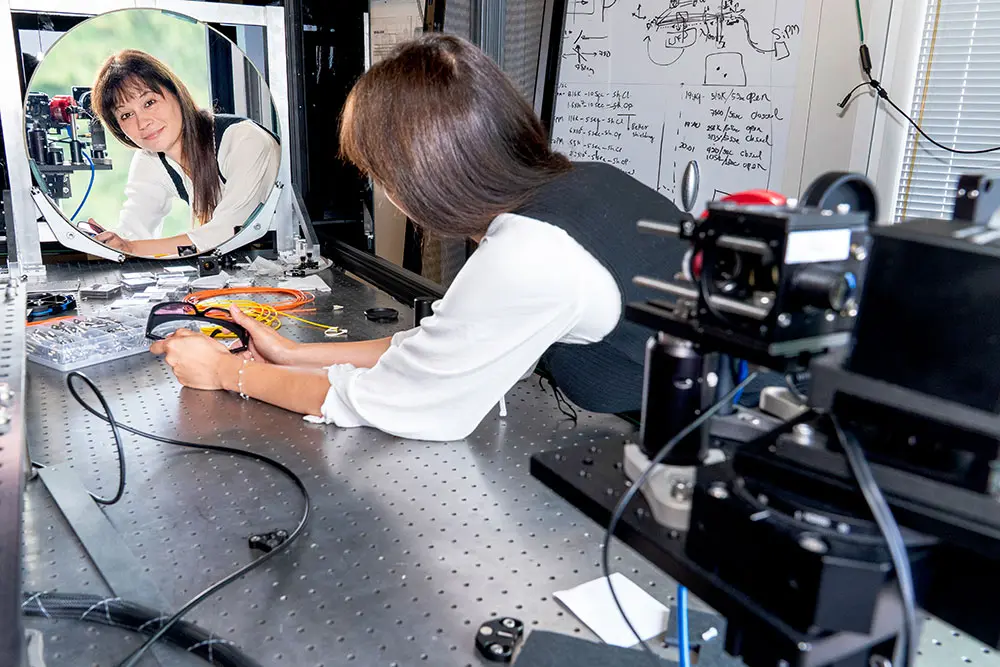
Extending 161 miles across Long Island and the New York metropolitan area, the nation’s longest quantum network now incorporates a wireless link established by Justine Haupt of Brookhaven Lab. Haupt developed the telescope technology, specifically the mirrors, to enable the transmission of light particles containing quantum information through open air. “An FSO link is analogous to the wireless technology that allowed today’s classical internet to expand beyond wired connections,” Haupt said, marking the first permanent free-space optical link of its kind and a crucial step toward a practical quantum internet.
Free-Space Optical Link Extends Long Island Quantum Network
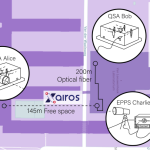
A 13-mile stretch of open air now carries quantum information between Brookhaven National Laboratory and Stony Brook University, extending the nation’s longest quantum network with a novel free-space optical (FSO) link. This achievement establishes the first permanent wireless connection of its kind, mirroring the expansion of the classical internet beyond wired infrastructure to include satellites and cellular networks. Justine Haupt at Brookhaven Lab spearheaded the development of the telescope technology central to this transmission.
The newly established link relies on transmitting entangled photons, pairs of light particles linked by quantum mechanics, across the open air, a feat complicated by atmospheric turbulence. Light traveling through the atmosphere encounters crinkling effects, requiring engineers to develop adaptive optics capable of real-time correction. Haupt explained that the system must counteract distortions caused by varying ground temperatures and wind interactions.
A Brookhaven Lab team of scientists, engineers, students, and leaders stand outside the Lab’s Quantum Lighthouse, a facility located on the rooftop of a seven-story building. This collaboration developed the adaptive optics technology essential for the free-space optical link connecting Brookhaven, Stony Brook University, and Yale University. The fiber diameter is 5 microns. Eden Figueroa, director of Stony Brook’s Quantum Institute, emphasized the shift from developing quantum devices to actively engineered large-scale quantum systems.
“We are moving past the era of developing quantum devices and entering an age where we actively engineer large quantum systems, such as our long-distance quantum network,” Figueroa said. Researchers have successfully transmitted entangled photons from Stony Brook’s Quantum Watchtower to Brookhaven’s Quantum Lighthouse. The connection between Stony Brook and Yale is currently under development.
The success of this link is not merely a technological demonstration; it’s a crucial step toward realizing the potential of secure quantum communications, advanced quantum sensing, and networked quantum computing. “By bridging our labs with deployed fiber and free-space optical quantum links, we are building Einstein’s ‘spooky action at a distance’ thought experiments, while also establishing secure quantum networks and training the brilliant minds who will run them,” Figueroa added.
An FSO link is analogous to the wireless technology that allowed today’s classical internet to expand beyond wired connections to orbiting satellites, as well as our cell phones.
Justine Haupt, Brookhaven Lab’s lead scientist on the cross-institutional FSO link project
Entangled Photons Enable Secure Quantum Communications
This FSO link isn’t simply about extending the reach of quantum communication; it’s about overcoming significant technical hurdles inherent in transmitting delicate quantum states. Entangled photons, the foundation of this network, require precise alignment and minimal disturbance to maintain their linked properties over distance. Traditional fiber optic cables shield photons from atmospheric turbulence, but transitioning to free space demands active compensation for distortions. The system utilizes mirrors, warped thousands of times per second, to counteract atmospheric “crinkling” of the light, ensuring a clear signal reaches the receiving telescope.
The engineering challenge proved greater than adapting technology from astronomy, despite Haupt’s team’s experience building components for the Vera C. Rubin Observatory. While astronomers observe through a limited layer of turbulent air at high altitudes, the FSO link traverses the entire turbulent ground layer. The FSO link, combined with existing fiber infrastructure, is building a platform for exploring the fundamental principles of quantum mechanics and paving the way for secure quantum communication and advanced quantum sensing.
When you look at the horizon over such a distance, it’s very blurry because of the atmosphere.
Justine Haupt, Brookhaven Lab’s lead scientist on the cross-institutional FSO link project
Adaptive Optics Corrects Atmospheric Turbulence for FSO Transmission
Haupt’s team faced a unique challenge: adapting adaptive optics, traditionally used to sharpen astronomical images, to maintain the integrity of single photons traveling a relatively short distance through turbulent air. The core problem lies in atmospheric “crinkling” of light, a phenomenon that blurs images over long distances. As light traverses the atmosphere, variations in temperature and density distort its wavefront, requiring correction to refocus the beam.
To counteract this turbulence, engineers employ mirrors that are rapidly reshaped thousands of times per second. These mirrors, pushed and pulled by actuators, compensate for the atmospheric distortions in real time, effectively “uncrinkling” the light.
The system doesn’t simply magnify or enlarge the signal; it actively corrects for the distortions, ensuring a clear transmission. This expansion is crucial for capturing enough photons to establish a reliable quantum link. The complexity of this system extends beyond correcting for atmospheric effects; the team also had to account for ground-level turbulence caused by buildings, trees, and varying terrain, all of which contribute to atmospheric instability.
Despite the engineering hurdles, the team is actively working to overcome limitations and enable all-weather operation, acknowledging that clear skies and nighttime conditions currently provide the most reliable transmission windows. “It’s one of the key technologies needed to make a quantum internet truly useful,” Haupt added, highlighting the potential of this technology to move quantum communication beyond the confines of fiber optic cables.
We are moving past the era of developing quantum devices in the laboratory and entering an age where we actively engineer large quantum systems, such as our long-distance quantum network.
Eden Figueroa, director of Stony Brook’s Quantum Institute, endowed presidential professor of physics in the Department of Physics and Astronomy in the College of Arts and Sciences, and a joint appointee at Brookhaven Lab
This permanent wireless connection built around the Quantum Lighthouse and Quantum Watchtower represents a step toward realizing a practical quantum internet, mirroring how wireless technology broadened the scope of the classical internet.
The most exciting part of the FSO link is that we might be able to do really groundbreaking kinds of science using this setup.
Justine Haupt, Brookhaven Lab’s lead scientist on the cross-institutional FSO link project

See today’s quantum computing news on Quantum Zeitgeist for the latest breakthroughs in qubits, hardware, algorithms, and industry deals.