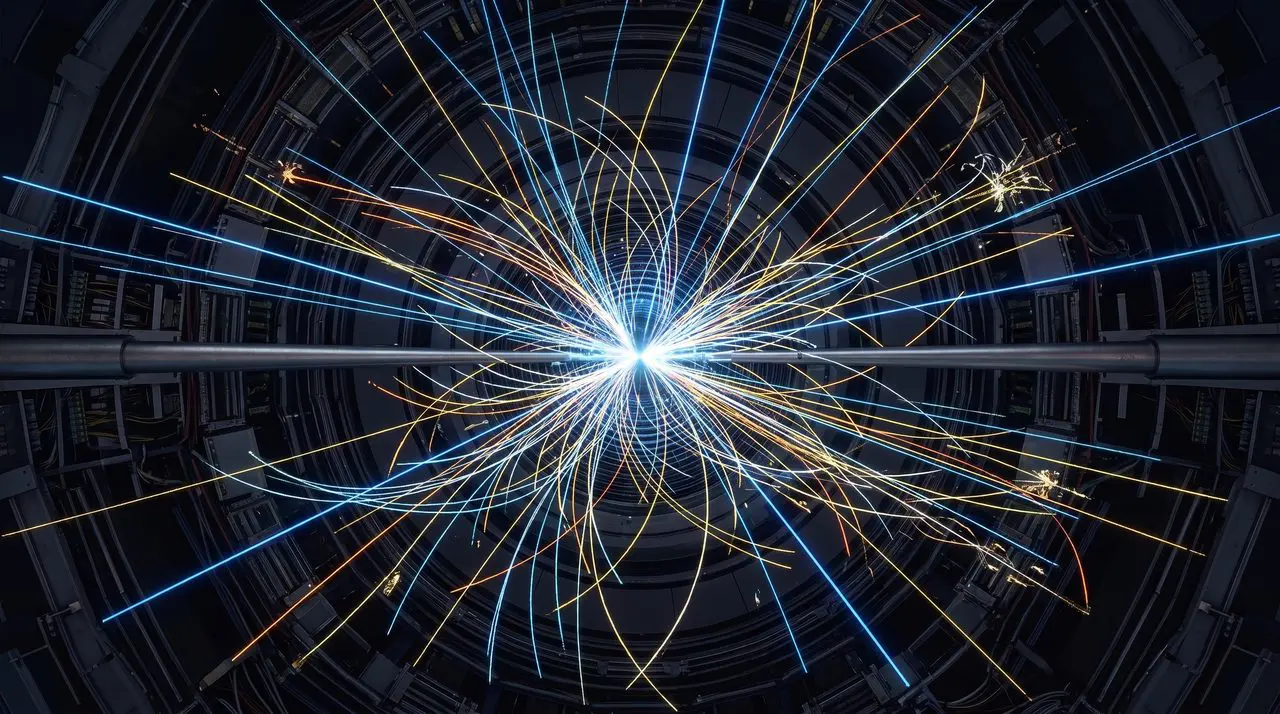
Engineers may soon test vehicle designs with 60 percent less data thanks to a new artificial intelligence model developed by researchers at MIT’s Computer Science and Artificial Intelligence Laboratory and Tsinghua University. The GeoPT model learns physics through virtual reenactments of everyday mechanical interactions, enabling more efficient simulations of real-world scenarios.
“The GeoPT model could be extremely helpful for engineers hoping to test blueprints for vehicles without running so many physical experiments,” says Haixu Wu, an MIT postdoc and CSAIL researcher. This advancement promises to accelerate testing for systems ranging from cars and planes to everyday robotics.
GeoPT Achieves 60% Data Reduction in Physics Simulations
The GeoPT model achieves peak accuracy four times faster than existing tools. This new pre-training approach virtually reenacts mechanical interactions, allowing the model to learn physics through 1.3 million samples of synthetic dynamics involving particles and 3D shapes.
The efficiency gains are particularly striking in data requirements; GeoPT needed 60 percent fewer labeled data to accurately simulate how the hull of a boat handles both air and waves compared to leading models. Minghao Guo, a co-lead author and MIT PhD student, explains that “Our general-purpose model has the versatility to help build a world model for physics,” and that existing models adept at text and visuals will achieve more realistic results with improved physical accuracy.
The system’s ability to rapidly generate heat maps showing how forces affect 3D objects, from battleships to passenger airplanes, simplifies the simulation process for engineers. Fei Sha, an AI research scientist at Meta not involved in the study, believes this success signals an important moment, stating, “We are ready to build physics foundation models, now and fast.” He acknowledges the challenge to traditional assumptions about the relationship between physics, geometry, and data acquisition.
Using synthetic dynamics data is an exciting paradigm for imbuing physics into foundation models,” says Fei Sha, AI research scientist at Meta, who wasn’t involved in the research.
Synthetic Dynamics Training Enables Accurate 3D Interaction Modeling
Numerical solvers, the standard method for calculating physical properties in 3D simulations, often create a bottleneck by limiting the amount of data researchers can gather. GeoPT studied 1.3 million samples of these dynamics, where spheres moved until contacting an object’s surface, effectively “sticking” upon impact. On a dataset testing responses to wind and pressure, GeoPT not only matched but surpassed existing models in speed and accuracy.
This capability extends to simulating the impact of collisions, as demonstrated by accurate predictions of vehicle deformation using less data than current benchmarks. Wu adds, “If your model performs well on industrial benchmarks, that means it can solve the hardest physics tasks.”
extremely helpful for engineers hoping to test out blueprints for vehicles without needing to run so many physical experiments,” says Haixu Wu, an MIT postdoc and CSAIL researcher.
Haixu Wu, an MIT postdoc and CSAIL researcher
GeoPT Outperforms Baselines in Industrial and Aerodynamic Benchmarks
GeoPT’s core innovation lies in a process where virtual particles interact with 3D shapes, allowing the model to learn fundamental physics principles before tackling real-world simulations. This efficiency was particularly evident in industrial benchmarks; GeoPT outperformed existing models on datasets testing responses to wind and surface pressure. In simulations of fighter jets responding to wind, GeoPT matched the accuracy of existing models but did so with greater speed.
Further demonstrating its capabilities, the system accurately predicted vehicle deformation during collisions using less data than baseline tools, and even accurately simulated light refraction through a 3D model of a rabbit without prior training on light physics. The implications extend beyond speed and data reduction, as GeoPT’s ability to handle simulations with over 100 million mesh points in seconds suggests a pathway toward more comprehensive and realistic testing.
If your model performs well on industrial benchmarks, that means it can solve the hardest physics tasks,” says co-lead author Haixu Wu, an MIT postdoc and CSAIL researcher.
The ability to accurately model physical interactions is expected to expand the reach of artificial intelligence into areas demanding realistic simulations. Minghao Guo, MIT PhD student and CSAIL researcher, says, “We believe physics is the third modality for AI models, after text and pixels.”
We believe physics is the third modality for AI models, after text and pixels,” says MIT PhD student and CSAIL researcher Minghao Guo, a co-lead author on a paper introducing GeoPT.
Minghao Guo, MIT PhD student and CSAIL researcher



See today’s quantum computing news on Quantum Zeitgeist for the latest breakthroughs in qubits, hardware, algorithms, and industry deals.