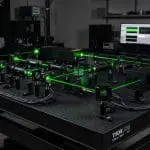
Xanadu secured $67.2 million through a synthetic at-the-market facility with Yorkville Advisors, bolstering its capacity for expansion and continued research. The photonic quantum computing company reported $312.8 million in cash on hand as of June 30, 2026, enabling investment in both engineering talent and increased wafer production. “Every decision at Xanadu comes back to one mission: building quantum computers that are useful and available to people everywhere,” said Dr. Christian Weedbrook, Founder and Chief Executive Officer, as the company advances hardware performance alongside software breakthroughs.
Photonic Component Progress & Fabrication Scaling
Achieving an average edge-coupling loss of just 0.085 dB per facet represents a significant leap forward in Xanadu’s photonic quantum computing hardware, demonstrating tangible progress in component refinement. This reduction in signal loss, supported by collaborations with material science specialists Corning and precision engineering firm DISCO, directly impacts the fidelity and scalability of Xanadu’s quantum processors. The company is actively scaling fabrication runs of its two core material platforms, thin-film lithium niobate and silicon nitride, increasing production by approximately 75% and 50% respectively.
This expansion indicates a move beyond laboratory prototypes towards repeatable, higher-volume manufacturing. Xanadu’s operational expansion, anchored in Albany, New York, further underscores this commitment to scaling, and U.S. headcount has grown more than five-fold since 2023, with continued growth anticipated by year-end, signaling a substantial investment in engineering talent.
This strategic location facilitates access to established semiconductor manufacturing infrastructure and expertise, crucial for translating photonic component advancements into functional quantum systems. This focus on practical application drives the prioritization of fabrication scaling alongside software development. Beyond hardware, Xanadu is simultaneously pursuing algorithmic improvements to enhance quantum computational efficiency. The company published a breakthrough in Quantum Read-Only Memory (QROM) that reduces the number of Toffoli gate operations by roughly half, a patent-filed innovation now available within its open-source PennyLane platform.
Michael Trzupek, Chief Financial Officer of Xanadu, stated, “We ended the quarter in a strong financial position, with $312.8 million of cash on hand,” providing the company with the resources to continue investing in both hardware and software initiatives.
Every decision at Xanadu comes back to one mission: building quantum computers that are useful and available to people everywhere.
Dr. Christian Weedbrook, Founder and Chief Executive Officer of Xanadu
Quantum Read-Only Memory & Machine Learning Advancements
Xanadu’s recent advancements extend beyond hardware fabrication into quantum algorithms and memory architecture, signaling a push toward practical quantum computation. This QROM innovation reduces the number of Toffoli gates, fundamental building blocks of quantum circuits, by approximately half, a significant step toward streamlining complex calculations and lowering resource demands.
The patent-filed advancement is immediately available within PennyLane, Xanadu’s open-source quantum computing platform, demonstrating a commitment to rapid dissemination of research. Beyond memory optimization, Xanadu is actively exploring the potential of quantum machine learning, and this scale is noteworthy as the model is now capable of learning the distribution of ribosomal RNA, a complex biomolecule crucial to cellular function.
This achievement suggests a pathway toward applying quantum algorithms to increasingly sophisticated data analysis tasks, potentially unlocking new insights in fields like bioinformatics and drug discovery. Financial results for the second quarter of 2026 reveal a clear prioritization of resources to support these software and hardware developments, with the company reporting $19.7 million in research and development expense, an increase of $2.4 million from the first quarter of 2026, primarily reflecting increased spending on engineering hires. This investment in personnel underscores Xanadu’s strategy of building internal expertise to drive innovation, and these combined initiatives suggest a focused strategy to translate theoretical quantum capabilities into tangible, real-world applications.
Second Quarter 2026 Financial Performance & Funding
Xanadu Quantum Technologies is actively scaling its photonic quantum computing platform, as evidenced by recent financial reports for the second quarter of 2026. The company demonstrated progress in both hardware development and software advancements, alongside a strategic approach to funding that extends beyond conventional investment avenues.
Specifically, Xanadu secured $67.2 million under its synthetic at-the-market facility with Yorkville Advisors, and the company intends to remain disciplined, drawing on that facility only when conditions are favorable to the Company, including its shareholders. Michael Trzupek, Chief Financial Officer, explained, “That balance sheet gives us the runway to keep investing in the engineering talent and wafer capacity our roadmap requires.” The company’s focus on engineering is reflected in a $2.4 million increase in research and development expense, reaching $19.7 million for the quarter, driven largely by new hires.
Xanadu is also expanding its physical footprint, with a significant operational expansion underway in Albany, New York, increasing U.S. Despite these advancements, the company reported a net loss of $42.1 million for the quarter, with an adjusted EBITDA loss of $21.3 million, attributed to increased spending and reduced grant revenue. Capital expenditures also rose significantly, reaching $6.4 million compared to $0.3 million in the first quarter of 2026, signaling a commitment to long-term infrastructure development. The company intends to provide more detailed spending guidance later in the summer, maintaining a disciplined approach to resource allocation and a focus on delivering tangible quantum computing capabilities.
We ended the quarter in a strong financial position, with $312.8 million of cash on hand.
Michael Trzupek, Chief Financial Officer of Xanadu
See today’s quantum computing news on Quantum Zeitgeist for the latest breakthroughs in qubits, hardware, algorithms, and industry deals.