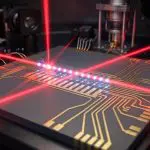
The chips in your laptop and the neurons in your head solve problems in almost opposite ways. Neuromorphic computing is the long effort to build machines that borrow the brain’s design, and it is quietly reshaping how the industry thinks about energy, sensing and intelligence at the edge.
Neuromorphic computing is a way of building computers that copy the physical design of the brain rather than the blueprint every ordinary computer has followed since the 1940s. Instead of a processor that fetches data from a separate memory, a neuromorphic chip scatters many small artificial neurons across the silicon, lets each one hold its own tiny store of information, and has them talk to each other in brief electrical pulses called spikes. The point of the exercise is not novelty for its own sake, it is efficiency, because the human brain runs on roughly twenty watts while a data centre training a large model burns megawatts.
The field has existed since the late 1980s, yet it has moved from the laboratory to shipping products only in the last few years. Intel, IBM, a British and German university partnership and a handful of well-funded startups now sell or demonstrate real neuromorphic computing hardware, and the first chips have reached phones, satellites and factory sensors. This guide explains what the technology actually is, how spiking neurons and memristors work, who is building the machines, and why a quantum-focused publication has a stake in the answer.
- What neuromorphic computing means
- A short history of the field
- The bottleneck the brain avoids
- Spiking neural networks
- Event-based senses
- Memristors and the artificial synapse
- Analog against digital
- Intel, Loihi and Hala Point
- IBM from TrueNorth to NorthPole
- SpiNNaker and the edge chips
- Where neuromorphic meets quantum
- What the technology is good for
- The honest catches
What neuromorphic computing means
The word neuromorphic simply means shaped like a nervous system, and the engineer Carver Mead coined it at Caltech in the late 1980s while building circuits whose transistors behaved like biological neurons. His insight was that the transistors in a chip, operated gently in what is called the subthreshold region, obey equations remarkably close to the ones that govern the flow of ions across a nerve membrane. Rather than fight that physics to build clean digital logic, Mead proposed to lean into it and let the silicon imitate the brain directly.
From that starting point, neuromorphic computing has grown into a family of approaches that share three commitments. They co-locate memory and computation so that data does not travel far, they represent information as discrete events in time rather than as numbers read every clock tick, and they favour dense, parallel connectivity in place of a single fast processor. A useful working definition is that a neuromorphic computer is any machine whose architecture is organised around spiking neurons and local memory instead of the fetch-and-execute cycle of a conventional chip. That definition still leaves room for wildly different hardware, from fully digital chips to exotic analog devices, which is part of what makes the field hard to summarise.
Our older primer on machines that think like brains traces the same lineage in more detail. The short version is that neuromorphic computing is less a single product than a design philosophy, one that keeps producing new chips as the underlying device technology improves.
A short history of the field
The story of neuromorphic computing runs in three long acts. The first belongs to Carver Mead and his students in the 1980s and early 1990s, who built the founding analog circuits, wrote the field’s first textbook, and created the silicon retina and silicon cochlea that proved sensory organs could be imitated in transistors. Their work was visionary but ahead of the manufacturing and software of the day, and for years neuromorphic engineering stayed a small academic speciality rather than an industry.
The second act opened in the 2000s as governments began funding brain-scale ambitions. The United States poured money into DARPA’s SyNAPSE program, which produced IBM’s TrueNorth, while Europe launched the billion-euro Human Brain Project that gave rise to Manchester’s SpiNNaker and Heidelberg’s analog BrainScaleS machine. These efforts pushed neuromorphic computing from single clever chips toward systems that could model millions or billions of neurons at once.
The third act is the one unfolding now, in which the technology finally reaches products. Intel’s Loihi line, IBM’s NorthPole, the commercial SpiNNcloud platform and a wave of edge startups have carried neuromorphic computing out of the lab and into satellites, factory sensors and consumer devices. Each act was slower to arrive than its champions hoped, a pattern worth remembering whenever a new breakthrough is announced.
The bottleneck the brain avoids
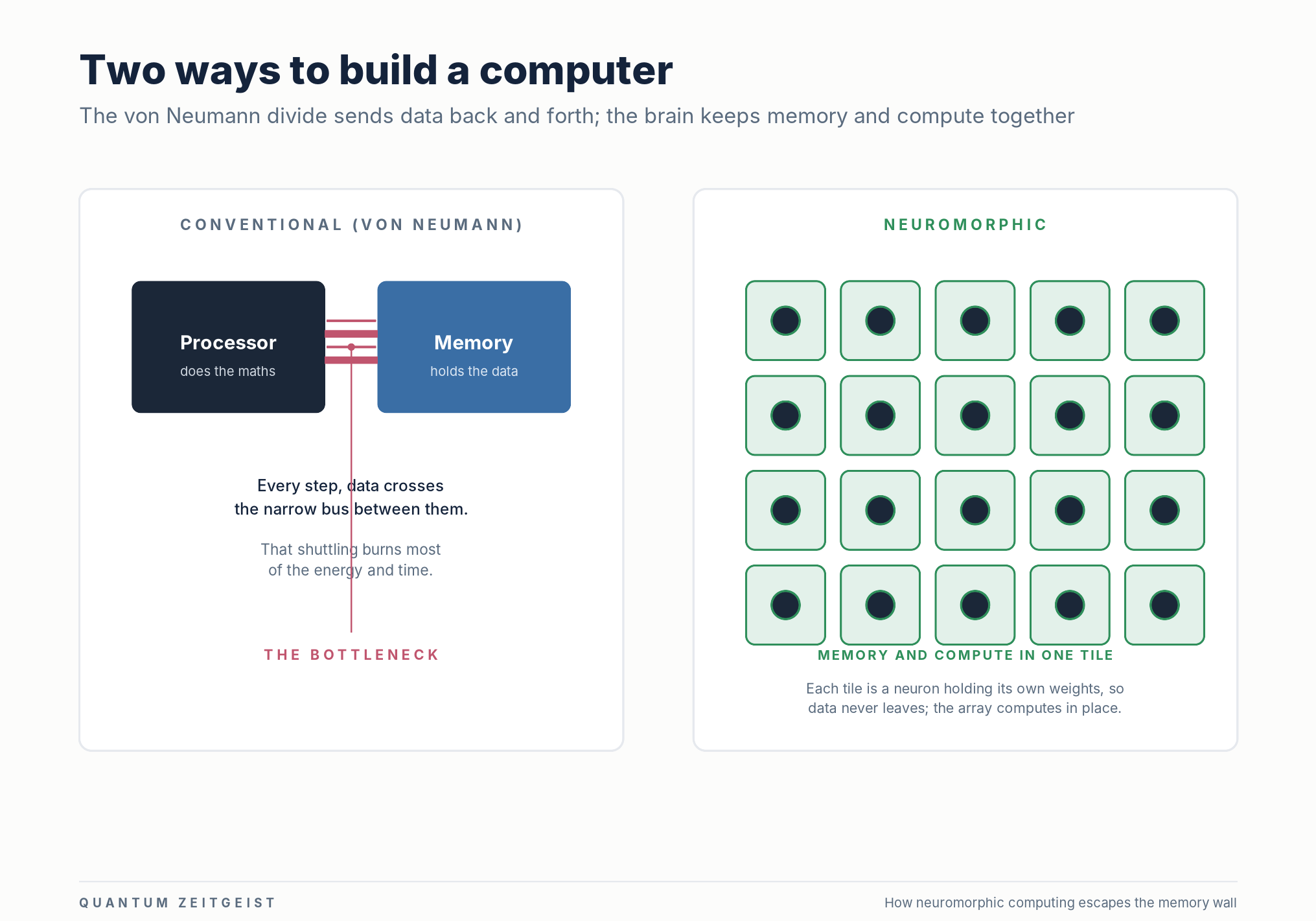
To see why anyone bothers, it helps to understand the weakness that neuromorphic computing is designed to sidestep. Almost every computer built in the last eighty years follows the von Neumann architecture, named after the mathematician John von Neumann, in which a central processor and a separate memory bank sit at opposite ends of a communication channel. Every calculation requires the processor to fetch data and instructions across that channel, operate on them, and send the results back, and the channel has a fixed width.
As processors grew faster than memory, that channel became the limiting factor, a problem engineers call the von Neumann bottleneck or the memory wall. On modern artificial-intelligence workloads the effect is stark, because moving a number from memory into the processor can cost far more energy than the arithmetic performed on it once it arrives. The chip spends most of its power not on thinking but on shuttling data back and forth.
The scale of the gap is easy to underestimate. Training a single large language model can consume as much electricity as hundreds of homes use in a year, and even routine inference on a phone drains the battery noticeably, yet the brain performs its astonishing feats on about the power of a dim light bulb. That contrast is the number that keeps the field alive, because closing even a fraction of it would change the economics of computing. It is also why efficiency, not speed, is the metric that matters most in almost every neuromorphic pitch.
The brain has no such divide. Each of its roughly eighty-six billion neurons stores its own state and its own connection strengths in the very same structure that does the computing, so information rarely has to travel far. Neuromorphic computing tries to reproduce that arrangement in silicon by fusing memory and processing into the same physical location, an approach often called in-memory or near-memory computing. When the memory sits where the maths happens, the bottleneck largely disappears, and that is the single deepest reason the field exists.
Spiking neural networks
The software counterpart of neuromorphic hardware is the spiking neural network, usually shortened to SNN. Ordinary deep-learning networks pass smooth numerical values from layer to layer on every step, whereas a spiking network communicates the way real neurons do, through brief all-or-nothing pulses that occur at particular moments in time. Researchers sometimes call spiking networks the third generation of neural models, following the simple perceptrons of the 1950s and the deep networks that power today’s chatbots.
How a spiking neuron decides to fire
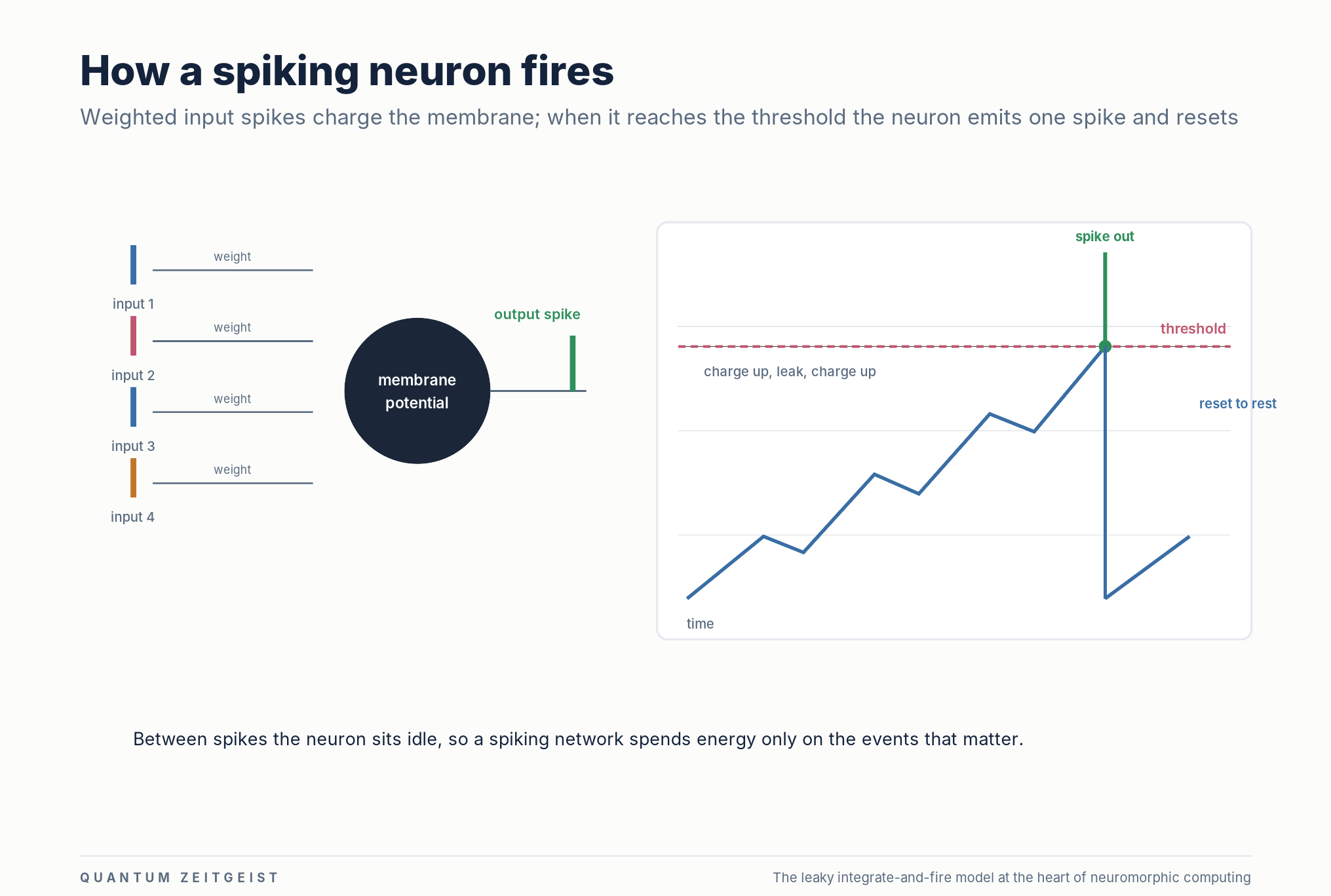
The workhorse model is the leaky integrate-and-fire neuron, and its behaviour is easy to picture. Incoming spikes each carry a weight, they add charge to the neuron’s membrane potential, and that potential slowly leaks away when no input arrives. When enough spikes push the potential past a threshold, the neuron fires a spike of its own and resets to rest, ready to begin accumulating again.
The consequence of this design is that a spiking neuron does nothing at all between events, which is precisely where the energy savings come from. A conventional network multiplies every input by every weight on every pass, while a spiking network only spends power when and where a spike actually occurs. On sparse, real-world signals where most of the input is unchanging, that difference can be enormous, and it is the reason neuromorphic computing pairs so naturally with sensors.
How information rides on spikes
A natural question is how a string of identical pulses can carry meaning at all, and the answer lies in timing. In rate coding, the information sits in how often a neuron fires, so a bright light or a loud sound simply produces more spikes per second. In temporal coding, the exact moment of each spike matters, and the relative timing between neurons can encode far more information per pulse, which is closer to how biological brains appear to work.
Learning in these networks can also happen locally, without the global error signal that ordinary training requires. A rule called spike-timing-dependent plasticity strengthens a connection when one neuron reliably fires just before another and weakens it otherwise, turning the simple order of events into a learning signal. This kind of on-chip, biologically grounded learning is one of the features that sets neuromorphic computing apart from a plain accelerator.
The awkward part is training at scale. The sharp, discontinuous nature of a spike breaks the smooth gradient descent that trains ordinary networks, so researchers rely on workarounds such as surrogate gradients or on converting a pre-trained conventional network into a spiking one. Recent QZ coverage of a spiking transformer with synaptic plasticity and of a low-power spiking receiver shows how quickly the training toolkit is maturing.
Event-based senses
Neuromorphic ideas reach beyond processors into the way machines perceive the world. A conventional camera captures full frames at a fixed rate, tens of times a second, whether or not anything in the scene has changed, which wastes both bandwidth and power. An event-based camera, sometimes called a dynamic vision sensor, works on a different principle drawn straight from biology.
The silicon retina
In an event camera every pixel is independent and reports only when the brightness in front of it changes, sending a timestamped event rather than waiting for the next frame. The design descends directly from the silicon retina that Carver Mead and Misha Mahowald built in the late 1980s, and companies such as Prophesee in France and iniVation in Switzerland now sell commercial versions. Because each pixel reacts on its own, these sensors resolve motion in microseconds, tolerate enormous swings in lighting, and produce almost no data when a scene is still.
Vision is not the only sense being rebuilt this way. The same laboratories that produced the silicon retina also built the silicon cochlea, an event-based audio sensor that breaks sound into frequency channels and emits spikes much as the inner ear does, feeding keyword-spotting and sound-classification chips. Touch, smell and other senses are following more slowly, yet the pattern holds, since any signal that stays mostly quiet with occasional important changes suits an event-based sensor well.
The payoff is a natural fit with spiking hardware, since the camera already speaks in events and the chip already computes on events. QZ has followed the sensing side closely, from an overview of sensors that mimic the human nervous system to concrete results in event-based pupil tracking and a system that reached far faster eye tracking at a fraction of the power. These are the applications where neuromorphic computing already beats the conventional approach today, not in some promised future.
Memristors and the artificial synapse
If spikes are the language of a neuromorphic chip, synapses are its memory, and building a good artificial synapse has become a research field of its own. In the brain a synapse is a connection whose strength can be tuned, and that strength is exactly what a trained network stores as its weights. The challenge is to build a device that holds an analog value, changes it when instructed, and does so in a tiny footprint using almost no power.
The memristor arrives
The leading candidate is the memristor, a name that fuses memory and resistor. The theorist Leon Chua predicted such a device in 1971 as a missing fourth fundamental circuit element, and a team at HP Labs led by Stanley Williams built the first convincing physical example in 2008. A memristor remembers the history of the current that has passed through it by holding a particular resistance, which means a single component can store a synaptic weight as its conductance.
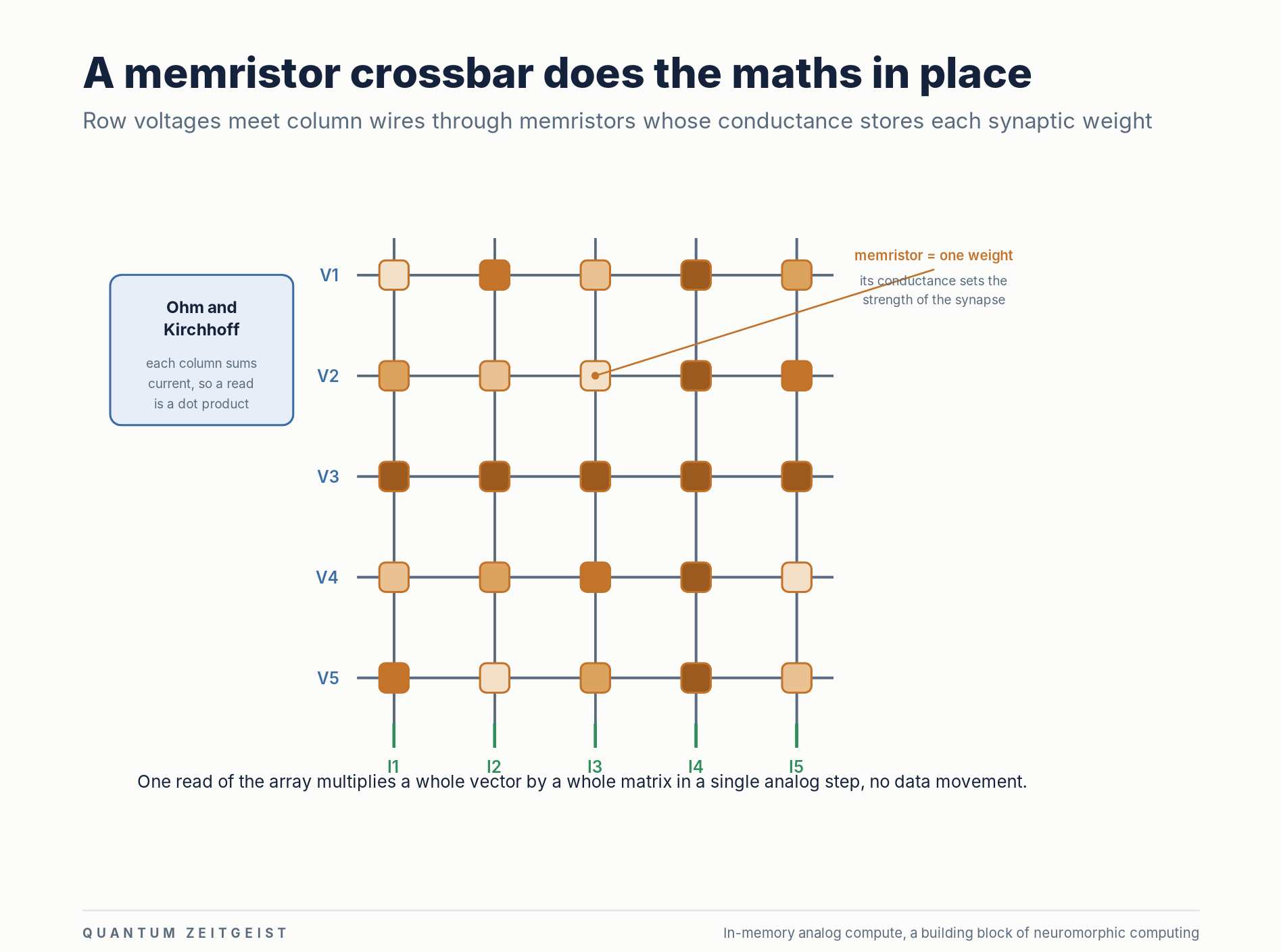
Arrange these devices in a grid, or crossbar, and something powerful happens. Apply voltages along the rows, and the laws of Ohm and Kirchhoff cause each column to sum a current that is exactly the dot product of the inputs with the stored weights, computing a whole matrix multiplication in a single analog step with no data movement at all. That is why memristor research sits so close to the heart of neuromorphic computing. QZ has reported on memristors that mimic brain synapses, on quantized memristive neurons, and on ferroelectric artificial synapses that pursue the same goal with a different material.
Memristors are not the only route to an analog synapse. Phase-change memory, which IBM has used in its research prototypes, stores a weight in the crystalline state of a material, and ferroelectric transistors hold it in an electric polarisation. All of these technologies share the ambition of putting the weight and the multiplication in the same spot, and all of them remain harder to manufacture reliably at scale than the mature digital memory they hope to complement.
Analog against digital
A common misconception is that neuromorphic computing must be analog, all wobbly voltages and physics tricks. In truth the field splits into two camps, and the most successful commercial chips so far sit firmly in the digital one. The distinction matters because it shapes what a given chip can do and how easily engineers can program it.
Digital neuromorphic chips, such as Intel’s Loihi and IBM’s TrueNorth, still communicate in spikes and still fuse memory with computation, but they represent everything in ordinary binary and use standard transistors clocked in the usual way. That makes them precise, repeatable and comparatively easy to build with existing fabrication lines. Analog and mixed-signal designs, by contrast, let the physics of the devices do the arithmetic directly, as in a memristor crossbar, which promises even greater efficiency at the cost of noise, device variation and a much harder programming model.
The programming problem
Whichever camp a chip belongs to, someone has to program it, and this is where the field feels its youth most sharply. A conventional processor sits beneath decades of compilers, libraries and tutorials, while a neuromorphic chip often arrives with a thin toolkit and a steep learning curve. Intel’s open Lava framework and the community’s shared network descriptions are attempts to fix this, yet a developer moving between Loihi, Akida and SpiNNaker still faces very different tools for each.
Neither camp has clearly won. Digital designs dominate today because they are practical and trustworthy, while analog approaches hold the theoretical efficiency crown and attract a great deal of research money. Most observers expect the future of neuromorphic computing to be mixed-signal, with digital control wrapped around analog compute cores, but the balance is still being worked out chip by chip.
Intel, Loihi and Hala Point
No company has done more to make neuromorphic computing tangible than Intel, whose Loihi research chips have set the pace for nearly a decade. The first Loihi, revealed in 2017, packed about a hundred and thirty thousand artificial neurons into a fully asynchronous design that woke up only when spikes arrived. It was never a product, but it gave academics a common platform and proved that a modern process could support a large spiking network. Intel then scaled the first generation into Pohoiki Springs in 2020, a rack that wired 768 Loihi chips into roughly a hundred million neurons, about the scale of a small mammal’s brain.
The Loihi line is not Intel’s first attempt at brain-inspired silicon. Back in 1989 the company announced ETANN, the first commercial analog neural-network chip, which packed 64 analog neurons and 10,240 floating-gate synapses onto one die at the height of the Carver Mead era described earlier. Those early neural chips found few buyers and the line went quiet for two decades, which makes the modern revival all the more striking.
Loihi 2 and a billion neurons
The second generation, Loihi 2, arrived in 2021 with up to a million neurons and around a hundred and twenty million synapses on a single chip, along with programmable neuron models and faster, richer spikes. Intel pairs the hardware with an open software framework called Lava, an attempt to give the field the kind of common toolkit that deep learning enjoys. The company covered the chip’s arrival in QZ’s report on Intel getting behind Loihi 2.
The headline demonstration is Hala Point, unveiled in April 2024 and installed at Sandia National Laboratories, which wires together one thousand one hundred and fifty-two Loihi 2 chips into the largest neuromorphic system yet built. The machine supports around 1.15 billion neurons across more than a hundred and forty thousand neuromorphic cores, and it draws a maximum of roughly 2.6 kilowatts, a striking figure for a system of that scale. Our coverage of Intel’s Hala Point launch put the neuron count in the same league as an owl’s brain. For readers who want the vendor’s own framing, Intel’s neuromorphic computing research program lays out the roadmap in detail.
IBM from TrueNorth to NorthPole
IBM has pursued brain-inspired silicon for even longer, largely through the work of the researcher Dharmendra Modha and the DARPA-funded SyNAPSE program. The landmark result was TrueNorth in 2014, a chip that placed one million spiking neurons and two hundred and fifty-six million synapses on a single piece of silicon while sipping only around seventy milliwatts. TrueNorth was a genuine milestone in scale and efficiency, though its rigid design made it awkward to program for many tasks.
NorthPole changes the target
Modha’s team followed it in 2023 with NorthPole, described in the journal Science, and the change of emphasis is worth understanding. NorthPole is not a pure spiking chip but an inference accelerator that keeps all of its memory on the chip itself, with two hundred and twenty-four megabytes of storage woven directly into two hundred and fifty-six compute cores so that data never leaves the die. The result is a part that IBM reported as roughly twenty-five times more energy efficient than a comparable graphics processor on a standard image-recognition benchmark, and thousands of times faster than TrueNorth.
The lesson of NorthPole is that the deepest idea of neuromorphic computing, keeping memory and computation together, can pay off even in a chip that has quietly dropped the biological spiking model. IBM published the work in Science in 2023, and the design points toward a pragmatic middle path where brain-inspired principles improve otherwise conventional accelerators. That blurring of categories is a recurring theme as the field matures.
SpiNNaker and the edge chips
Not every neuromorphic machine chases raw scale in a data centre, and two other threads deserve attention. The first is SpiNNaker, short for Spiking Neural Network Architecture, a project led by Steve Furber at the University of Manchester, one of the original designers of the Arm processor. Rather than invent exotic devices, SpiNNaker wires together a vast number of small, ordinary Arm cores with a custom communication fabric tuned to shuttle spikes, and the first full machine reached a million cores in 2018 as part of Europe’s Human Brain Project.
Dresden and the commercial turn
The second generation, SpiNNaker2, was developed with TU Dresden and its spin-off company SpiNNcloud, and it packs one hundred and fifty-two Arm cores onto each chip alongside dedicated accelerators. The Dresden system scales to several million cores and can model billions of neurons, and SpiNNcloud now sells it commercially as a platform for brain-inspired supercomputing. It is one of the clearest signs that neuromorphic computing is leaving the pure-research phase.
At the opposite end of the spectrum sit the edge chips, designed to run tiny spiking networks inside battery-powered devices. BrainChip, an Australian company, sells a fully digital event-based processor called Akida that learns on the chip and targets sensors and wearables, and its CyberNeuro-RT product, built on Akida, was named 2026 Enterprise AI Product of the Year for low-power threat detection at the network edge.
The Dutch startup Innatera unveiled a mixed-signal microcontroller called Pulsar in 2025 that runs spiking networks in a microwatt power budget, and other firms such as SynSense pursue the same ultra-low-power niche. QZ has also tracked the infrastructure around all this, from a new national centre for neuromorphic computing in the United Kingdom to the Aston University and Hartree Centre roadmap for the technology.
| System | Type | Scale | Where it fits |
|---|---|---|---|
| Intel Loihi 2 | Digital, spiking | Up to 1 million neurons per chip | Research and the Hala Point supercomputer |
| Intel Hala Point | Digital, spiking | 1,152 chips, about 1.15 billion neurons | Largest neuromorphic system to date |
| IBM TrueNorth | Digital, spiking | 1 million neurons, about 70 mW | 2014 efficiency milestone |
| IBM NorthPole | Digital, near-memory inference | 256 cores, 224 MB on-chip | Energy-efficient deep-network inference |
| SpiNNaker2 | Many Arm cores | Millions of cores in Dresden | Brain simulation and hybrid AI |
| BrainChip Akida | Digital, event-based | Small networks, on-chip learning | Edge sensors and wearables |
| Innatera Pulsar | Mixed-signal, spiking | Microwatt power budget | Always-on sensor intelligence |
Where neuromorphic meets quantum
A quantum publication has good reason to watch neuromorphic computing, because the two fields are cousins in ambition even when they differ in method. Both are attempts to escape the limits of the conventional digital computer, one by exploiting quantum mechanics and the other by copying biology, and both promise dramatic efficiency on problems the standard machine handles badly. Readers who want the direct comparison can start with our piece on quantum and neuromorphic computing as rival future technologies.
Two paths that keep crossing
The connections are more than thematic. Researchers at Washington University in St. Louis have built what they call a discovery machine by pairing a brain-inspired network with a technique borrowed from quantum mechanics, an approach QZ covered in its report on neuromorphic architectures that boost quantum solution reliability. There is also a growing academic effort in quantum neuromorphic computing, which uses the dynamics of quantum systems to implement neural networks directly, a strand QZ has followed through work on quantum neuromorphic machine learning.
The most concrete overlap may be in control hardware. A superconducting quantum computer needs its qubits kept near absolute zero, yet the electronics that steer them usually sit at room temperature and connect through a thicket of wires that limits how far the machine can scale. Engineers at the University of Hong Kong recently demonstrated a brain-like circuit that spikes at ten thousandths of a kelvin, a result QZ reported as silicon carbide transistors mimicking brain cells for quantum control. If neuromorphic circuits can run inside the refrigerator, they could shrink the wiring problem that holds quantum machines back, which is why the intersection is worth taking seriously.
What the technology is good for
For all its promise, neuromorphic computing is not a general replacement for the processor in your laptop, and pretending otherwise has hurt the field’s credibility before. Its advantages appear in a specific shape of problem, one involving sparse, streaming, real-world signals where power is scarce and latency matters. Understanding that shape is the key to seeing where the technology will actually land.
Edge intelligence and robotics
The strongest near-term case is always-on sensing at the edge, in devices that must watch or listen continuously on a small battery. A neuromorphic chip can sit quietly and consume almost nothing until a relevant event occurs, which suits keyword spotting, gesture recognition, health monitoring and anomaly detection in industrial equipment. QZ has reported on neuromorphic processors reaching real-time performance on a robotics platform and on a neuromorphic memory guiding a mobile manipulator, both cases where fast reaction on a tight power budget is the whole point.
Two further arenas suit the technology unusually well. Space is one, because a satellite runs on a fixed power budget and cannot rely on a distant cloud, so an event-based sensor that processes images on board and sends down only what matters is genuinely valuable. Automotive is another, since a car must spot a hazard within milliseconds while sipping power, and event cameras paired with spiking networks can flag sudden motion far faster than a frame-based pipeline. In both cases the appeal is the same pairing of low latency and low energy that defines the field.
Robotics is a natural home for the same reasons, because a robot must react to a changing world within milliseconds and cannot afford to carry a data centre on its back. The efficiency argument extends to larger systems too, and QZ has covered efforts to cut the energy cost of large language models with brain-inspired methods, as well as scalable edge-AI processors built from RISC cores and neuromorphic arrays. Photonics adds yet another dimension, with neuromorphic photonic processors and photonic spiking neurons chasing speeds that electronics cannot reach.
The honest catches
A fair guide has to state the obstacles as plainly as the promise, because neuromorphic computing has been ten years away for rather longer than ten years. The technology is real and improving, yet several genuine problems still keep it from the mainstream, and glossing over them does the reader no favours.
Training, tooling and benchmarks
The first problem is software. Training a spiking network remains harder and less reliable than training a conventional one, the tools are young compared with the vast ecosystems around ordinary deep learning, and every hardware platform tends to need its own approach. The second problem is measurement, since the field lacks the mature, agreed benchmarks that let buyers compare chips fairly, and vendor efficiency claims are often quoted on workloads chosen to flatter the hardware.
The deepest problem is the missing killer application. Neuromorphic computing has clear wins in narrow niches such as event-based vision and always-on sensing, but it has yet to find the single, large, must-have use case that would pull it into every device the way graphics processors were pulled into artificial intelligence. Until that application appears, the technology will keep advancing as a specialist tool rather than a universal one. The honest summary is that neuromorphic computing is a maturing, genuinely useful approach with a real foothold at the edge, not a finished revolution, and the next few years of hardware from Intel, IBM and the startups will decide how far it climbs.
Frequently asked questions
What is neuromorphic computing in simple terms?
Neuromorphic computing is a way of building computers modelled on the brain, with many small artificial neurons that store their own information and communicate through brief electrical pulses called spikes. Because memory and processing sit together and the chip works only when a spike arrives, this design can use far less energy than a conventional processor on the right tasks. The goal is brain-like efficiency rather than raw speed.
How is neuromorphic computing different from a normal computer?
A normal computer follows the von Neumann design, with a processor and a separate memory that constantly exchange data across a channel, and that shuttling burns most of the energy. Neuromorphic computing fuses memory and computation into the same place and represents information as timed events instead of numbers read on every clock tick. The result is a machine that suits sparse, streaming signals rather than general-purpose number crunching.
What is a spiking neural network?
A spiking neural network is the kind of model that neuromorphic hardware runs, and it communicates through discrete pulses in time rather than the smooth numbers of ordinary deep learning. Each neuron adds up weighted incoming spikes, and it fires its own spike only when its internal potential crosses a threshold. Between spikes it does nothing, which is where the energy savings come from.
What is a memristor and why does it matter?
A memristor is a circuit element whose resistance depends on the history of current that has flowed through it, so it can store an analog value with no power. In neuromorphic computing a memristor acts as an artificial synapse, holding a network weight as its conductance. Arranged in a grid, memristors can perform a full matrix multiplication in a single analog step, which is the operation that dominates neural networks.
Which companies build neuromorphic chips?
Intel leads with its Loihi 2 research chip and the billion-neuron Hala Point system, while IBM has built TrueNorth and the more recent NorthPole inference accelerator. The University of Manchester and TU Dresden run the SpiNNaker machines through the SpiNNcloud spin-off, and edge-focused firms include BrainChip with its Akida processor and Innatera with its Pulsar microcontroller. Several startups such as SynSense and sensor makers such as Prophesee round out the field.
Is neuromorphic computing the same as artificial intelligence?
No, they are related but distinct. Artificial intelligence is about the algorithms and models that let machines learn and reason, while neuromorphic computing is a style of hardware that can run certain of those models very efficiently. Most AI today runs on graphics processors, and neuromorphic chips aim to be a more efficient alternative for specific tasks rather than a replacement for the whole field.
How does neuromorphic computing save energy?
The savings come from two design choices. First, memory sits next to the computation, so the chip avoids the heavy energy cost of moving data back and forth that dominates conventional processors. Second, spiking networks are event-driven, so the hardware does work only when a spike occurs instead of computing on every clock cycle, which is a large advantage on sparse real-world signals.
What is neuromorphic computing used for today?
The clearest present-day uses are always-on sensing and event-based vision, in devices that must watch or listen continuously on a small battery. Applications include keyword spotting, gesture recognition, robotics, industrial anomaly detection and low-power tracking from event cameras. These are niches where the efficiency and low latency of neuromorphic hardware already beat the conventional approach.
How does neuromorphic computing relate to quantum computing?
Both fields try to move beyond the limits of the ordinary digital computer, one through quantum mechanics and the other through brain-inspired design, and researchers increasingly combine them. Some projects pair neuromorphic optimisation with quantum techniques, and others build brain-like control circuits that operate at the cryogenic temperatures a quantum computer needs. That control application could help solve the wiring bottleneck that limits quantum machines.
Will neuromorphic computing replace conventional processors?
It is very unlikely to replace them wholesale, and that was never really the goal. Neuromorphic computing is a specialist tool that excels on sparse, low-power, real-time workloads, and it is expected to sit alongside conventional processors and graphics chips rather than displace them. Its future probably lies in edge devices and as an efficient companion inside larger systems.



See today’s quantum computing news on Quantum Zeitgeist for the latest breakthroughs in qubits, hardware, algorithms, and industry deals.