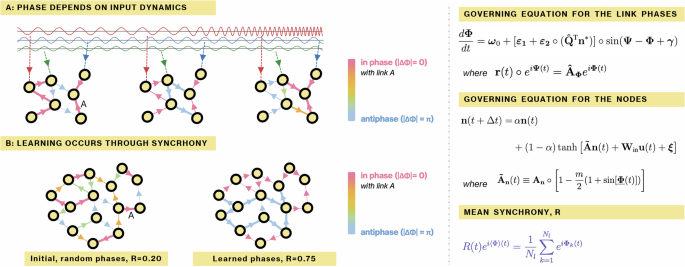
Inspired by the rhythmic oscillations of astrocytes in the brain, a new algorithm achieves high performance in detecting subtle shifts within complex data streams. Researchers Ian Whitehouse, Hoony Kang, and Wolfgang Losert authored the work, where connections between computational nodes vary sinusoidally, mirroring biological processes and producing an emergent sensitivity to what’s known as distributional drift. They introduced a new measure to harness this sensitivity and improve drift detection across datasets including NASA C-MAPSS, SWaT, and WADI, resulting in improved F1-scores on the SWaT and WADI datasets. These datasets demonstrate the model’s ability to detect drift in highly-complex, real-world systems. Published in volume 3 of npj Unconventional Computing, these results suggest oscillatory link dynamics could be a general computational principle with implications for both neuromorphic hardware and understanding astrocytic network biology.
Rhythmic Sharing Algorithm for Concept Drift Detection
Oscillatory learning, mirroring the brain’s own mechanisms, has yielded a new algorithm capable of detecting subtle shifts in complex data streams with improved accuracy. Researchers Ian Whitehouse, Hoony Kang, and Wolfgang Losert authored a ‘rhythmic sharing’ algorithm, inspired by the oscillations observed in astrocytes, support cells within the brain, to autonomously identify concept drift, the phenomenon where the characteristics of data change over time. The core innovation lies in the algorithm’s recurrent links, which vary sinusoidally, creating an emergent sensitivity to distributional drift. To further enhance this capability, the team introduced a new metric designed to harness this sensitivity and improve the performance of drift detectors. Testing the algorithm across three challenging datasets, NASA C-MAPSS, SWaT, and WADI, revealed significant gains. These industrial datasets demonstrate the ability of the model to detect drift in highly-complex, real-world systems.
The output of per-input synchrony features improves detector performance, resulting in improved F1-scores on the SWaT and WADI datasets. Visualizations demonstrate how imperceptible drifts in sensor readings are magnified by the rhythmic sharing process, allowing for earlier detection. The researchers found that the algorithm not only identified drift but also distinguished between different types of changes, reacting to cyberattacks and ordinary operational shifts within the simulated water utility systems used in the SWaT and WADI datasets. The team’s results suggest that oscillatory link dynamics may represent a general computational principle, offering a biologically plausible alternative to traditional weight-based learning methods.
Per-Input Synchrony as a Drift Metric
The pursuit of reliable drift detection in complex systems has long relied on statistical tests and reconstruction accuracy, methods often falling short when faced with subtle or hidden changes in data streams. Researchers Ian Whitehouse, Hoony Kang, and Wolfgang Losert authored a study exploring biologically-inspired algorithms, specifically those mirroring the rhythmic oscillations observed in astrocytes, star-shaped glial cells in the brain, to enhance sensitivity to these distributional shifts. The algorithm, inspired by astrocytic oscillations, features recurrent links that vary sinusoidally, creating a system attuned to even minute changes in incoming data. The researchers explain that “per-input synchrony identifies even tiny changes in each channel’s dynamics,” highlighting its ability to extract subtle signals often missed by conventional approaches. For instance, analysis of the NASA C-MAPSS data showed the algorithm detecting engine failure before the standard 60%/40% cutoff used in the literature, as evidenced by the decreasing per-input synchronies preceding erratic sensor readings.
Performance on NASA C-MAPSS Dataset
Researchers Ian Whitehouse, Hoony Kang, and Wolfgang Losert authored the work detailing the algorithm, inspired by the oscillatory behavior of astrocytes, to the challenging problem of detecting subtle failures in complex systems, with initial tests focusing on the NASA C-MAPSS dataset. This dataset consists of sensors recording the engines’ degradation at the end of their lifetime, presenting a realistic scenario for assessing the algorithm’s ability to identify anomalies before catastrophic failure occurs. Tests on the NASA C-MAPSS dataset demonstrate the effectiveness of this methodology, showing that incorporating the algorithm’s preprocessing steps elevates the performance of standard machine learning models. Results, detailed in a table comparing precision, recall, F1-score, and detection delay, reveal that the algorithm begins identifying potential engine failures before the commonly used 60%/40% cutoff point for defining anomalous data. These datasets demonstrate the ability of the model to detect drift in highly-complex, real-world systems.
Visualizations further illustrate how the algorithm amplifies imperceptible drifts in sensor readings, with per-input synchrony values increasing as the engine’s condition deteriorates and then decreasing as erratic behavior begins. This dynamic response suggests the model isn’t simply reacting to a predefined threshold, but rather learning and adapting to the evolving system dynamics. The team observed that the algorithm recognizes these changing dynamics before the standard 60%/40% cutoff, which is confirmed by a reduction in detection delay.
SWaT and WADI Dataset Results
The ability to detect subtle shifts in complex systems has immediate implications for industrial safety and process optimization, and recent results demonstrate an algorithm’s proficiency in this area using established benchmark datasets. Researchers Ian Whitehouse, Hoony Kang, and Wolfgang Losert have showcased the efficacy of a ‘rhythmic sharing’ algorithm, inspired by astrocytic oscillations, on the Secure Water Treatment testbed (SWaT) and water distribution testbed (WADI) datasets, achieving improved F1-scores. These industrial datasets, simulating sensors recording the engines’ degradation at the end of their lifetime, present a significant challenge for drift detection methodologies due to their inherent complexity and noise. These datasets demonstrate the ability of the model to detect drift in highly-complex, real-world systems. Focusing on SWaT and WADI allowed for direct comparison with existing methods, including the Bidirectional Dynamic Model (BDM) and the Normalized Spectral Information Bias Factor (NSIBF) algorithm.
Results indicate a substantial performance increase when integrating the new algorithm’s output with NSIBF, surpassing the performance of BDM on both datasets. The output of per-input synchrony features results in improved F1-scores, demonstrating a clear advancement in drift detection accuracy. Further analysis of the WADI dataset revealed that the algorithm doesn’t simply flag all inputs as affected by drift, but rather identifies specific channels experiencing distributional shifts. This nuanced approach potentially improves the performance of downstream detectors by providing more targeted information.
Oscillatory Link Dynamics & Neuromorphic Computing
The prevailing assumption that robust artificial intelligence demands immense computational power and static, precisely-tuned parameters is increasingly challenged by research into biological systems; natural intelligence often thrives on rhythmic, adaptable processes rather than brute-force calculation. The algorithm, initially inspired by the rhythmic activity of astrocytes, demonstrates an emergent ability to identify subtle shifts in complex systems, improving performance on challenging industrial datasets. Researchers tested the algorithm’s efficacy using the NASA C-MAPSS dataset, alongside the more complex SWaT and WADI datasets, all simulating real-world industrial processes. The core innovation isn’t simply achieving high accuracy, but how it’s achieved. The team introduced a novel metric, designed to harness the algorithm’s inherent sensitivity to distributional drift. These datasets demonstrate the ability of our model to detect drift in highly-complex, real-world systems. This approach, where complex behaviors emerge without explicit design, has implications extending beyond drift detection, potentially informing the development of neuromorphic hardware and offering new insights into the function of astrocytic networks within the brain.
Biological Inspiration from Astrocytic Oscillations
Astrocytic rhythms, long understood to modulate neuronal communication, are now revealing a surprising potential: enhancing algorithms for detecting subtle shifts in complex systems. This measure, detailed in the publication, allows for the early and precise detection of hidden or complex drifts that often elude conventional methods. Unlike statistical tests or reconstruction accuracy-based detectors, the approach excels at identifying “tiny changes in each channel’s dynamics.” These industrial datasets demonstrate the ability of the model to detect drift in highly-complex, real-world systems. The implications extend beyond improved anomaly detection. The spontaneous emergence of drift detection from these dynamics mirrors the adaptability of living neurons, which drastically adjust their topology in response to environmental changes. This convergence of biological inspiration and computational advancement suggests a promising new direction for unconventional computing, where complex behaviors arise without explicit design.



See today’s quantum computing news on Quantum Zeitgeist for the latest breakthroughs in qubits, hardware, algorithms, and industry deals.