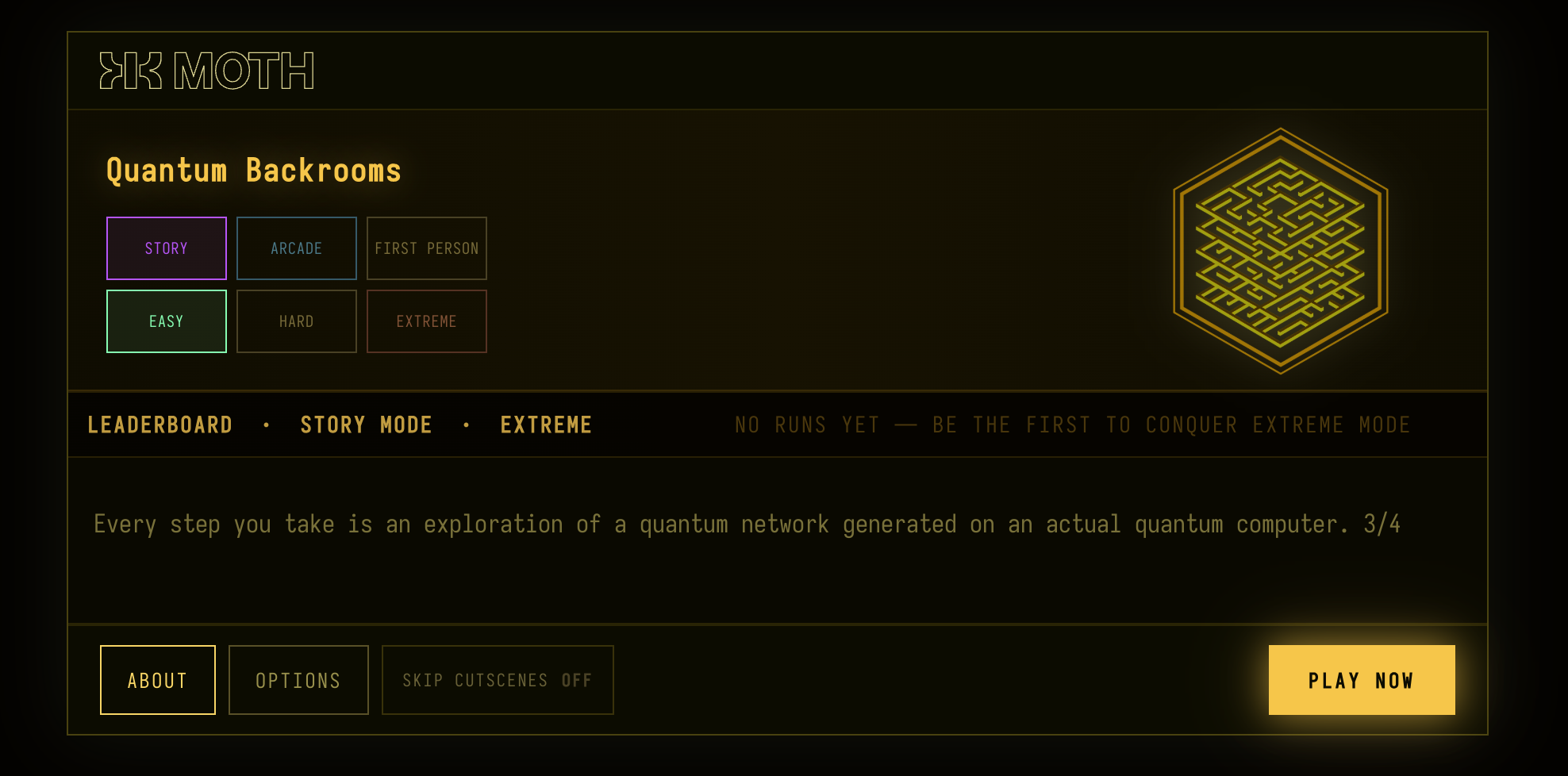
London quantum company Moth has launched Quantum Backrooms, billing it as the world’s first quantum consumer product and an open-access game whose shifting labyrinths are generated on live quantum hardware from IBM and IQM. The launch builds directly on the company’s earlier Space Moths project and pushes the hardware-agnostic creator platform behind its games towards a wider public debut later this year.
A game built on live qubits
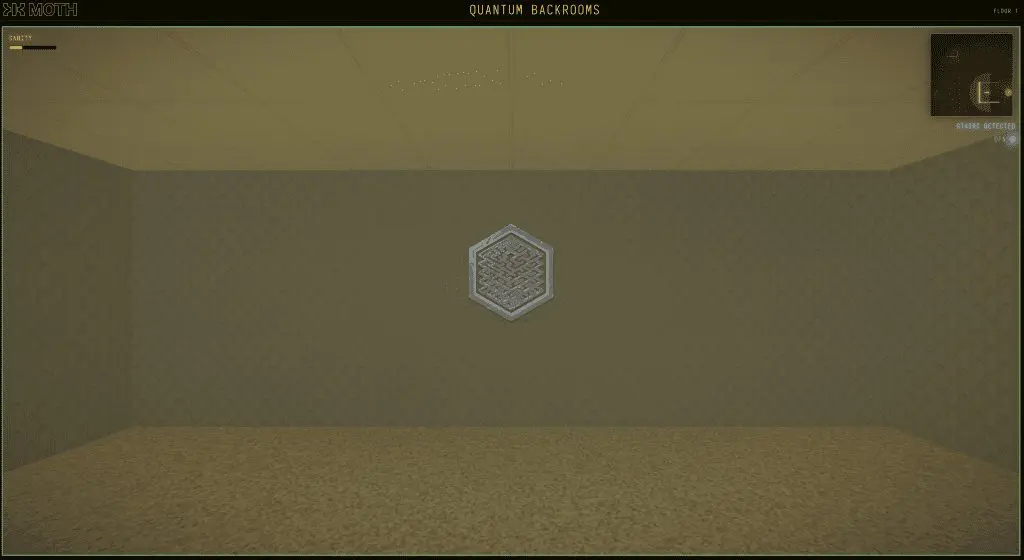
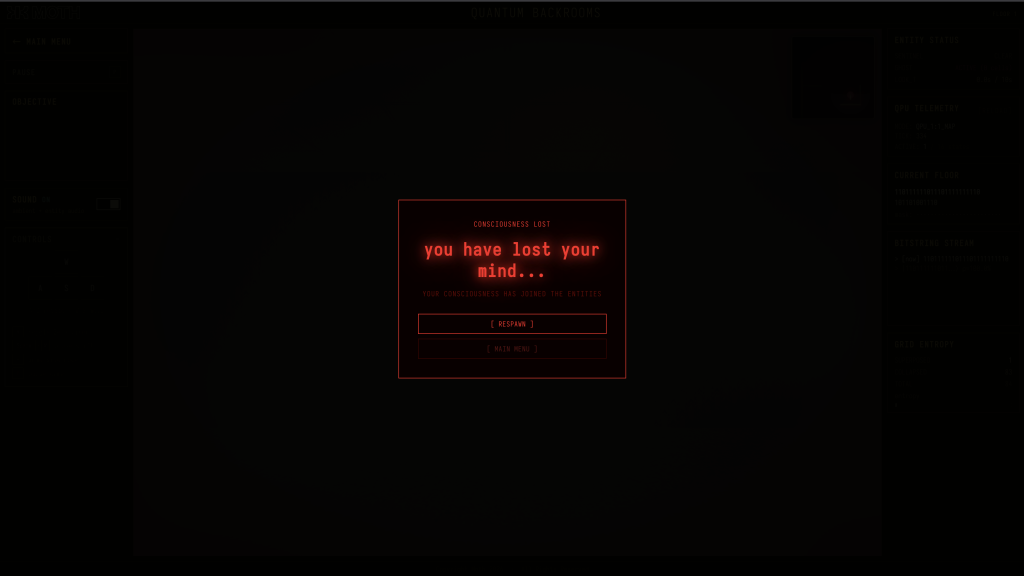
Quantum Backrooms is a playable game in which the levels and the game dynamics are produced by real quantum hardware rather than by conventional procedural generation. Drawing on the internet phenomenon known as the Backrooms, the game drops players into evolving mazes that are shaped by the behaviour of real Quantum Processing Units.
The mapping between the machine and the world is unusually literal for a consumer title. Each qubit corresponds to a section of the game world, and the connections between qubits determine the possible routes through the maze, so the topology of the processor becomes the topology of the level.
Moth describes its consumer applications as platform neutral, meaning anything the company builds can in principle be run on any quantum computer. In the case of Quantum Backrooms the company drew on machines from both IBM Quantum and IQM Quantum Computers, reinforcing the hardware-agnostic positioning that the firm has emphasised since its first game projects.
Some of the Backroom levels.Exploring Moth Backrooms which is using real quantum computers behind the scenesImmersing ourselves in the Backroom Adventure
From Space Moths to Quantum Backrooms
The new title is not Moth’s first foray into quantum-generated play. The company’s earlier collaboration with IBM Quantum, IQM and VTT produced Space Moths, a multiplayer experience built for the Roblox platform with indie studio Onward Studios and unveiled at Gamescom 2025.
That project leaned on VTT’s superconducting fifty-qubit machine alongside the IBM and IQM systems, generating game levels in real time through a quantum machine learning approach based on Moth’s Quantum Reservoir Computing System. It served as a working demonstration of the company’s Archaeo platform, which is designed to slot quantum algorithms into existing creative workflows without forcing studios to rebuild their tools.
Where Space Moths was framed largely as a showcase for developers and the games industry, Quantum Backrooms is pitched squarely at consumers. The continuity matters because it shows Moth moving along a deliberate path, from a generative music project, to an industry-facing multiplayer demonstration, and now to an open-access product that anyone can pick up and play.
Why Moth is chasing a quantum ChatGPT moment
Moth’s central argument is that quantum computing is following the same arc that carried artificial intelligence from a research curiosity into everyday products such as ChatGPT and Claude. The company points to early public-facing AI tools, including Google’s Magenta in 2018 and OpenAI’s DALL-E in 2021, as precedents for a technology that becomes real to people once they can touch it directly.
Sean Harpur, chief executive of Moth, framed the launch as a turning point for adoption rather than a one-off novelty.
“Every major computing shift becomes mainstream when people can experience it directly. Quantum computing is viewed as something remote, technical and inaccessible. Quantum Backrooms changes that. This is how the next phase of quantum adoption begins.”
Sean Harpur, CEO, Moth
The timing also rides a wave of mainstream interest in the Backrooms genre, with a feature film of the same name from director Kane Parsons and studio A24 due to arrive on 29 May 2026, the day after the game’s launch. That cultural tailwind gives Moth a rare opportunity to reach an audience that would not normally encounter anything labelled quantum.
A platform aimed at creators
The game sits beneath the same underlying technology that Moth wants to put in front of developers and studios. The company says the platform used to build Quantum Backrooms is designed to let creators build quantum applications without deep technical expertise, and it has already been opened to a small group of alpha users ahead of a planned launch later this year.
Harry Kumar, founder and chief commercial officer of Moth, argued that the next advance for the sector will be driven by users rather than by hardware specifications alone.
“Our platform will catalyse a huge leap forward for the quantum sector, unlocking the kind of creative experimentation that historically supercharges adoption and innovation. The next leap in quantum computing will not come from hardware alone. It will come when consumers start to engage with it and our collective imagination for new applications is unlocked.”
Harry Kumar, Founder and CCO, Moth
That framing echoes the case the company made through its chief technology officer, Spencer Topel, who has previously contended that classical computing is holding the games industry back and that quantum methods could compress lengthy development cycles. The consumer launch and the creator platform are therefore two sides of the same strategy, one building public familiarity while the other courts the developers who would supply future applications.
What it means for the quantum sector
For players, Quantum Backrooms asks for nothing technical, since the proposition is simply to explore and enjoy a world generated by a quantum computer. For the industry, the more interesting claim is that quantum computing is shifting from something debated in research papers and difficult-to-parse announcements into something a global audience can experience first-hand.
Whether a maze game proves to be quantum’s equivalent of DALL-E or merely an inventive marketing exercise will depend on what Moth’s platform delivers when it opens more widely. Either way, the launch is a notable attempt to reframe a technology that is still routinely described as distant and abstract, and it gives the sector a rare consumer-facing story to point to.
To provide the best experiences, we and our partners use technologies like cookies to store and/or access device information. Consenting to these technologies will allow us and our partners to process personal data such as browsing behavior or unique IDs on this site and show (non-) personalized ads. Not consenting or withdrawing consent, may adversely affect certain features and functions.
Click below to consent to the above or make granular choices. Your choices will be applied to this site only. You can change your settings at any time, including withdrawing your consent, by using the toggles on the Cookie Policy, or by clicking on the manage consent button at the bottom of the screen.
Functional
Always active
The technical storage or access is strictly necessary for the legitimate purpose of enabling the use of a specific service explicitly requested by the subscriber or user, or for the sole purpose of carrying out the transmission of a communication over an electronic communications network.
Preferences
The technical storage or access is necessary for the legitimate purpose of storing preferences that are not requested by the subscriber or user.
Statistics
The technical storage or access that is used exclusively for statistical purposes.The technical storage or access that is used exclusively for anonymous statistical purposes. Without a subpoena, voluntary compliance on the part of your Internet Service Provider, or additional records from a third party, information stored or retrieved for this purpose alone cannot usually be used to identify you.
Marketing
The technical storage or access is required to create user profiles to send advertising, or to track the user on a website or across several websites for similar marketing purposes.