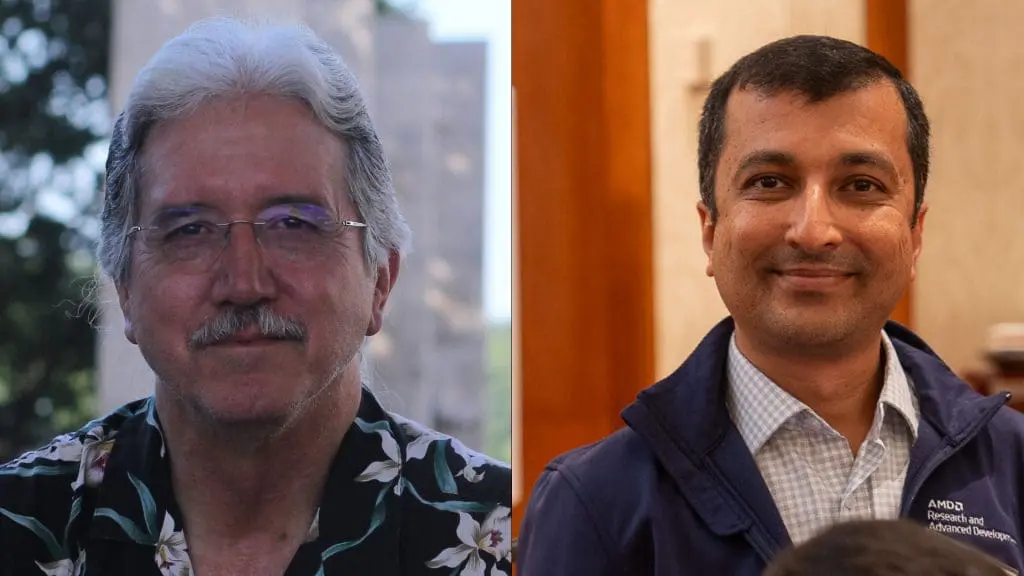
Randy Marchany has been inducted as the 15th member of the Virginia Tech Department of Computer Science Academy of Distinguished Alumni, recognizing a career dedicated to both advancing the field and serving the university itself as director of the IT Security Lab. Ashwin Aji of AMD Research also received the department’s seventh Distinguished Early Career Alumni Award for his contributions to cybersecurity, high-performance computing, and artificial intelligence research. “What strikes me about both Ashwin and Randy is that their work doesn’t just advance their fields, it matters to people,” said Christine Julien, head of computer science. Aji’s research is now enabling climate system modeling at scales previously unattainable, while Marchany’s long tenure has established Virginia Tech as a national leader in cybersecurity, mentoring students who have gone on to secure leadership roles in the field.
Marchany’s Cybersecurity Leadership & IT Security Lab Development
Marchany, currently the university’s information technology security officer and director of the IT Security Lab, has spent decades cultivating a robust cybersecurity presence at Virginia Tech, developing early standards and establishing a hands-on training environment for students. This dedication extends beyond campus boundaries, with Marchany’s involvement in numerous national cyberdefense efforts and incident responses. “One of the things that Dr. Gorsline instilled in that first cadre of students was to pay it forward,” Marchany said, reflecting the foundational principles that guided his career. The impact of the IT Security Lab is quantifiable; Marchany reported the lab facilitated the graduation of approximately 14 Ph.D. students and 15 or 16 master’s students, resulting in three cybersecurity patents stemming directly from their research. Beyond student development, Marchany spearheaded the launch of the Virginia Cyber Range, a cloud-based platform now utilized by educational institutions across the commonwealth to enhance cybersecurity training.
Marchany’s leadership has fostered a legacy of expertise, with graduates assuming key roles in cybersecurity and technology organizations. This sustained influence, combined with his contributions to national cybersecurity standards, solidifies his position as a pivotal figure in the field and highlights the Department of Computer Science’s success in nurturing impactful alumni. Marchany emphasized the tangible outcomes of research endeavors.
Aji’s AI Systems Work & High-Performance Computing Contributions
The convergence of artificial intelligence and high-performance computing is currently reshaping scientific inquiry, enabling researchers to tackle previously intractable problems across diverse fields. Advances in AI-driven systems are demonstrably impacting areas like climate modeling and supercomputing infrastructure. This shift is exemplified by the accomplishments of Virginia Tech alumni like Ashwin Aji, whose work is pushing the boundaries of computational possibility. Aji, now a principal researcher at AMD Research, is the seventh recipient of the department’s Distinguished Early Career Alumni Award, recognizing his contributions to AI systems optimization and high-performance computing. His research directly supports advancements in scientific computing, notably contributing to the development of Frontier, the first exascale supercomputer in the United States. “Ashwin’s contributions are helping us model climate systems at scales we couldn’t reach before,” noted Christine Julien, head of computer science, highlighting the tangible impact of his work.
Aji’s journey began with a pivotal opportunity at Virginia Tech; “Professor Wu Feng took a chance on a very raw aspiring master’s student from India,” he said, emphasizing the importance of mentorship in fostering innovation. The impact of early setbacks also shaped Aji’s research philosophy. He recounted a challenging presentation during his graduate studies, stating that the experience was ultimately liberating and motivating. “I realized that there was only one direction I could go from there, it was up.” This resilience, coupled with a foundation in high-performance computing, positions Aji as a key figure in the ongoing evolution of AI-accelerated scientific discovery.
Dr. Gorsline’s resilience, forged through a challenging early research presentation, highlights the value of embracing failure as a learning opportunity, as Aji explained, “But I felt something liberating after the presentation.”


See today’s quantum computing news on Quantum Zeitgeist for the latest breakthroughs in qubits, hardware, algorithms, and industry deals.