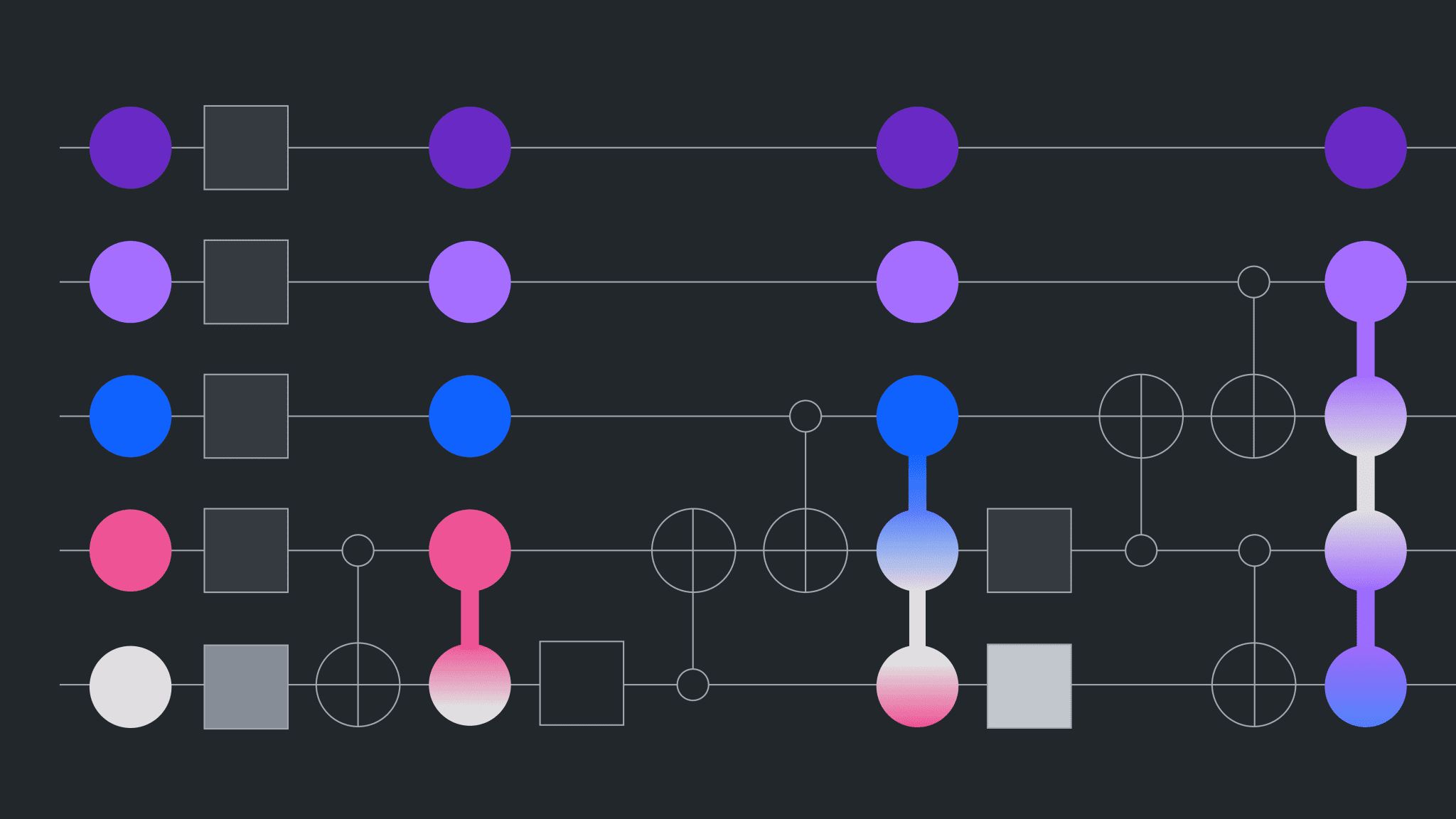
Researchers from ParityQC have successfully executed a 52-qubit Quantum Fourier Transform (QFT) on an IBM Quantum Heron r3 processor, demonstrating the largest such circuit reported to date and establishing a new benchmark for quantum computation. Scaling QFTs is notoriously difficult because routing overhead, circuit depth, and accumulated noise degrade performance as size increases, but the team employed a novel parity-based construction method to eliminate explicit SWAP-based routing by rethinking how quantum information is represented and propagated. “It’s not about the qubit count,” explained ParityQC co-founder and co-CEO Wolfgang Lechner, “With our method, we were actually able to reduce the errors and still achieve this doubling,” nearly doubling a previous QFT benchmark set on trapped-ion hardware. This advance, combining improved algorithms with current hardware capabilities, signals progress toward more efficient implementations of complex algorithms with applications in fields like optimization and quantum chemistry.
Qubit Quantum Fourier Transform Achieved on IBM Heron Processor
This achievement isn’t simply about scaling up qubit counts; the team was able to reduce errors and still achieve this doubling, a critical distinction for practical applications. The QFT, a cornerstone of many quantum algorithms, decomposes complex signals into their constituent frequencies, analogous to isolating a single voice within a crowded room, and is essential for tasks ranging from optimization to materials simulation. ParityQC’s innovation centers on a method called Parity Twine, which fundamentally alters how quantum information is handled. Traditionally, superconducting quantum processors address this limitation with SWAP operations, which move quantum states across the device so distant qubits can interact. Parity Twine rethinks this problem by tracking parity information, the relationships between qubits, instead of tracking the state of individual qubits, effectively merging routing and computation. This approach utilizes CNOT gates to transfer parity information, reducing the overall gate count and circuit depth.
The result is a shift from localized quantum states moving between qubits to delocalized information flowing through overlapping pathways, performing computations and propagating correlations simultaneously. “This is a fundamental difference, and it changes a lot of things,” Lechner stated. This conceptual shift applies to how the computation is represented at a higher level, rather than to the underlying hardware operations, and it has a real impact. It means that multi-qubit interactions, typically among the most resource-intensive operations in quantum computing, can, at least in some cases, be reduced to simpler primitives. The team’s results, compared to circuits generated by the Qiskit transpiler, showed improved fidelity, particularly as the system scaled, suggesting a pathway toward more efficient and robust quantum computations.
Parity Twine Method Eliminates SWAP-Based Routing Overhead
The pursuit of scalable quantum computation currently hinges on overcoming limitations in qubit connectivity and minimizing the errors that accumulate during complex calculations. Existing superconducting quantum processors, while advancing rapidly, largely restrict interactions to nearest-neighbor qubits, necessitating the use of SWAP operations, which move quantum states across the device so distant qubits can interact. These SWAP operations, however, introduce additional gates, increasing circuit depth and amplifying noise, a significant bottleneck as qubit counts rise. This is achieved by utilizing CNOT gates to transfer parity information, the relationships between qubits, rather than the state of individual qubits, effectively merging the logistical aspect of routing with the computational steps of the algorithm. This conceptual change applies to how the computation is represented at a higher level, rather than to the underlying hardware operations, but it makes a real impact.
It means that multi-qubit interactions, typically among the most resource-intensive operations in quantum computing, can, at least in some cases, be reduced to simpler primitives. The result is a reduction in gate count and circuit depth, leading to improved performance and reduced error rates. The team’s success with the 52-qubit QFT is particularly noteworthy because they were able to achieve this record-setting scale. “This is a fundamental difference, and it changes a lot of things,” Lechner said. The researchers demonstrated that this approach delivers improved process fidelity, a key metric for evaluating the accuracy of quantum algorithms, especially as system size increases, and that the IBM Quantum Heron r3 processor was instrumental in achieving these results. “Our experiments show that this is the best hardware around at the moment,” Lechner said. The work underscores the importance of collaboration within the quantum ecosystem, where advances in algorithms, compilation techniques, and hardware work in concert to push the boundaries of what’s possible.
With our method, we were actually able to reduce the errors and still get this doubling.
Process Fidelity Benchmarks Demonstrate Algorithm Performance Gains
ParityQC is pushing the boundaries of quantum circuit performance, not simply by adding qubits, but by fundamentally altering how those qubits interact. This achievement isn’t merely about scale; it’s about maintaining accuracy as complexity increases, a critical hurdle in realizing practical quantum computation.
The team’s success hinges on a novel approach to circuit construction, focusing on process fidelity as a key metric. Process fidelity measures the accuracy of an entire algorithm, accounting for circuit depth, noise accumulation, and compilation strategies, allowing for meaningful comparisons across different quantum hardware platforms. “We want to compare all these different quantum devices,” said ParityQC co-CEO Wolfgang Lechner, “Are they built on superconducting qubits, ions, or atoms? This shouldn’t matter.” Previously, superconducting quantum processors addressed this limitation with SWAP operations, which move quantum states across the device so distant qubits can interact. “Previously, it was like you do the swapping, which is the logistics, and the algorithm,” Lechner explained. “This is a fundamental difference, and it changes a lot of things,” Lechner stated. The results underscore the importance of a collaborative quantum ecosystem, where platform tools like Qiskit provide a foundation for innovation, and companies like ParityQC develop new methods to enhance performance on existing hardware.
It’s not about the qubit count,” said ParityQC co-founder and co-CEO Wolfgang Lechner, who noted that the new work nearly doubles a previous QFT benchmark set in on trapped-ion hardware.
Quantum Fourier Transform as a Versatile Computational Benchmark
The difficulty in scaling QFT circuits stems from how routing overhead, circuit depth, and accumulated noise degrade performance as size increases. Traditionally, superconducting quantum processors address this limitation with SWAP operations, which move quantum states across the device so distant qubits can interact. ParityQC addressed this bottleneck with an innovative approach called Parity Twine, rethinking how quantum information is represented and propagated. Instead of tracking the state of individual qubits, it tracks parity information, the relationships between qubits. “This is a fundamental difference, and it changes a lot of things,” Lechner stated, highlighting the efficiency gains. The team’s success demonstrates the power of a collaborative quantum ecosystem, leveraging IBM’s hardware alongside novel algorithmic approaches. The ability to accurately measure process fidelity, capturing the combined effects of circuit depth, noise, and compilation, is crucial for comparing different quantum platforms and driving further progress. “It’s an important benchmark because it is a building block for many other algorithms,” Lechner said, “and I would go so far to say that it should be a standard component of a quantum device.”
Even if you think about addition-adding two numbers-if you do this on a quantum computer, it’s based on QFT,” Lechner said.
See today’s quantum computing news on Quantum Zeitgeist for the latest breakthroughs in qubits, hardware, algorithms, and industry deals.