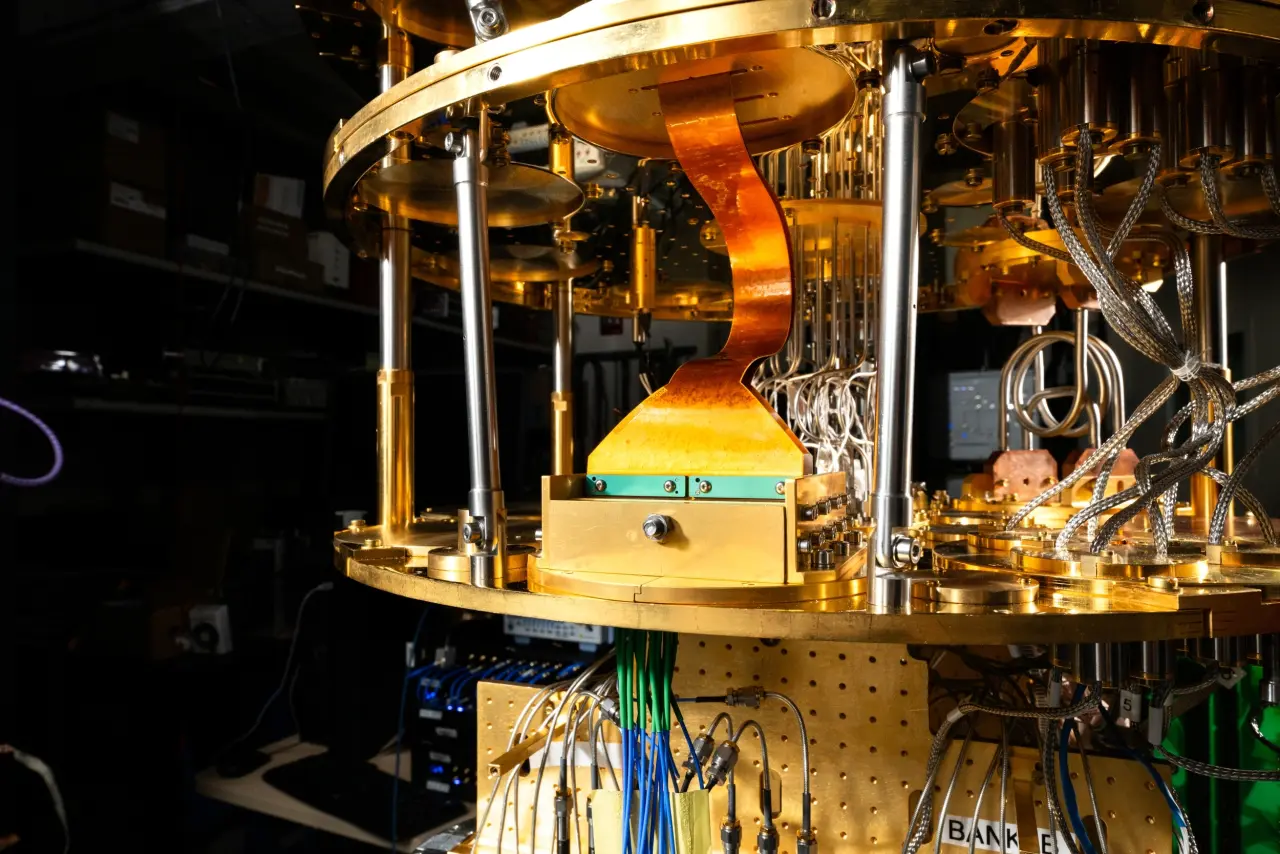
Maintaining current at temperatures of 5 to 10 millikelvin, colder than the depths of space, is now possible thanks to a new wiring system developed by researchers at MIT Lincoln Laboratory and licensed to Maybell Quantum, a Colorado-based company. These flexible, ribbon-like cables address a critical need in quantum research and development, where stabilizing qubits requires extremely dampened thermal noise. Dilution refrigerators, essential for creating the cryogenic conditions necessary for quantum computing, previously lacked a compatible wiring system capable of both direct current and high-speed data transmission. Lasse Nielsen, Strategy and Operations Lead at Maybell Quantum, states that the company intends to utilize the cables for thermometry, heaters, and sensors, with further expansion planned after qualification testing.
Stripline Cable Design for Cryogenic Environments
A new wiring design resolves a critical bottleneck in the advancement of quantum computing hardware. Researchers at MIT Lincoln Laboratory have developed flexible cryogenic cables, utilizing a stripline configuration, that address limitations inherent in traditional coaxial cabling used within dilution refrigerators, the essential cooling systems for stabilizing qubits. These new cables were conceived as an alternative to coaxial cables, which can generate substantial heat loads and present difficulties in integration as qubit counts rise. The design centers around conductive layers positioned between flexible polymer layers, effectively shielding against electromagnetic interference and minimizing signal loss across various frequencies.
Unlike brittle coaxial cables, these striplines are compatible with standard printed-circuit-board manufacturing processes, significantly reducing fabrication costs and simplifying installation. “The main innovation is that the Laboratory’s cables can be fabricated by a traditional printed-circuit-board manufacturer,” explains John Cummings, a principal investigator in the flexible cables project of the Lincoln Laboratory Quantum-Enabled Computation Group. “They’re cheaper to fabricate and easier to install than traditional coaxial cables.” This ease of manufacturing is particularly crucial as quantum systems demand increasingly complex wiring configurations. Maybell Quantum, a Colorado-based company specializing in quantum hardware, recognized the potential of this design and has licensed it for integration into their dilution refrigerators. This simplifies assembly, reducing tasks from days to hours, and Maybell Quantum anticipates that these cables will reshape manufacturing norms, enabling faster builds, easier maintenance, and more modular upgrades, ultimately supporting the transition from research-based quantum research to industrial-scale quantum computing.
Maybell Quantum is planning to integrate the newly licensed wiring system into its dilution refrigerators. The Colorado-based company secured a license for the low-frequency CryoTrace cables from MIT Lincoln Laboratory, a design utilizing a stripline configuration with conductive layers embedded within flexible polymer shielding. This approach minimizes signal loss and electromagnetic interference, and the cables’ ease of manufacture represents a significant advantage.
We’re planning to integrate Maybell LF CryoTrace, the ribbon wiring system transferred from MIT Lincoln Laboratory, across all thermal stages of our dilution refrigerators. Initially, the cables will be used for LF services, such as thermometry, heaters, and sensors, with feasibility studies planned for additional functions.
Lasse Nielsen, Strategy and Operations Lead at Maybell Quantum
Scalability of Flexible Cables for Quantum Systems
Maybell Quantum, a Colorado-based company focused on quantum hardware, is actively integrating a novel wiring design licensed from MIT Lincoln Laboratory into its dilution refrigerators, addressing a critical bottleneck in scaling quantum computing research. After qualification testing, the company plans to implement LF CryoTrace across the entire Maybell product family. Beyond simplified installation, Maybell Quantum emphasizes the mechanical robustness of the ribbon-like cables, noting a reduction in handling-related breakages compared to fragile coaxial alternatives. This durability translates to faster assembly times, reducing tasks that previously took days to mere hours.
Lasse Nielsen, Strategy and Operations Lead at Maybell Quantum, envisions a broader impact on manufacturing processes, stating, “Over time, we think ribbonized, quantum-specific internal wiring can reshape manufacturing norms: faster and more consistent builds, easier field service, and more modular upgrades.” Kyle Thompson, founder and chief technology officer of Maybell Quantum, underscores the long-term implications, asserting, “If you want to scale to hundreds of chips, you need interconnects that can handle more signals more reliably, and that’s why the Lincoln Laboratory cables are so exciting for us, they enable true scalability.”
After qualification testing, LF CryoTrace is planned for the next iteration of our internal wiring across the Maybell product family.
Lasse Nielsen, Strategy and Operations Lead at Maybell Quantum
Source: https://www.ll.mit.edu/news/flexible-cryogenic-cables-solve-challenge-quantum-system-development