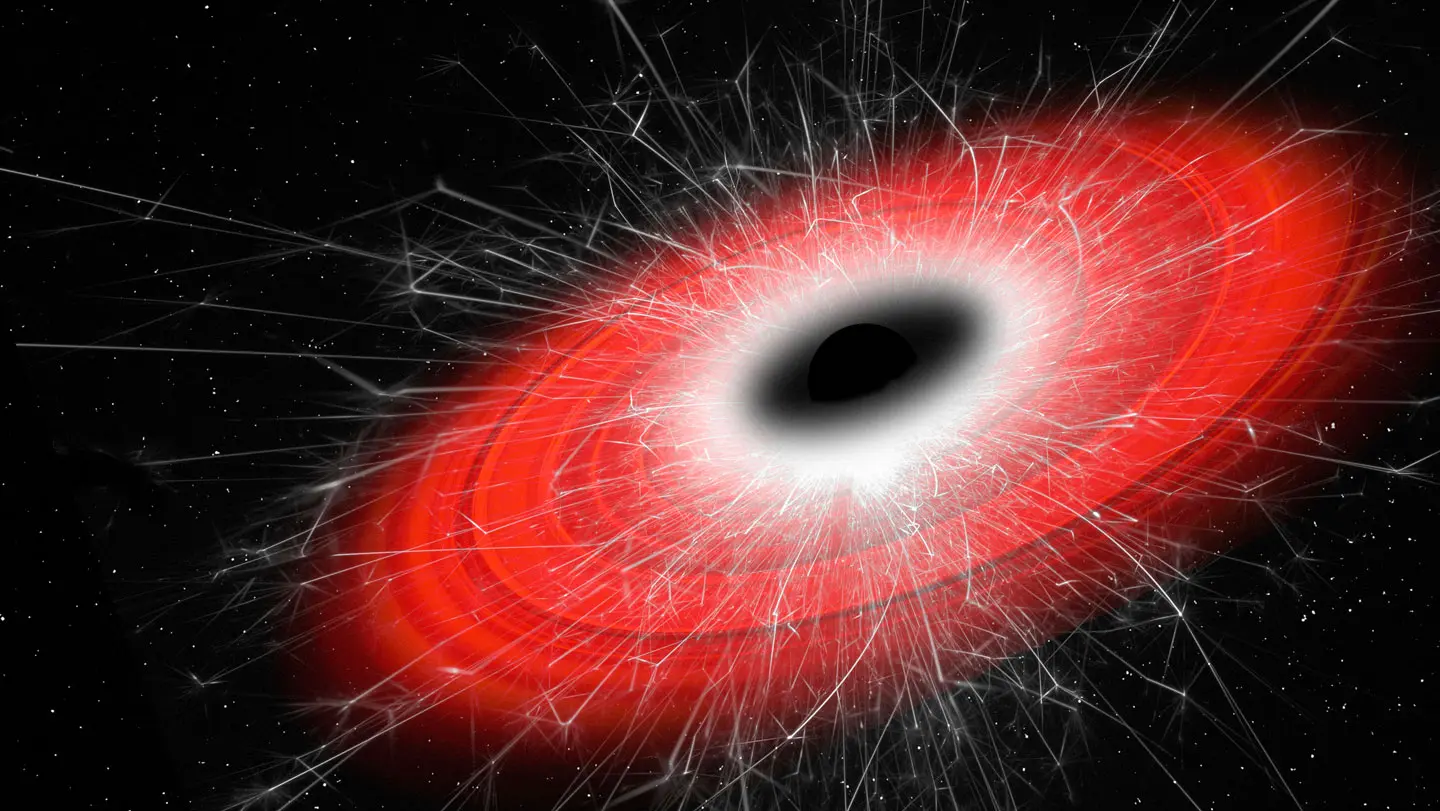
Physicists are leveraging a surprising mathematical connection to probe the elusive nature of Hawking radiation, the faint emission of particles from black holes too weak to be observed directly. The approach utilizes a relationship called the double copy, which allows calculations to be translated between the standard model of particle physics and the general theory of relativity, essentially using one theory to solve problems in the other. According to this connection, phenomena in general relativity are mathematically equivalent to those of certain particles, but with two copies of a specific part of the equation; researchers have now identified how this applies to Hawking radiation. “It allows us to calculate things we’ve never been able to calculate before, just by recycling results in a clever way,” says theoretical physicist Chris White of Queen Mary University of London, as this discovery bridges the gap between the immense scale of black holes and the quantum world of tiny particles. Reported in Physical Review Letters on February 27, 2026, the pair of papers shows that physics intrinsic to black holes is contained in the standard model of particle physics.
Double Copy Connects Particle Physics and Gravity
A surprising mathematical relationship is now allowing physicists to indirectly study the elusive Hawking radiation emitted by black holes. This connection, known as the double copy, provides a novel approach to understanding phenomena previously inaccessible to direct observation, as the radiation itself is far too faint to detect with current instruments. Fundamental physics traditionally divides into the standard model, governing subatomic particles, and general relativity, describing gravity; however, the double copy establishes a mathematical equivalence between calculations within these two distinct frameworks. This relationship functions as a translation tool, enabling physicists to reframe problems from one theory into the language of another, potentially simplifying complex calculations and revealing previously hidden insights. Since its discovery and development in recent years, it has proven valuable in analyzing various gravitational effects, and its application to Hawking radiation represents a significant advancement.
Recently, multiple teams have identified a standard model analog for Hawking radiation using this double copy technique. In a paper accepted to the Journal of High Energy Physics, White and colleagues demonstrated that Hawking radiation mathematically corresponds to a charged particle scattering off a collapsing sphere of charged matter. Two other teams reached similar conclusions, published in February in Physical Review Letters, confirming that the physics governing black holes is embedded within the standard model of particle physics, according to theoretical physicist Anton Ilderton of the University of Edinburgh, a coauthor of one of the studies. “These papers have started to show how to extract that information from the standard model.” This breakthrough offers a pathway to explore even more complex black hole characteristics, such as the event horizon, with researchers hoping to ultimately address the long-standing question of information preservation as black holes evaporate.
Hawking Radiation as a Standard Model Analog
Because Hawking radiation is inherently too weak for direct observation, physicists continually seek innovative theoretical avenues for its investigation, and recent work demonstrates a connection to the well-established standard model of particle physics. This link, known as the double copy, functions as a translation tool, allowing calculations to move between the realms of general relativity, governing gravity, and the standard model, which describes subatomic particles. The double copy posits that many gravitational phenomena have mathematical equivalents within the standard model, differing by a factor of two in specific equation components.
It allows us to calculate things we’ve never been able to calculate before, just by recycling results in a clever way.
Investigating Black Holes via Mathematical Translation
The double copy doesn’t simply offer an alternative calculation method; it fundamentally alters how physicists approach complex problems, allowing them to repurpose existing solutions in innovative ways. Arizona State University’s Cynthia Keeler, not involved in the research, affirms that this discovery “constitutes a major advance for these techniques,” given the challenge of connecting phenomena across vastly different scales, enormous black holes emitting minuscule particles. Harvard University’s Uri Kol notes, “That’s the big question that we would like to answer,” adding that these recent publications “provide tools that can be used to address this question.” Ultimately, understanding Hawking radiation, described by Northwestern University’s John Joseph Carrasco as a “Rosetta stone” problem, could unlock deeper insights into the fundamental laws governing gravity and information itself.
These papers have started to show how to extract that information from the standard model.


See today’s quantum computing news on Quantum Zeitgeist for the latest breakthroughs in qubits, hardware, algorithms, and industry deals.