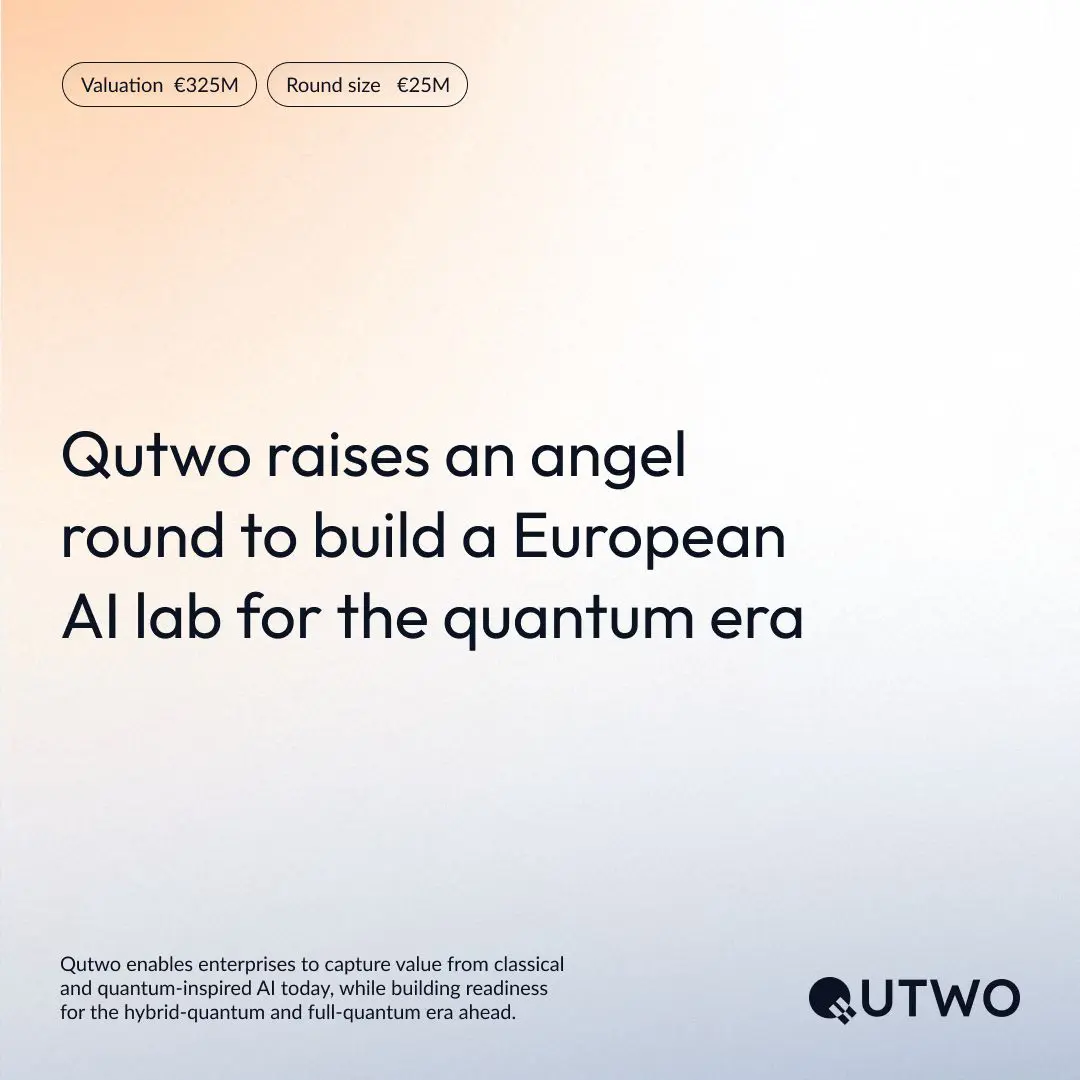
Qutwo has secured 25 million euros in angel funding at a 325 million euro valuation just two months after its launch, indicating strong investor confidence in the company’s approach to artificial intelligence. The funding, from a group of tech investors and founders, will accelerate Qutwo’s mission to prepare European enterprises for the integration of quantum technologies. Unlike companies waiting for fully realized quantum computing, Qutwo offers solutions now that leverage quantum-inspired techniques alongside classical AI. “The question isn’t whether quantum will reshape AI at scale, it’s whether you’ll be ready when it does,” the company stated, positioning itself to enable businesses to capture value from both current and future AI paradigms. Incubated within PostScriptum, Qutwo aims to establish European leadership in the next generation of AI.
Qutwo Secures €25M Angel Round at €325M Valuation
The funding originates from a consortium including Midas-listed investors, founders of unicorn companies, and European family offices, reflecting a broad commitment to bolstering European leadership in the field. A company representative said that for many, this is more than just a financial investment; it is a strategic commitment to ensure that the next generation of AI is developed in Europe. This substantial investment allows Qutwo to rapidly expand its product development, customer acquisition, and team size, positioning the company to capitalize on the growing demand for quantum-inspired AI solutions. Unlike competitors focused solely on future quantum computing capabilities, Qutwo delivers value to enterprises now by integrating quantum-inspired techniques with existing classical AI infrastructure. The company asserts that Qutwo allows enterprises to capture value from classical and quantum-inspired AI today, while preparing for the full quantum era ahead.
Incubated within PostScriptum, Qutwo is focused on ensuring European businesses are prepared for the shift toward quantum computing, a transition similar to the earlier move from CPU to GPU technology. The company believes the question is not if quantum will reshape AI, but rather whether organizations will be positioned to benefit when it does, and this funding round is designed to accelerate that preparation.
Classical & Quantum-Inspired AI for European Enterprises
This valuation, unusually high for an angel stage company, signals expectations of significant growth and potential within the European artificial intelligence market. The investment aims to position European enterprises as leaders in the evolving AI landscape, particularly as the field transitions beyond conventional computing architectures. The company states that the shift from CPU to GPU transformed AI, framing quantum computing not as a distant possibility, but as an inevitable progression. Qutwo differentiates itself by delivering value through both classical and quantum-inspired AI solutions now, rather than solely awaiting the maturity of full quantum systems.
The question isn’t whether quantum will reshape AI at scale-it’s whether you’ll be ready when it does.
Source: https://qutwo.com/
See today’s quantum computing news on Quantum Zeitgeist for the latest breakthroughs in qubits, hardware, algorithms, and industry deals.