Researchers have uncovered a novel piezomagnetic effect within a newly identified class of two-dimensional materials called Dirac quadrupole altermagnets. H. Radhakrishnan, B. Bell, and C. Ortix, alongside J. W. F. Venderbos et al., detail how strain applied to these insulating altermagnets generates a piezomagnetic response originating from the unique behaviour of their Dirac points. This work establishes a theoretical framework, utilising minimal models including a Lieb lattice structure, to explain the orbital piezomagnetic polarizability and demonstrates a connection to gapless parent phases. Understanding this effect is significant as it expands the possibilities for manipulating magnetism with mechanical strain and potentially opens avenues for developing new spintronic devices based on these recently proposed compounds.
This research introduces a previously unobserved interplay between material topology and strain-induced magnetization, potentially opening new avenues for manipulating magnetic properties with mechanical force.
Topological Roots of Strain-Induced Magnetism
Topological Origins of Orbital Piezomagnetism
The study demonstrates that the orbital piezomagnetic response, the magnetization arising from the movement of electrons, in these materials possesses a topological contribution rooted in the electronic structure of their parent phase, the Dirac quadrupole semimetal. Researchers have successfully modeled this effect using microscopic theoretical frameworks, revealing how strain applied to the material directly impacts the Dirac points that define its electronic behavior.
Specifically, the application of strain distorts the arrangement of these Dirac points, creating what is termed a “Dirac dipole”, which drives the observed piezomagnetic response. Two distinct models were employed: a spinless two-band model focusing on orbital contributions and a Lieb lattice model, a well-established representation of altermagnetism in two dimensions.
The significance of this work lies in the identification of a mechanism where the topology of a material dictates its response to external mechanical stress. By focusing on the orbital magnetization, independent of spin, the study highlights a pathway to control magnetism through purely geometric means.
Impact on Spintronics and Device Development
This discovery has implications for the development of novel spintronic devices and materials where strain engineering can be used to tailor magnetic properties without relying on traditional magnetic fields or currents. The research also points towards potential material realizations, referencing recently proposed compounds exhibiting a Lieb lattice motif, suggesting a pathway for experimental verification of these theoretical predictions.
Exploring Strain-Induced Magnetism in Altermagnets
Strain-induced piezomagnetism via Dirac point manipulation in Dirac quadrupole altermagnets
Modeling Strain in Dirac Quadrupole Altermagnets
Altermagnets represent a compelling platform for investigating and utilizing piezomagnetism. This work introduces Dirac quadrupole altermagnets as a novel class of two-dimensional (2D) insulating altermagnets, demonstrating through microscopic minimal models that their orbital piezomagnetic polarizability possesses a response-theory-described contribution.
The essential low-energy electronic structure of these altermagnets originates from a gapless parent phase, specifically the Dirac quadrupole semimetal, which significantly influences their response to external fields. Focusing on strain-induced responses, the research demonstrates that the piezomagnetic effect arises from the manner in which strain alters the Dirac points forming a quadrupole structure.
Minimal Modeling Approaches for Quantum Systems
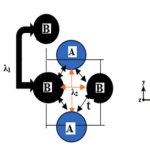
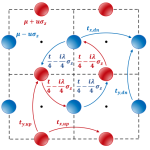
Two microscopic models were employed to explore this phenomenon: a spinless two-band model describing a band inversion of and states, and a Lieb lattice model exhibiting collinear Néel order. The Lieb lattice model, a prototypical minimal model for altermagnetism in 2D, is realized in several recently proposed compounds, providing a direct connection to current material science interests.
The spinless nature of the two-band model simplifies the study of altermagnetism and topology, offering a minimal framework for understanding their interplay. Furthermore, the Lieb lattice model’s established role in studying diverse altermagnetic phenomena strengthens its utility for probing orbital piezomagnetism in realistic materials.
Promising material candidates include layered bulk compounds such as V2Se2O and V2Te2O, alongside their Rb or K-intercalated variants, which exhibit a monolayer Lieb lattice structure. The correlated insulator La2O3Mn2Se2, featuring MnO2 planes forming a Lieb lattice, and the proposed metallic compound Sr2CrO2Cr2OAs2, predicted to have a large altermagnetic magnon splitting, also serve as potential platforms for experimental verification.
Strain-induced piezomagnetism in Dirac quadrupole altermagnets revealed by microscopic modelling
Researchers detail the properties of Dirac quadrupole altermagnets, a class of two-dimensional insulating materials exhibiting piezomagnetism. Orbital piezomagnetic polarizability within these altermagnets is demonstrated through microscopic models based on response theory. The essential electronic structure originates from a gapless parent phase, a Dirac quadrupole semimetal, which significantly influences the material’s response to external fields.
Strain-induced responses reveal that the piezomagnetic effect arises from how strain alters the Dirac points forming a quadrupole configuration. Investigations utilized a spinless two-band model describing band inversion between s and d states, alongside a Lieb lattice model with collinear Néel order.
The Lieb lattice model, a prototypical example of altermagnetism in two dimensions, is found in several recently proposed compounds. The crystallographic environment of magnetic atoms enables these unique properties, indicating an interconnected relationship between crystal structure, magnetic order, and symmetry within altermagnets.
A direct consequence of this interrelation is the emergence of piezomagnetic responses, specifically the magnetization response to applied strain. The orbital contribution to magnetization is sensitive to the quantum geometric structure of the electronic wave functions, particularly the Berry curvature, and thus reflects band topology.
By employing minimal models with vanishing spin magnetization, the research demonstrates that strain-induced orbital magnetization is determined by the distortion of the Dirac quadrupole, creating a “Dirac dipole”. The generalized spinless altermagnetic model emphasizes the orbital nature of topological piezomagnetism.
The Lieb lattice model realizes a Dirac quadrupole semimetal in the non-relativistic limit and serves as a paradigm for studying altermagnetism. Given the recent proposals and investigations of candidate altermagnets with a Lieb lattice motif, the study discusses potential material realizations of this topological piezomagnetic effect.
Orbital magnetisation linked to strain in Dirac quadrupole altermagnets
Scientists have identified a novel topological orbital piezomagnetic effect within a specific class of two-dimensional materials known as Dirac quadrupole altermagnets. These materials exhibit a unique response to strain, stemming from the behaviour of their Dirac points which form a quadrupole arrangement.
This piezomagnetic effect, a coupling between mechanical strain and magnetic properties, arises from the orbital arrangement of electrons and is described by a response theory applicable to Dirac semimetals. Investigations involved microscopic models, including a spinless two-band model and a Lieb lattice model, to understand the electronic structure and resulting piezomagnetic behaviour.
The Lieb lattice model is particularly relevant as it mirrors the structure found in several recently proposed compounds, such as V2Se2O and La2O3Mn2Se2, offering potential avenues for experimental verification. The research demonstrates that the orbital magnetization is proportional to the time component of the Dirac point energy-momentum dipole moment, a characteristic that distinguishes these materials from conventional topological insulators with quantized responses.
A key limitation acknowledged is that the predicted responses are non-quantized, differing from the behaviour of topological insulators. Future research could focus on exploring the specific material candidates identified, like the layered compounds and correlated insulators mentioned, to experimentally confirm the predicted orbital piezomagnetism. Further theoretical work may also investigate the influence of electron interactions and disorder on the observed effects, refining the understanding of these complex materials and their potential applications in novel devices.
🗞 Topological piezomagnetic effect in two-dimensional Dirac quadrupole altermagnets
🧠 ArXiv: https://arxiv.org/abs/2602.05894


See today’s quantum computing news on Quantum Zeitgeist for the latest breakthroughs in qubits, hardware, algorithms, and industry deals.