The pursuit of stable and controllable quantum bits is driving innovation in materials science, and recent attention has focused on defects within hexagonal boron nitride. Chanaprom Cholsuk, Tobias Vogl, and Viktor Ivády, from the Technical University of Munich and Eötvös Loránd University, investigate the behaviour of negatively charged boron vacancies, known as V centres, within this material. Their work addresses a critical gap in understanding how these defects lose quantum information through spin relaxation, a process limiting the duration of quantum computations. By developing a detailed model of spin dynamics, the researchers reveal a strong interplay between the electron spin and surrounding nuclear spins, demonstrating that controlling these interactions is essential for extending coherence times and advancing nuclear-spin-based quantum technologies.
Boron Nitride Vacancy Spin Relaxation Times
The development of robust quantum technologies relies on identifying and controlling defects in materials that can function as stable, controllable quantum bits, or qubits. Recent research focuses on the negatively charged boron vacancy (V B ) defect within hexagonal boron nitride (hBN), a material well-suited for integration into advanced quantum devices. This defect demonstrates promising characteristics for spin-based quantum sensing and computation, notably its ability to maintain quantum information at relatively high temperatures. However, a key challenge remains in fully understanding how long this quantum information persists, specifically the spin relaxation time, denoted as T1, which determines how quickly the qubit loses its state.
Currently, much research focuses on maintaining the coherence of these qubits, but less is known about the factors that govern T1 and how to control it. Understanding T1 is crucial because it fundamentally limits the duration for which quantum information can be stored and processed. The V B centre’s electronic spin interacts strongly with the nuclear spins of surrounding nitrogen atoms, creating a complex interplay that governs relaxation. Researchers have developed a novel spin dynamics model to investigate the T1 relaxation mechanisms in V B centres at low temperatures, utilising a cluster expansion technique to analyse interactions between the electron spin and surrounding nuclear spins without oversimplification.
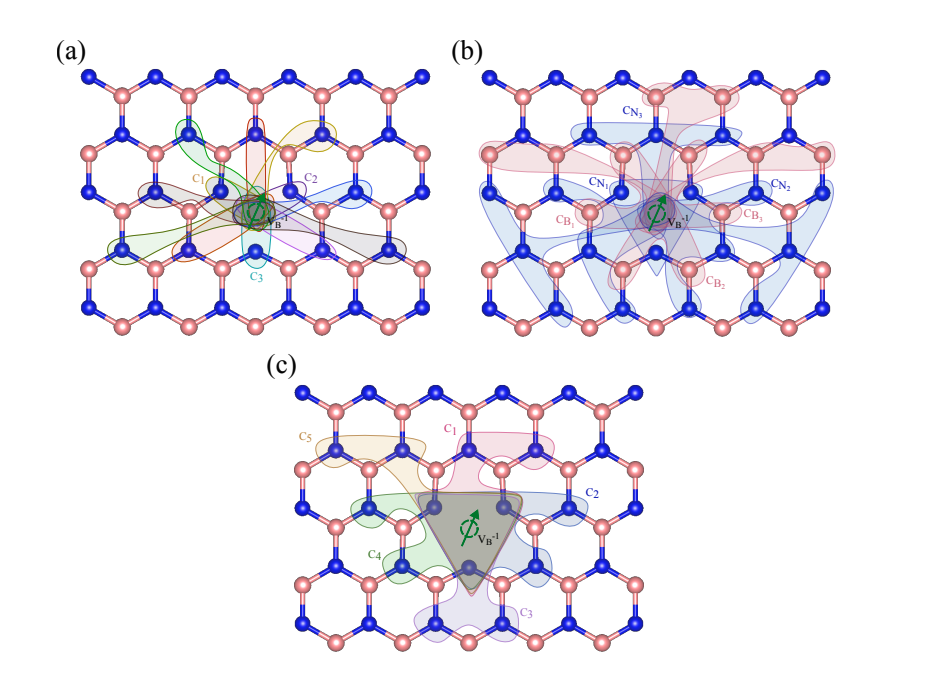
The team discovered that accurately modelling T1 requires treating the electron spin and the three nearest nitrogen nuclear spins as a single, interconnected unit, an “extended core”, highlighting the strong coupling between these spins and the importance of considering their collective behaviour. The results of this model closely reproduce experimentally observed T1 values and predict how T1 changes with varying external magnetic field, a vital capability for designing future quantum devices. By elucidating the microscopic mechanisms governing spin relaxation, this work provides a theoretical foundation for advancing coherence control, defect engineering, and ultimately, the realisation of practical quantum technologies based on hBN. This research establishes a reliable and scalable approach for describing T1 relaxation, offering valuable insights for the development of nuclear-spin-based quantum technologies.
T1 Relaxation Across Magnetic Field Regimes
Summary of the Research Paper: T1 Dependence on Magnetic Field. This research details a computational investigation into the spin relaxation time (T1) of a defect centre with a surrounding nuclear spin bath. The study uses a six-spin cluster model to simulate the dynamics and predict T1 as a function of the applied magnetic field (B). Key findings reveal that T1 varies with magnetic field strength, significantly influenced by the surrounding nuclear spin bath through interactions and fluctuations. The researchers employed a density matrix formalism and extensive computational simulations to track population dynamics and extract the T1 time, systematically varying the magnetic field strength to investigate its influence. Calculated T1 values at a specific field strength are in alignment with experimental observations. This research provides a detailed understanding of the factors governing spin relaxation. It highlights the importance of considering the nuclear spin bath in predicting T1, with implications for optimising the performance of quantum devices.
V− Centre Relaxation Driven by Nuclear Dynamics
Results reveal that the V-centre constitutes a strongly coupled electron spin-nuclear spin core, necessitating the inclusion of the coherent dynamics and derived memory effects of the three nearest-neighbour nitrogen nuclear spins. Using this framework, the research closely reproduces experimentally observed T1 time and further predicts the T1 dependence on external magnetic field, demonstrating that spin relaxation is predominantly driven by electron-nuclear and nuclear-nuclear flip-flop processes mediated by hyperfine and dipolar interactions.
Relaxation Mechanisms and Strong Coupling at GSLAC
Both nuclear-nuclear dipolar interactions and electron-nuclear hyperfine coupling contribute to spin relaxation across the range of magnetic fields. However, the dominant relaxation mechanism evolves as a function of the applied field strength. At low magnetic fields, both interactions are enhanced, leading to faster relaxation. In contrast, at high fields, increasing Zeeman splitting suppresses these interactions, resulting in prolonged relaxation. However, near the Ground State Level Anti-Crossing (GSLAC), the system enters a strongly coupled regime where conventional descriptions fail, resulting in a significantly reduced T1 time.
🗞 Spin Relaxation Mechanisms and Nuclear Spin Entanglement of the V Center in hBN
🧠 DOI: https://doi.org/10.48550/arXiv.2507.11494
See today’s quantum computing news on Quantum Zeitgeist for the latest breakthroughs in qubits, hardware, algorithms, and industry deals.