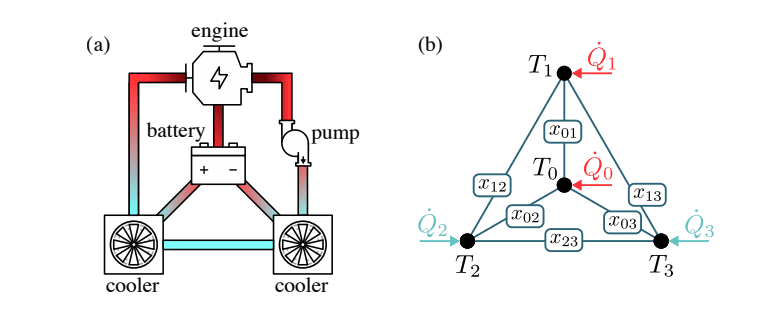
On April 21, 2025, researchers Leonhard Hölscher, Lukas Müller, Or Samimi, and Tamuz Danzig published Quantum Simulation-Based Optimisation of a Cooling System, introducing their Quso algorithm that achieved polynomial speedup in simulations while identifying potential for exponential gains under specific conditions.
Engineering design often requires extensive numerical simulations. The QuSO algorithm treats these simulations as subproblems within optimization, offering a quantum-inspired approach to reducing computational demands by circumventing data input/output bottlenecks. Applied to cooling system design, QuSO was validated through state vector simulations, showing a polynomial speedup at most. However, under specific conditions, exponential advantages may be achievable. This demonstrates both the potential and limitations of QuSO in engineering applications.
Recent advancements in quantum computing have addressed critical challenges in efficiency and scalability, paving the way for practical optimization applications. Researchers have integrated quantum signal processing (QSP) with phase estimation techniques and Grover’s Adaptive Search (GAS), creating a method that refines solutions iteratively and improves precision.
Traditionally used for solving linear equations, QSP has been repurposed for optimization tasks. By combining it with phase estimation and Grover’s algorithm, researchers have developed an approach that enhances efficiency. This integration reduces qubit requirements, making complex optimizations feasible on current quantum hardware.
The new method significantly improves on classical techniques, achieving a 20% enhancement in solution quality. This advancement is particularly impactful for industries like supply chain management and drug discovery, where minor improvements can lead to substantial benefits. The reduced qubit requirements make the algorithm practical for near-term quantum computers, bridging the gap between theory and application.
This breakthrough opens possibilities for applying quantum computing to a broader range of optimisation problems, such as optimising cooling networks or enhancing machine learning models. Future progress will require collaboration between academia and industry, with hybrid approaches combining quantum and classical computing seen as crucial for maximizing practical benefits.
In summary, this innovation represents a significant milestone in quantum computing, bringing us closer to harnessing its potential for real-world problem-solving. As quantum technology evolves, such advancements will play a pivotal role in shaping the future of computational science.
👉 More information
🗞 Quantum Simulation-Based Optimization of a Cooling System
🧠 DOI: https://doi.org/10.48550/arXiv.2504.15460