On April 17, 2025, Haipeng Xie and colleagues published Unbiased Quantum Error Mitigation Without Reliance on an Accurate Error Model, introducing spacetime noise inversion, a method that achieves unbiased error mitigation in quantum computing with minimal parameter requirements.
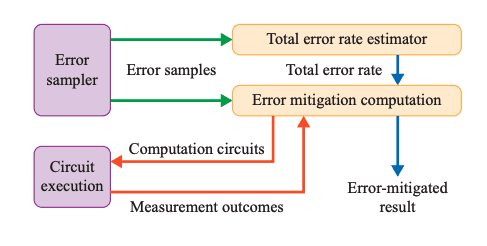
Probabilistic error cancellation requires an accurate error model, which can scale exponentially with qubits. This paper introduces spacetime noise inversion, enabling unbiased error mitigation with just one accurately measured error parameter and a Pauli error sampler. The method is efficient, robust to error parameter fluctuations, and has low implementation costs comparable to the task itself. It offers a promising approach for integrating error mitigation with correction in early fault-tolerant quantum computing.
Recent progress in quantum computing has addressed critical challenges such as error correction and resource efficiency, marking a significant step toward practical, scalable systems. A key breakthrough involves fault-tolerant quantum computation with low overheads, ensuring that quantum systems can operate correctly despite component failures.
Researchers have successfully implemented quantum low-density parity-check (LDPC) codes, adapted from classical error-correcting codes, to detect and correct errors efficiently without requiring excessive qubits or resources. This approach minimizes the additional computational steps needed for fault tolerance, making quantum computations more feasible by reducing the burden of error-checking processes.
Experimental demonstrations of logical magic state distillation have also been achieved. Magic states are essential resources enabling universal computation when combined with Clifford operations. Efficiently distilling these states is vital for scaling up quantum computers, marking a significant move from theory to practice.
Innovations in real-time noise adaptation and spacetime-noise-inversion techniques address the dynamic nature of quantum noise. These methods adjust computations on the fly, mitigating noise effects without attempting to eliminate all noise, thus enhancing system robustness and reliability.
Additionally, advancements in parallel logical measurements via code surgery suggest a method for performing multiple checks or operations simultaneously without interference, potentially speeding up processes and reducing errors.
Collectively, these developments are pivotal in making quantum computing more practical. They improve error correction, reduce resource requirements, and dynamically adapt to noise, all critical steps toward building scalable and reliable quantum computers capable of outperforming classical systems for specific tasks. These innovations highlight the field’s progress and its promising future.
👉 More information
🗞 Unbiased Quantum Error Mitigation Without Reliance on an Accurate Error Model
🧠 DOI: https://doi.org/10.48550/arXiv.2504.12864
See today’s quantum computing news on Quantum Zeitgeist for the latest breakthroughs in qubits, hardware, algorithms, and industry deals.