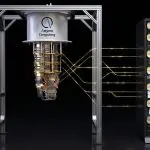
Quantum computing is an emerging field with transformative potential across various industries. Companies like IBM, Google, AWS, Quantinuum, IonQ, Xanadu, D-Wave, and Microsoft are exploring diverse approaches, such as superconducting qubits, trapped ions, photonic systems, and Majorana fermions. A recent article from the WEF explores how businesses can embrace quantum computing.
These advancements are supported by significant investments from hyperscalers and public-private partnerships, alongside efforts to educate future talent through early exposure in schools and tailored workplace training to unlock the technology’s full potential for global benefit.
Sustained investment in quantum research is essential for advancing the field. Companies like IBM, Google, and AWS are leading efforts with superconducting qubits, focusing on improving coherence times and gate fidelities. Recent advancements include AWS’s Ocelot chip, which integrates error correction directly into hardware design, enhancing system reliability. Government initiatives and academic collaborations further drive innovation, addressing scalability and fault tolerance challenges.
Error correction remains a critical challenge due to quantum state fragility. Superconducting qubits face issues with decoherence and noise, requiring robust mitigation techniques. Trapped ion systems offer high-fidelity operations but struggle with slower gate speeds compared to superconducting architectures. Photonic approaches demonstrate progress in scalability, as seen in Xanadu’s modular design using fibre-optic links. Microsoft’s exploration of Majorana fermions shows promise for topological qubits, though experimental validation is still pending.
Hybrid methods combine classical and quantum resources to address current limitations. Nvidia’s work on simulating error correction codes highlights the role of classical computing in advancing quantum reliability. These approaches enable practical applications by bridging gaps between theoretical models and real-world implementations, supporting the development of fault-tolerant systems.
The quest for fault-tolerant quantum computing demands sustained investment and collaboration across industries and academia. While challenges remain, ongoing research and innovation are bringing the field closer to realizing its potential.
More information
External Link: Click Here For More



See today’s quantum computing news on Quantum Zeitgeist for the latest breakthroughs in qubits, hardware, algorithms, and industry deals.