The advent of Universal Scene Description (OpenUSD) has revolutionized the way 3D virtual worlds are composed, edited, and simulated, offering a versatile framework that seamlessly integrates with existing assets and tools.
As an open, extensible ecosystem with APIs for rendering, collaborating, and simulating within 3D environments, OpenUSD provides a common language for representing data across various concepts, including meshes, physics, and materials. By leveraging OpenUSD’s capabilities, users can efficiently manage large-scale projects, facilitate collaboration, and enhance asset reusability, making it an essential component of modern 3D production workflows.
With its robust features, such as composition arcs, asset structuring principles, and content aggregation, OpenUSD empowers creators to develop complex, hierarchical structures that simplify managing and maintaining 3D assets, ultimately streamlining the production process and unlocking new possibilities for innovation and creativity.
OpenUSD facilitates efficient data exchange by enabling ingestion processes, often called ETL (Extract, Transform, Load). This prepares data for seamless integration into USD-based workflows. A structured approach to asset management ensures that 3D content is broken down into smaller, reusable components. These modular assets can then be efficiently aggregated into cohesive scenes through composition arcs, enabling more streamlined and scalable workflows.
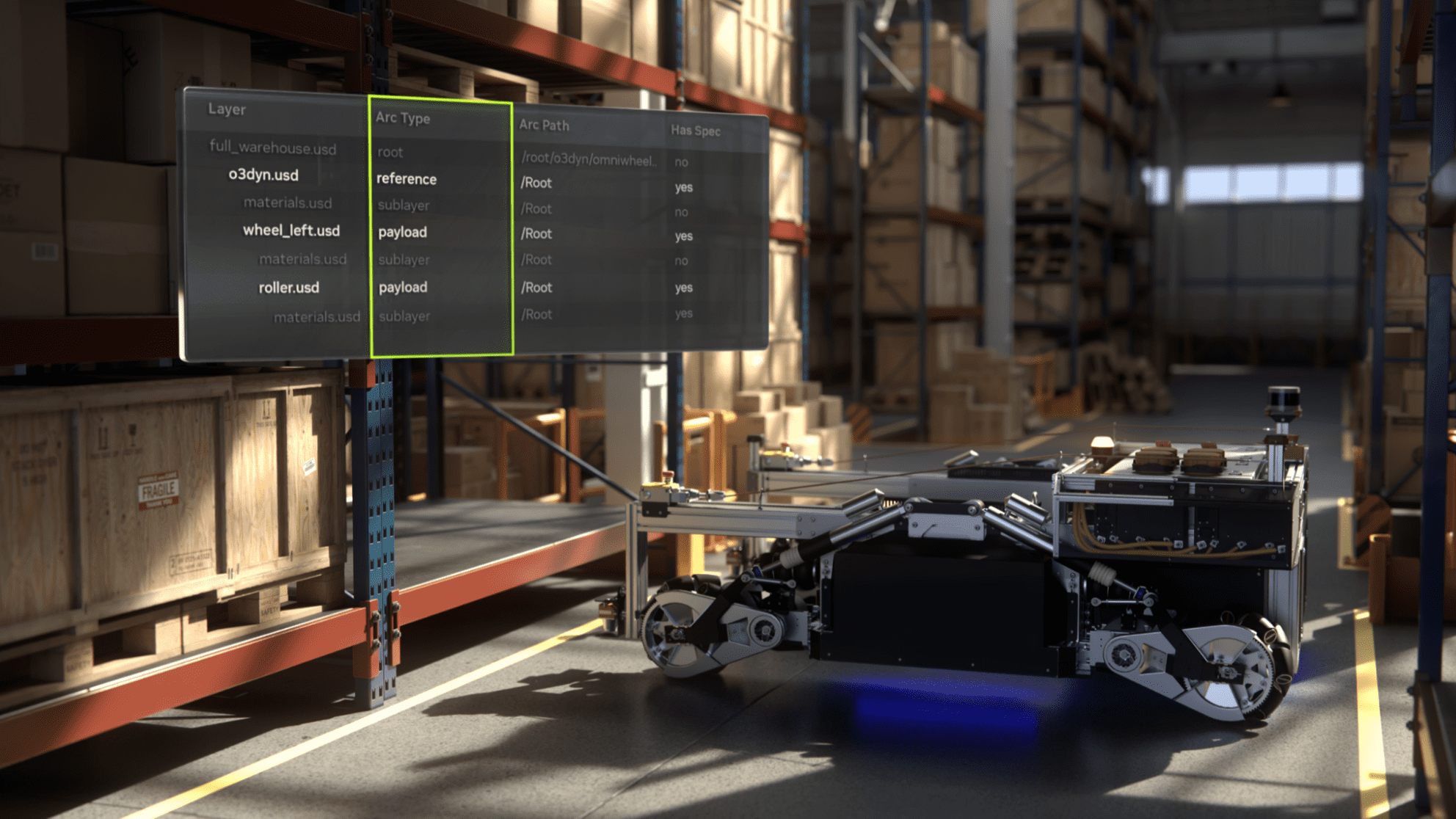
Composition arcs provide a powerful mechanism for assembling and managing complex 3D scenes. Sublayers allow multiple users or processes to work on the same USD context without conflict. References facilitate content aggregation by integrating one USD context within another, enabling hierarchical scene construction. Variant sets offer a way to store multiple variations of a component, improving flexibility without unnecessary duplication. Additional composition arcs, including Payloads, Inherits, Specializes, and Relocates, further enhance content organization and reuse.
OpenUSD enhances collaboration by adopting a non-destructive editing approach, ensuring that one team’s modifications do not overwrite others’ work. Performance optimizations are achieved by dynamically loading only the necessary components, reducing computational overhead. A well-structured asset pipeline improves reusability, minimizing redundancy and streamlining content creation workflows.
Users can begin learning OpenUSD through self-paced curricula that cover key topics such as data exchange, asset structuring, and composition arcs. Hands-on experimentation with the Omniverse Kit SDK and generative AI models via USD NIM microservices provides practical insights into OpenUSD development. Additionally, engaging with the Alliance for OpenUSD (AOUSD) forum and website offers valuable resources and community support.
By mastering OpenUSD, users can significantly enhance collaboration, performance, and reusability in their 3D workflows, making it an essential framework for managing large-scale projects efficiently.
External Link: Click Here For More