Australian physicists have programmed a quantum computer composed of 57 quantum particles, formed in a chain of mechanical magnets that points in all directions even at the same time. The development of the system has led to the mimicking of a record-size time crystal, a quantum system that repeats in time, analogous to the repeating spatial pattern of an ordinary crystal.
When Frank Wilczek, a Nobel Prize–winner, and a theoretical physicist at the Massachusetts Institute of Technology, pondered the stunning spatial pattern of atoms in a conventional crystal ten years ago, the concept of a time crystal was developed. The concept was that if the atoms cool down to an optimum temperature, it arises spontaneously. Once a few atoms have nestled next to one another, the next one’s position becomes predictable, and a pattern forms that is simply implicit in the forces.
The new time crystal has 57 quantum particles, which is more than double the size of a 20-particle time crystal that Google scientists simulated last year. The research demonstrates the ability of quantum computers to model complicated systems that would otherwise only exist in physicists’ theories.
No normal computer could mimic it. So that’s clearly a significant development.
Chetan Nayak, a condensed matter physicist at Microsoft
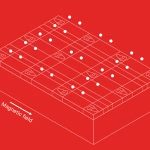
The magnets are periodically flipped up and down by a constant stream of magnetic pulses. The notion is that under the correct circumstances, any combination of magnets will rotate once every two pulses. Researchers have demonstrated the concept in a variety of systems, including electrons in a diamond, ions trapped in a trap, and quantum bits, or qubits, in a quantum computer.
Now, University of Melbourne theorists Philipp Frey and Stephan Rachel have created a far larger qubit example. They used quantum computers manufactured and run by IBM in the United States to run the simulation remotely. The qubits, which may be set to 0, 1, or 1 and 0 at the same time, can be programmed to interact in the same way that magnets do. The researchers discovered that any initial setting of the 57 qubits, such as 01101101110…, is stable for certain settings of their interactions, returning to its original state every two pulses.
According to Dominic Else, a condensed matter theorist at Harvard University, what makes the system a time crystal is a way the interactions among the magnets stabilize the pattern. This makes the system impervious to flaws such as pulses that aren’t long enough to completely flip the spins. Else explains, “It’s essentially a phase of matter that’s stabilized by multiple body interactions.”
Rachel admits that the demonstration isn’t ideal. He claims that the flipping pattern should continue indefinitely, while qubits in IBM’s machines can only keep their states for roughly 50 cycles. Finally, the interactions’ stabilizing effect might be used to store the state of a string of qubits in a quantum computer’s memory.
Read more about the news here.
See today’s quantum computing news on Quantum Zeitgeist for the latest breakthroughs in qubits, hardware, algorithms, and industry deals.