Learning quantum computing no longer means buying a stack of textbooks or paying for a course. There are now excellent free quantum computing resources for every level, from your first qubit to Shor’s algorithm, and several of them even hand you free access to real quantum hardware in the cloud. This is our 2026 update to the list, with every link checked and the dead ones replaced.
We have grouped the best free quantum computing resources by what they are, so you can build a path that suits you. Most people learn fastest by pairing a structured course with an interactive simulator, reading the theory and then trying it out straight away. Everything below is genuinely free, or has a substantial free tier that we have flagged clearly.
Free Courses and Structured Learning
IBM Quantum Learning
IBM Quantum Learning is where most beginners should start. It offers a library of guided courses that run from the basics of quantum information upward, all written by IBM’s own team. A free account also lets you send circuits to real superconducting hardware, so the theory and the practice sit in one place.
PennyLane Codebook
The PennyLane Codebook, from the company Xanadu, teaches through short coding exercises rather than lectures. It builds steadily from the fundamentals to algorithms like Shor’s, and every step runs in your browser. It suits anyone who learns best by doing.
Microsoft Quantum Katas
If you would rather learn a real quantum language, Microsoft’s Quantum Katas are a set of self-paced Q# exercises. They now live inside the free Quantum Development Kit extension for Visual Studio Code, so you practise in a proper editor. Each kata checks your answer as you go.
edX Free Audits
For university-style lectures, several edX courses can be audited for nothing, including Berkeley’s Quantum Mechanics and Quantum Computation and Delft’s course on the quantum internet. You only pay if you want a certificate at the end. Auditing gives you the full teaching material.
Free Textbooks and Reading
Quantum Computing for the Very Curious
Quantum Computing for the Very Curious, by Andy Matuschak and Michael Nielsen, is an essay that embeds spaced-repetition review questions so the ideas actually stick. It is still one of the clearest free introductions anywhere, and it costs nothing to read. The format is unusual but genuinely effective for retention.
PennyLane Demos
PennyLane’s demo library is a deep set of runnable tutorials that lean towards quantum machine learning and chemistry. Each one is a working notebook you can copy and adapt. One note on an old favourite: the IBM Qiskit Textbook was retired at the end of 2023 and its material folded into IBM Quantum Learning, so begin there rather than the archived pages. Our roundup of quantum textbooks covers the paid options.
Free Interactive Tools and Simulators
IBM Quantum Composer
IBM Quantum Composer lets you build a circuit by dragging gates onto a stave and watch the quantum state evolve as you go. When you are ready, the same tool sends your circuit to real hardware. It is the gentlest way to see what a quantum program actually does.
Quirk
Quirk is a fast, open-source circuit simulator that runs entirely in your browser, with live probability readouts that update as you edit. There is no sign-up and nothing to install. It is perfect for testing a small idea in seconds.
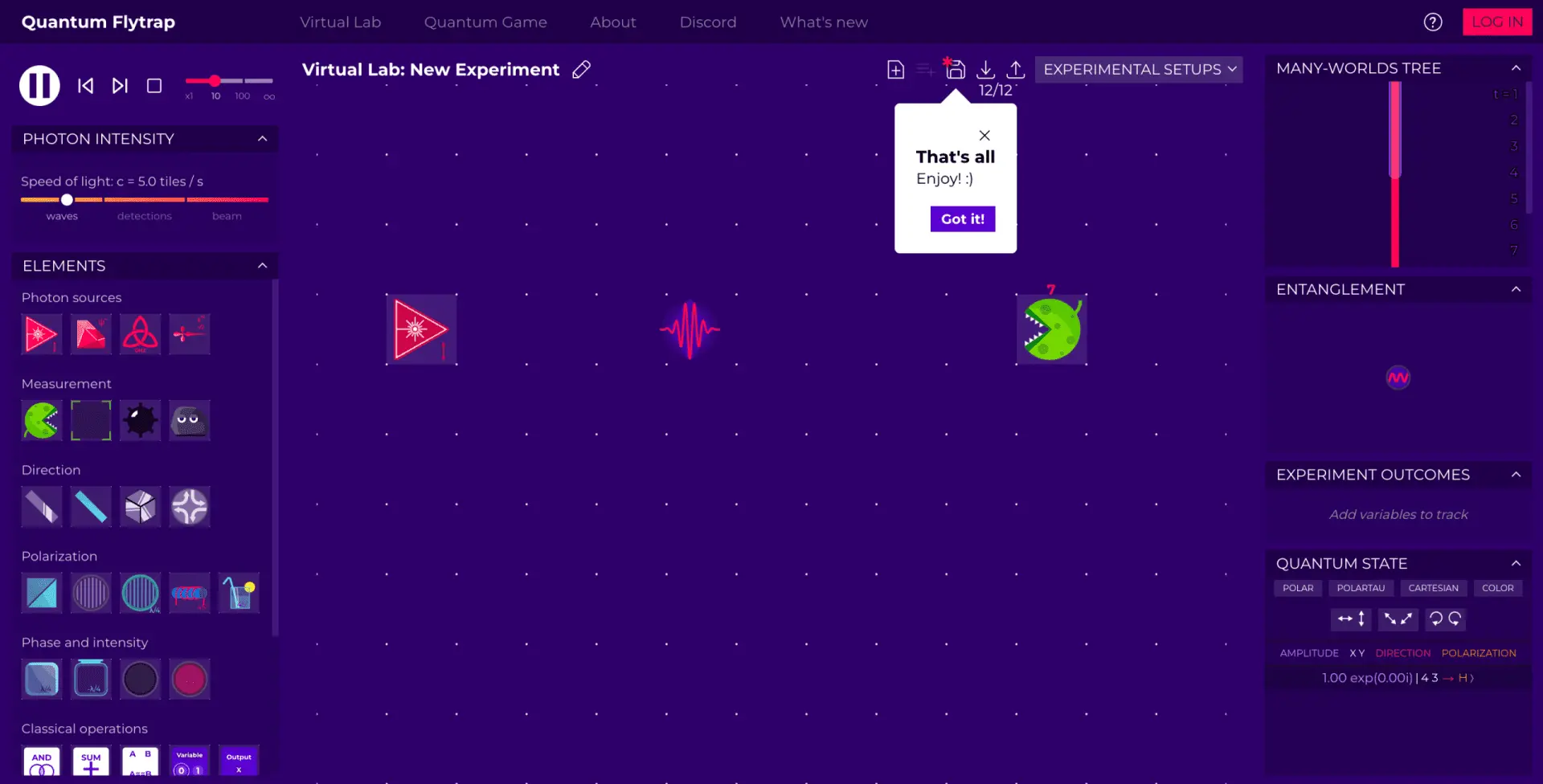
Quantum Flytrap Virtual Lab
Quantum Flytrap’s Virtual Lab takes a more visual route, letting you build optics experiments on a drag-and-drop table with no code at all. It simulates real quantum optics, so you can watch interference and entanglement play out. The company has since closed, but it has committed to keeping the lab online.
Classiq
Classiq sits at the other end of the scale, a higher-level design platform aimed at larger algorithms, and it is free for students and academics. Its open library on GitHub is one of the biggest collections of ready-made quantum algorithms. That makes it a natural companion to learning the quantum programming frameworks themselves.
Free Quantum Computing Communities
Unitary Foundation
The Unitary Foundation runs an active Discord, hands out small research grants and maintains open-source tools used across the field. It is one of the friendliest places to ask a beginner question. Membership is free and open to anyone.
Quantum Open Source Foundation
The Quantum Open Source Foundation keeps a well-known curated list of learning resources and runs a respected mentorship programme that pairs newcomers with experienced researchers. Both are free. It is a good place to turn once you have the basics and want a project.
How to Start
If you are brand new, open IBM Quantum Learning for the theory and keep Quirk in a second tab to try each idea as you meet it. Once circuits feel familiar, pick a language through the PennyLane Codebook or the Quantum Katas and start writing your own. The whole path, from first qubit to running code on real hardware, can be walked without spending a penny.
Frequently Asked Questions
Can you learn quantum computing for free? Yes. The free quantum computing resources on this list cover theory, programming and hands-on practice between them, with nothing to pay. Most working quantum developers learned the basics from exactly these kinds of open materials.
Can I use a real quantum computer for free? Yes, within limits. A free IBM Quantum account lets you run small circuits on real superconducting processors through the cloud, and several providers offer free simulator time. You do not need any special hardware of your own to begin.
What is the best free resource for a complete beginner? IBM Quantum Learning paired with the Quirk simulator is the most approachable combination, since one explains the ideas and the other lets you play with them at once. Add the Quantum Country essay if you prefer reading to coding.


See today’s quantum computing news on Quantum Zeitgeist for the latest breakthroughs in qubits, hardware, algorithms, and industry deals.