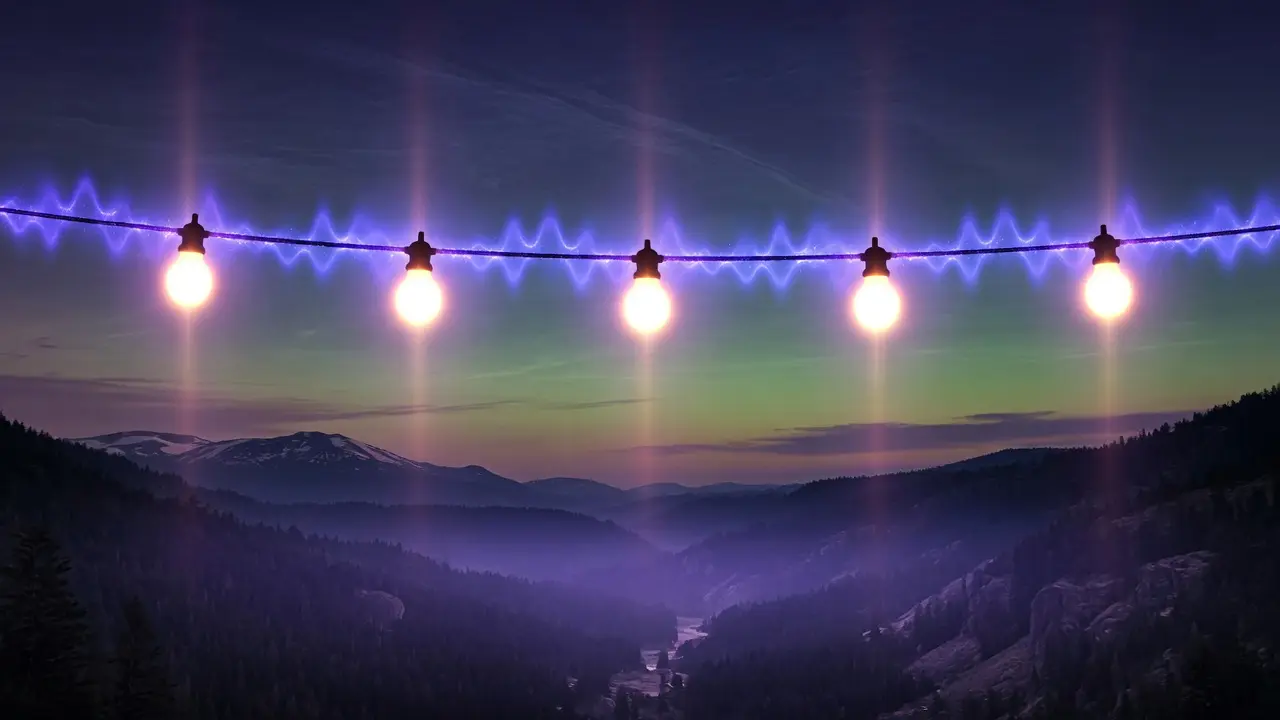
Researchers have introduced moiré quantum dots as a potential new platform for scalable qubits, addressing a key challenge in quantum technology: electrical control. The work resolves a conflict in valley physics by using moiré engineering to both protect quantum states through momentum-space separation and allow for their controllable mixing via an enlarged length scale. Dot geometry and an applied displacement field provide two noncommuting electrostatic axes for qubit control, offering a versatile approach to manipulating these quantum states.
Electrically Tunable Valley Qubits Challenge Existing Platforms
Moiré quantum dots offer a pathway to electrically tunable qubits by resolving a long-standing conflict between protecting quantum states and controlling them, a feat previously difficult to achieve in valley-based qubit designs. Unlike silicon or graphene platforms where valley mixing relies on microscopic interface structures or atomic-scale perturbations, this new approach uses moiré engineering to enable smooth gate control over valley hybridization. This design uses the unique properties of moiré superlattices, which have recently emerged as a means of creating tunable solid-state systems, to manipulate quantum states with greater precision.
The core innovation lies in the ability to separate valley extrema in momentum space while simultaneously allowing for controllable mixing through an enlarged moiré length scale, a feature absent in earlier valley qubit proposals. Momentum-space separation safeguards the quantum states from unintentional interactions, while the larger scale facilitates the application of smooth electrostatic gates to manipulate them.
This is particularly significant because existing valley platforms often struggle with balancing protection and control. Strong protection inherently hinders the ability to perform coherent valley rotations necessary for qubit operation. The work demonstrates that dot geometry and confinement strength program valley hybridization, offering a means to tailor the quantum properties of the system. The proposed system, built on twisted WSe2, establishes an electrically programmable moiré-valley two-level system where the balance between protection and control is dictated by the design of the gates.
This contrasts with previous attempts using monolayer transition-metal dichalcogenide quantum dots, which relied on spin-orbit coupling and valley-dependent orbital response, again facing challenges in achieving controlled intervalley coupling. The researchers highlight that this mechanism is not limited to a single material, suggesting broader applicability to the K-valley class of twisted TMD homobilayers.
The ability to independently control valley detuning through the application of a displacement field further enhances the versatility of this platform. This dual control allows for a wider range of qubit manipulations and could improve the fidelity of quantum operations. The researchers emphasize that the key to this approach is replacing atomic-scale valley coupling, which is difficult to control electrostatically, with moiré-scale coupling that can be engineered using smooth gates.
The design of these moiré quantum dots addresses a fundamental challenge in valley-based qubits: the need for both isolation and control of valley states. Previous platforms often prioritized one over the other, leading to limitations in performance. By using the unique properties of moiré superlattices, this new approach offers a pathway to overcome this trade-off.
The lowest confined shell within the moiré structure forms a moiré-valley doublet, the hybridization of which is precisely controlled by the dot radius and confinement strength. This level of control is important for creating stable and reliable qubits. The implications of this work extend beyond the specific materials investigated. The researchers suggest that the underlying principles apply more broadly, potentially opening up new avenues for exploring valley-based qubits in a variety of two-dimensional materials.
Moiré Quantum Dots Enable Programmable Valley Hybridization
Moiré quantum dots establish a direct link between dot geometry, confinement strength and the hybridization of valley states, offering a degree of control previously unseen in this type of qubit development. The design uses momentum-space separation to shield quantum states while simultaneously using an enlarged moiré length scale to allow for controlled mixing via smooth gates, a combination important for stable qubit operation. This approach bypasses the difficulties associated with manipulating atomic-scale valley coupling, replacing it with a moiré-scale equivalent that responds predictably to electrostatic manipulation.
The core of this control lies in the ability to program valley hybridization through precise adjustments to the quantum dot’s shape and the strength of carrier confinement, a feature demonstrated using twisted WSe₂ as a model system. The application of a displacement field independently manages valley detuning, providing a second, distinct control parameter for qubit manipulation.
This dual control, realized through two noncommuting electrostatic axes, allows for precise tuning of the qubit’s behavior. The researchers demonstrate that the effective two-level subspace is defined by the 1S states associated with the moiré-valley maxima, allowing for the creation of an electrically programmable system. The resulting Hamiltonian, expressed as = τ·d, where τ represents Pauli matrices acting in the valley basis and d is a vector set by hybridization and detuning, highlights the precise electrostatic control achieved.
“The dot radius and confinement depth tune the intervalley hybridization |t|, while the displacement field tunes the valley detuning ,” the paper states, emphasizing the independent control over key qubit parameters. The ability to independently manipulate hybridization and detuning is not merely a technical achievement. It unlocks two distinct operating modes for the qubit.
In a detuned regime, where the valley separation significantly exceeds the hybridization strength, the eigenstates closely resemble the valley states themselves. An alternating current modulation of the confinement potential depth then drives the hybridization term, enabling rotation of the moiré-valley pseudospin. This allows for the creation of electrically addressable frequencies ranging from tens to hundreds of gigahertz, while maintaining sufficient separation from higher-energy orbitals. The team’s findings establish a clear pathway toward laterally gated moiré quantum dots functioning as a platform for electrostatically engineered valley-based two-level systems.
The design allows for control over hybridization, detuning and the operating basis through gate design, a level of programmability that addresses a critical need in scalable quantum computing. The confined spectrum evolves predictably with dot radius, remaining on the meV scale throughout the range studied, further demonstrating the stability and controllability of the system.
This work moves beyond simply achieving valley protection or control, instead integrating both into a single, programmable platform. The researchers note that this construction belongs to a broader classification of moiré materials based on the momentum and orbital character of the parent-material band edges, suggesting that the principles demonstrated here could be extended to other materials and device architectures. The potential for realizing robust, electrically tunable qubits with this approach positions moiré quantum dots as a compelling alternative to existing qubit technologies, offering a new avenue for advancing the field of quantum information processing.
Confinement Strength Defines Moiré-Valley Orbital Structure
The lowest energy orbital shell within moiré quantum dots forms a doublet, its character defined by the interplay of confinement strength and the material’s inherent valley separation, a feature important for manipulating quantum information. This doublet’s hybridization, the degree to which the two states mix, is directly tuned by the size of the quantum dot and the strength of the confining potential, establishing a predictable relationship between physical dimensions and quantum behavior.
Analysis of these confined states reveals momentum-space densities localized near the moiré valleys, confirming the origin of these states in the underlying band structure of the twisted bilayer material. Increasing the amplitude of the confining potential directly increases the scale of the hybridization term, while a deeper quantum dot enhances momentum-space localization, further strengthening the coupling between valleys.
The researchers demonstrated that stronger intervalley coupling can be achieved while simultaneously maintaining separation from higher-energy orbitals, a critical balance for stable qubit operation. Specifically, the orbital spacing between the lowest 1S doublet and the next higher 2P orbital remains on the meV scale across a range of dot radii, indicating that the confinement can be adjusted without compromising the energy separation needed for qubit coherence. This predictable evolution of the confined spectrum with dot radius allows for precise engineering of the quantum dot’s properties, tailoring it to specific qubit requirements.
Electrostatic Control of Detuning and Valley Splitting
The design overcomes a central challenge in valley qubit development: the inherent trade-off between protecting quantum states and being able to manipulate them. The system’s functionality relies on a clear relationship between control parameters and quantum behavior.
This dual control scheme is not merely a refinement of existing methods. It establishes a pathway to program the moiré-valley pseudospin. The resulting splitting between the two 1S states follows a predictable equation, with the zero-field gap determined by confinement-induced hybridization and the field-dependent part set by the displacement field. The underlying mechanism extends beyond the specific material used in the study, WSe2, and applies more broadly to K-valley twisted TMD homobilayers with moiré-band extrema separated by mini-Brillouin-zone momenta.
This suggests the potential for adapting the approach to a wider range of materials and device architectures, expanding the possibilities for building scalable quantum computers. The twist angle itself provides an additional design parameter by setting the moiré length scale and, consequently, the momentum-space separation between the valleys. These two noncommuting electrostatic controls define the accessible axes of the moiré-valley pseudospin, offering a versatile platform for quantum information processing. The researchers write, highlighting the core principle of their design.
👉 More information
🗞 Electrical control of valley hybridization in moiré quantum dots
✍️ Yasser Saleem, Paweł Potasz and Ewelina M. Hankiewicz
🧠 DOI: http://link.aps.org/doi/10.1103/1m6r-p4dl
See today’s quantum computing news on Quantum Zeitgeist for the latest breakthroughs in qubits, hardware, algorithms, and industry deals.