

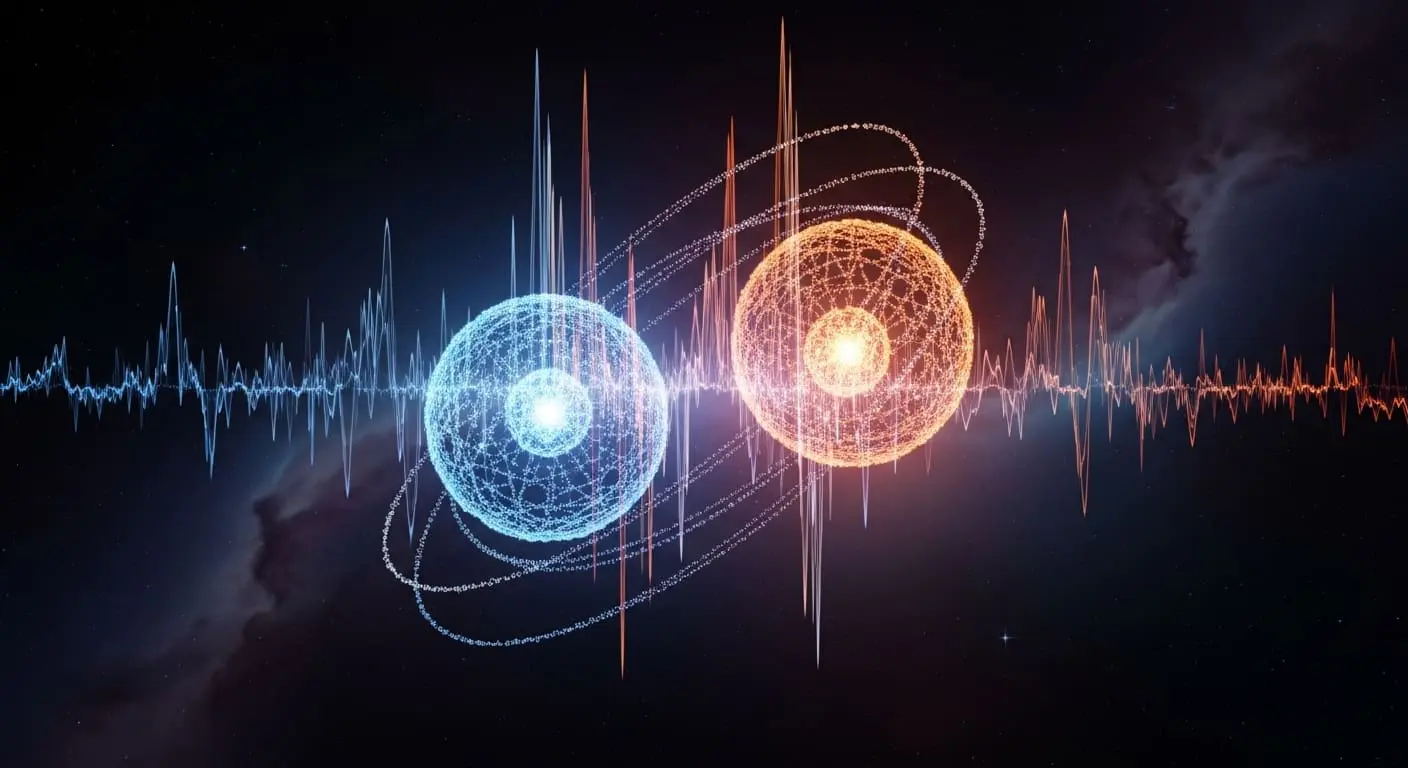
Scientists are continually refining methods to characterise the quantum state of free electrons, fundamental particles central to a wide range of technologies including high-resolution microscopy and particle accelerators. Y. Fang of the Ludwig-Maximilians-Universität München and colleagues from Friedrich-Alexander-Universität Erlangen-Nürnberg (FAU) and Universität Konstanz present a universal method for measuring arbitrary free-electron quantum states in continuous variables, overcoming previous limitations associated with incoherent electrons and discrete energy sidebands. Their approach utilises interfering quantum paths created by spectrally shifted laser waves to directly reveal the density matrix, providing crucial insight into essential properties of electron wavepackets and their interactions. This research demonstrates that many-body Coulomb interactions modify the quantum state of a single electron and paves the way for optimising exceptional quantum states for advanced free-electron quantum optics and microscopy.
Spectral shearing interferometry reveals free-electron quantum states and Coulomb interaction
An energy difference of 8.9 meV between two spectrally shifted laser waves enabled surpassing limitations of prior techniques, which were restricted to discrete energy sidebands and unable to measure arbitrary free-electron quantum states in continuous variables. Traditional methods often relied on analysing electrons at specific energy levels, providing only a fragmented picture of their overall quantum state. This new technique, utilising spectral shearing interferometry, offers a universal method to directly reveal the density matrix, a complete description of an electron’s quantum state, by creating interfering quantum paths. The density matrix fully encapsulates all possible quantum information about the electron, including its superposition of states and correlations. Insight into previously hidden correlations within electron beams was provided by observing how Coulomb interactions within an electron gas modify the quantum state of a single electron. These interactions, arising from the electrostatic repulsion between electrons, introduce complexities that affect the electron’s quantum behaviour and necessitate a comprehensive understanding for precise control.
Electron pulses with a central kinetic energy of 180 keV, routinely employed in ultrafast electron microscopy and related fields, were used to demonstrate the technique. These electron sources initially exhibited a degree of incoherence, stemming from the emission process, instrument voltage fluctuations, and Coulomb interactions; characterisation of this was the primary aim. Incoherence limits the ability to precisely control and manipulate electron beams, hindering the resolution and performance of electron-based instruments. Superimposing the electrons with two phase-stabilised laser pulses, differing slightly in wavelength at 514nm and 515.9nm, created a spectral separation of 8.9 meV, inducing coherent energy sidebands and allowing measurement of the resulting interference patterns. The precise control of laser phase and wavelength is critical for generating the necessary interference effects. Direct insight into the phase of the electron density matrix, indicating a quadratic spectral phase and a linear chirp, was provided by the observed tilt of these energy sidebands within each temporal interference lobe. A quadratic spectral phase indicates that different frequencies within the electron wavepacket travel at slightly different velocities, leading to pulse broadening or compression, while a linear chirp signifies a systematic frequency sweep over time.
Mapping Electron Quantum States via Interferometric Laser Interaction
The technique maps out all properties of an electron’s quantum state, functioning similarly to a medical scan for quantum systems. Just as a medical scan provides a comprehensive image of internal organs, this method provides a complete characterisation of the electron’s quantum state. Two spectrally shifted laser waves were central to the approach, creating interfering quantum paths. This interference is important as it directly reveals the density matrix, analogous to a detailed weather report outlining all atmospheric conditions. The density matrix provides a complete statistical description of the quantum state, allowing researchers to predict the probabilities of various measurement outcomes. Two laser waves interacted with electrons possessing 180 keV energy emitted from a Schottky field-emitter source within a transmission electron microscope, creating an energy difference of 8.9 meV between them. Schottky field emitters are commonly used due to their ability to generate high-brightness electron beams. Detailed analysis of the electron’s quantum properties and the influence of inter-electron interactions became possible through this interaction. Understanding these interactions is crucial for developing more accurate models of electron beam dynamics and improving the performance of electron-based instruments.
Laser interferometry reveals universal measurement of free-electron quantum states
Complete control over free-electron quantum states promises benefits for high-resolution microscopy and emerging electron-based quantum optics. The ability to tailor the quantum state of electron beams opens up possibilities for enhancing image resolution and developing new quantum technologies. A universal method to measure these states was demonstrated, though extending it to complex, multi-particle systems presents a key hurdle. Characterising the quantum states of many interacting electrons is significantly more challenging than studying a single electron. Currently, the technique relies on observing the influence of Coulomb interactions on a single electron within an electron gas; applying it to denser materials or more varied free-electron scenarios remains an open question. The behaviour of electrons in solids, where they interact with the lattice and other electrons, is far more complex than in a free electron gas.
The demonstration of a universal measurement approach for free-electron quantum states is a key step forward, despite the remaining challenge of applying this technique to more complex, dense materials. This unlocks possibilities for optimising electron beams and improving high-resolution microscopy, as well as the development of novel electron-based quantum optics. The method reveals previously hidden correlations within electron beams, enabling optimisation of their quantum properties. Optimising these properties could lead to brighter, more coherent electron beams with improved spatial and temporal resolution.
Potential benefits for technologies including high-resolution microscopy and emerging electron-based quantum optics are unlocked by complete control over free-electron quantum states. The team developed a universal method to measure these states, overcoming limitations of previous techniques. Complex behaviours and the underlying physics of electron beams were illuminated by observing how interactions between electrons within a gas modify the quantum state of a single electron. This understanding is vital for advancing the field of electron optics and developing new applications for free-electron beams in scientific research and technological innovation.
The researchers successfully demonstrated a universal method for measuring the quantum states of free electrons in continuous variables. This is important because free electrons are fundamental to technologies such as high-resolution microscopy and emerging areas of quantum optics, but their quantum states have previously been difficult to characterise. The technique utilises two laser waves to reveal the density matrix, providing insight into the properties of electron wavepackets and their interactions. The authors showed this method could be used to observe how Coulomb interactions from an electron gas modify the quantum state of a single electron.
👉 More information
🗞 Quantum tomography of free electrons
✍️ Y. Fang, J. Kuttruff, Z. Zhao, L. Moehrle, P. Hommelhoff and P. Baum
🧠 ArXiv: https://arxiv.org/abs/2606.25397


See today’s quantum computing news on Quantum Zeitgeist for the latest breakthroughs in qubits, hardware, algorithms, and industry deals.



