Quantinuum’s 98-qubit Helios system has achieved high fidelity in single-qubit operations, a result published this week in Nature and indicating steady advancement toward practical quantum computing. The findings are the result of a collaboration between Sandia National Laboratories, which maintains the Department of Energy’s longest running quantum computing program, and the private company Quantinuum; their work assesses emerging opportunities and threats in areas from cryptography to pharmaceutical research. This partnership demonstrates a commitment to accelerating quantum computing technology in support of economic and national security, according to Sandia senior manager Mike Descour, who stated, “As a national resource, we are committed to accelerating quantum computing technology in support of economic and national security.” The published results establish Helios as Quantinuum’s largest and most reliable quantum computer to date, building on four years of cooperative research formalized through a renewed agreement in May.
Helios System Achieves High Fidelity with 98 Qubits
Quantinuum’s Helios system is demonstrating increasingly precise quantum operations, achieving single-qubit operations with high fidelity. This level of precision is crucial as researchers push the boundaries of what’s computationally possible with quantum hardware, moving beyond simple demonstrations toward practical applications. Helios, Quantinuum’s commercial offering, currently boasts 98 qubits, a relatively substantial number for a system undergoing rigorous testing for fault-tolerant quantum computing. The system’s performance was independently assessed by researchers at Sandia National Laboratories, leveraging decades of experience in quantum computing research and development. Sandia’s role extended beyond simple evaluation; researchers developed a new benchmarking methodology to measure the performance of mid-circuit measurements, essential for correcting errors in quantum computations. Robin Blume-Kohout of Sandia explained that “The most important aspect of today’s quantum computers is not speed, but reliability,” highlighting the focus on stability over raw computational power. According to Quantinuum’s Tony Ransford, the Helios system “operates beyond the capabilities of classical simulation alone and established a new benchmark of fidelity and complexity for quantum computers,” signaling a significant step toward realizing the potential of quantum supercomputing.
As a national resource, we are committed to accelerating quantum computing technology in support of economic and national security.
Sandia & Quantinuum Advance Integrated Photonics for Scalability
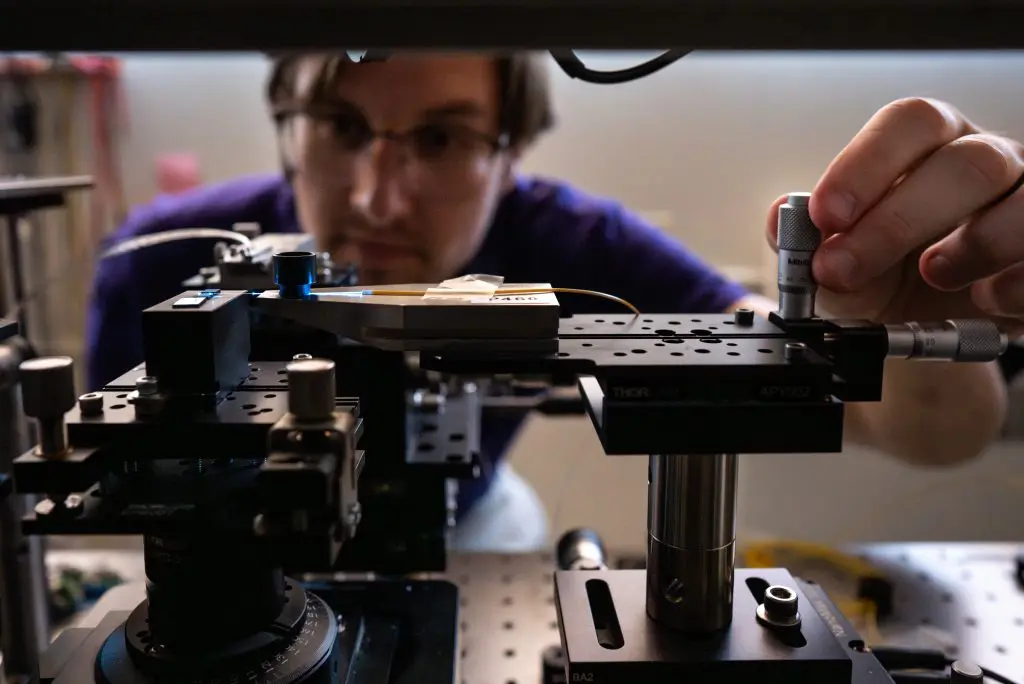
Sandia National Laboratories and Quantinuum are developing scalable quantum computing through advancements in integrated photonics, a technology that addresses key limitations in current systems. For over two decades, Sandia’s quantum research has combined engineering expertise with advanced facilities to develop and test quantum devices, culminating in a renewed Cooperative Research and Development Agreement with Quantinuum this past May. This collaboration focuses on integrated photonics, energy-efficient chips that utilize light to transmit information, promising a reduction in energy consumption and a step toward building larger, more practical quantum computers. Sandia researchers are now actively assisting Quantinuum in the design and testing of these components for integration into future quantum platforms. The partnership’s recent work, published in Nature, details an assessment of Quantinuum’s 98-qubit Helios system, revealing very high fidelity, 99.7 percent and 99.7 percent, respectively, in single- and two-qubit operations.
Chris DeRose, Sandia photonics manager, emphasized the laboratory’s open approach, stating, “We welcome collaboration with any interested partner including universities, industry and other national laboratories.” This willingness to partner underscores the importance of a collective effort in overcoming the significant engineering challenges inherent in quantum computer development. The focus on reliability, rather than sheer speed, is a defining characteristic of this research; he highlighted the numerous potential failure points in quantum systems, from laser calibration to atomic stability, all of which degrade performance.
In operations that involved only one or two qubits, or quantum bits, the system demonstrated very high fidelity – % and %, respectively.
Sandia National Laboratories
National Lab Validates Benchmarking for Quantum Error Correction
Sandia National Laboratories is playing a crucial role in validating the performance of commercial quantum systems, recently completing an assessment of Quantinuum’s 98-qubit Helios computer. This collaboration, formalized through a Cooperative Research and Development Agreement renewed in May, highlights a public-private partnership driving advances in scalable quantum hardware. The recent work, published in Nature, focused on establishing benchmarks for reliability, a critical factor as quantum computers move beyond theoretical potential. The Sandia team evaluated Helios, demonstrating high fidelity in single-qubit and two-qubit operations, results that establish the system as Quantinuum’s most reliable to date. Researchers pioneered new benchmarking methodologies, specifically for mid-circuit measurements, essential for correcting errors inherent in quantum computation. These non-destructive readout operations are vital for building fault-tolerant systems capable of tackling complex problems beyond the reach of classical computers. The lab’s work extends beyond simple performance metrics; it aims to identify and resolve the underlying issues hindering quantum computer stability.
Helios operates beyond the capabilities of classical simulation alone and established a new benchmark of fidelity and complexity for quantum computers.


See today’s quantum computing news on Quantum Zeitgeist for the latest breakthroughs in qubits, hardware, algorithms, and industry deals.